Colston David C, Simard Bethany J, Xie Yanmei, McLeod Marshall Chandler, Elliott Michael R, Thrasher James F, Fleischer Nancy L
Center for Social Epidemiology and Population Health, Department of Epidemiology, School of Public Health, University of Michigan, Ann Arbor, MI 48109, USA.
Biostatistics Core, Rogel Cancer Center, University of Michigan, Ann Arbor, MI 48109, USA.
Int J Environ Res Public Health. 2021 Mar 23;18(6):3297. doi: 10.3390/ijerph18063297.
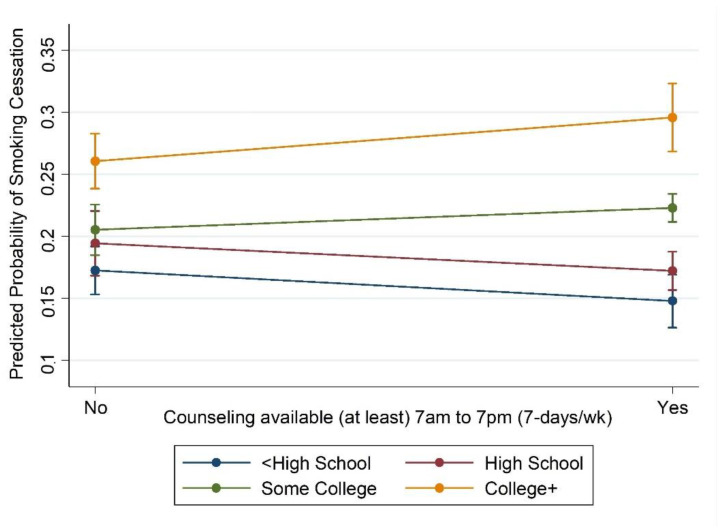
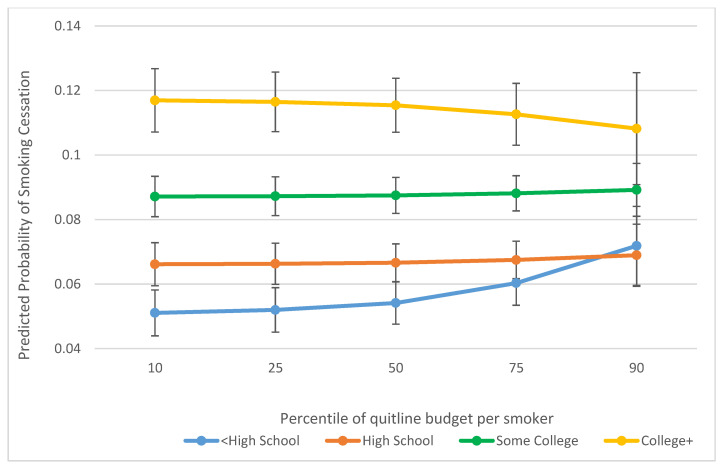
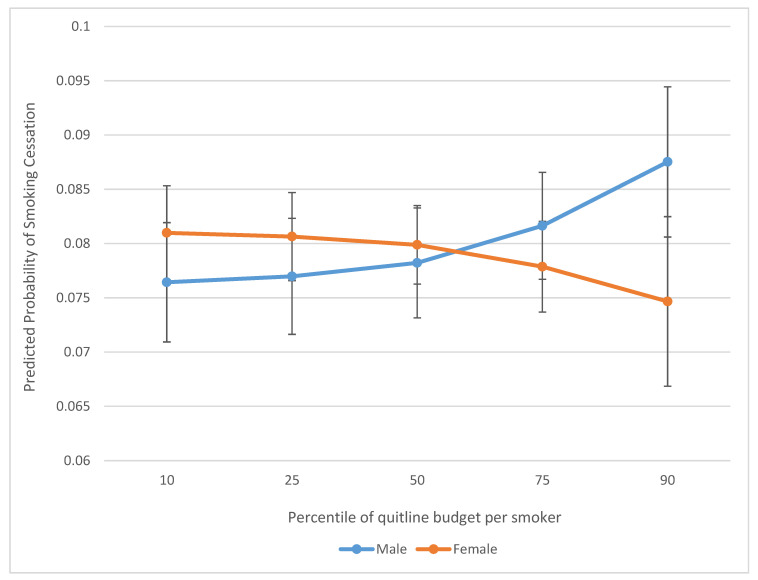
Little research examines how tobacco quitlines affect disparities in smoking cessation in the United States. Our study utilized data from the Tobacco Use Supplement to the Current Population Survey (2010, 2011, 2012, 2015, 2018) (TUS-CPS) and state-level quitline data from the North American Quitline Consortium and National Quitline Data Warehouse. We ran multilevel logistic regression models assessing a state-run quitline's budget, reach, number of counseling sessions offered per caller, and hours of operation on 90-day smoking cessation. Multiplicative interactions between all exposures and sex, race/ethnicity, income, and education were tested to understand potential effect modification. We found no evidence that budget, reach, number of counseling sessions, or hours available for counseling were associated with cessation in the main effects analyses. However, when looking at effect modification by sex, we found that higher budgets were associated with greater cessation in males relative to females. Further, higher budgets and offering more sessions had a stronger association with cessation among individuals with lower education, while available counseling hours were more strongly associated with cessation among those with higher education. No quitline characteristics examined were associated with smoking cessation. We found evidence for effect modification by sex and education. Despite proven efficacy at the individual-level, current resource allocation to quitlines may not be sufficient to improve rates of cessation.
很少有研究考察戒烟热线如何影响美国戒烟方面的差异。我们的研究使用了当前人口调查(2010年、2011年、2012年、2015年、2018年)烟草使用补充调查(TUS-CPS)的数据以及来自北美戒烟热线联盟和国家戒烟热线数据仓库的州级戒烟热线数据。我们运行了多级逻辑回归模型,评估由州运营的戒烟热线的预算、覆盖范围、每位来电者提供的咨询会话次数以及90天戒烟的运营时长。对所有暴露因素与性别、种族/族裔、收入和教育之间的相乘交互作用进行了检验,以了解潜在的效应修正情况。在主要效应分析中,我们没有发现证据表明预算、覆盖范围、咨询会话次数或咨询可用时长与戒烟有关。然而,在考察性别对效应的修正时,我们发现相对于女性,较高的预算与男性更高的戒烟率相关。此外,较高的预算和提供更多会话与受教育程度较低者的戒烟有更强的关联,而可用咨询时长与受教育程度较高者的戒烟关联更强。所考察的戒烟热线特征均与戒烟无关。我们发现了性别和教育对效应进行修正的证据。尽管在个体层面已证实其有效性,但目前对戒烟热线的资源分配可能不足以提高戒烟率。