Service D'anesthésie-Réanimation Chirurgicale, DMU CARE, DHU A-TVB, Hôpitaux Universitaires Henri Mondor, Assistance Publique-Hôpitaux de Paris (AP-HP), F-94010 Créteil, France.
The Mondor Institute for Biomedical Research, Institut National de la Santé et de la Recherche Médicale, University Paris Est Créteil, F-94010 Créteil, France.
Int J Mol Sci. 2021 Mar 23;22(6):3257. doi: 10.3390/ijms22063257.
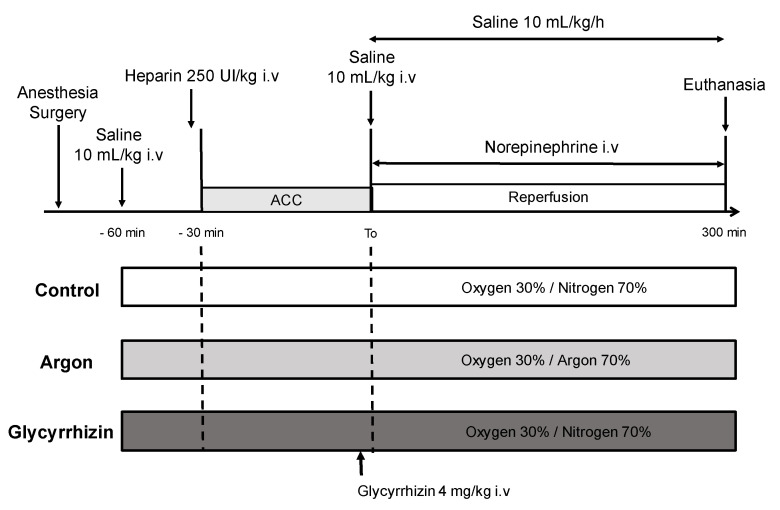
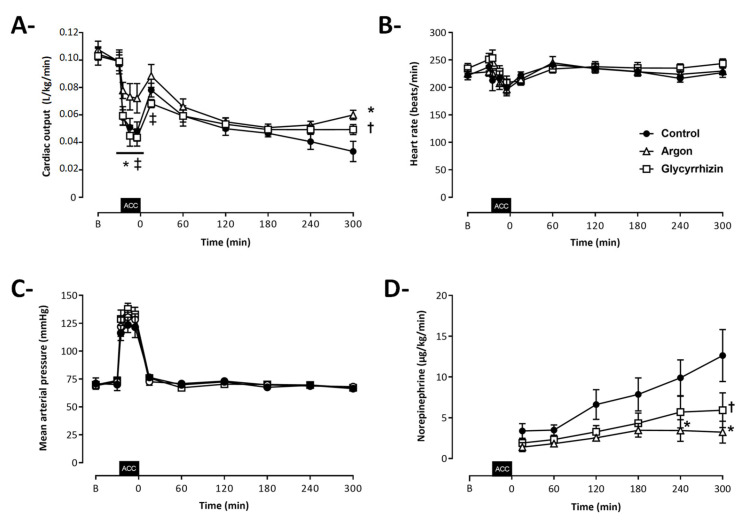
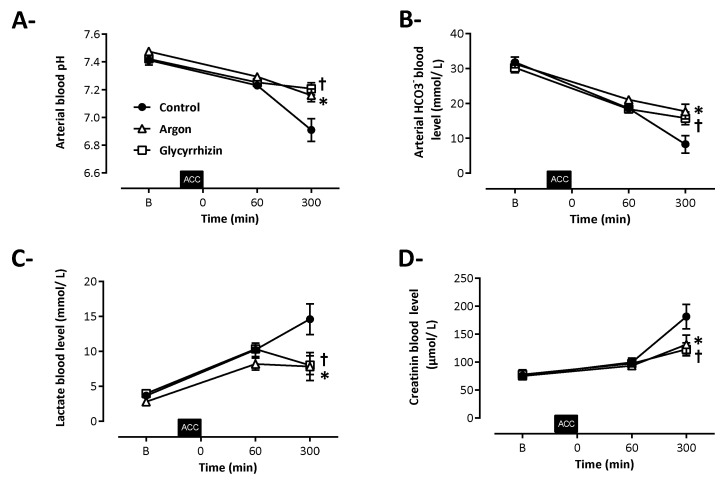
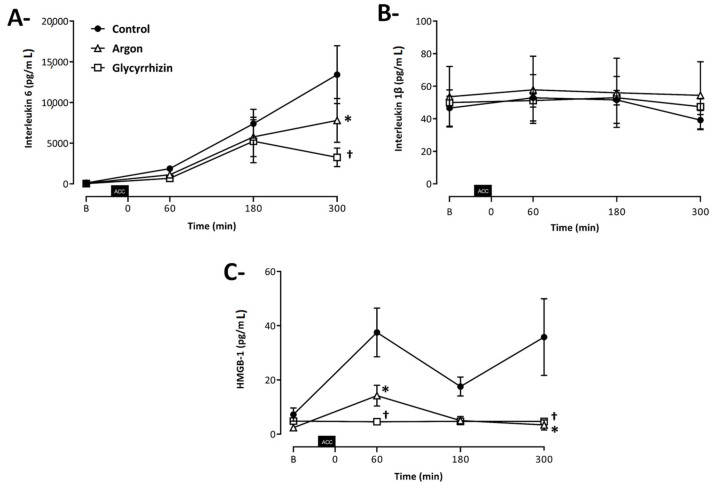
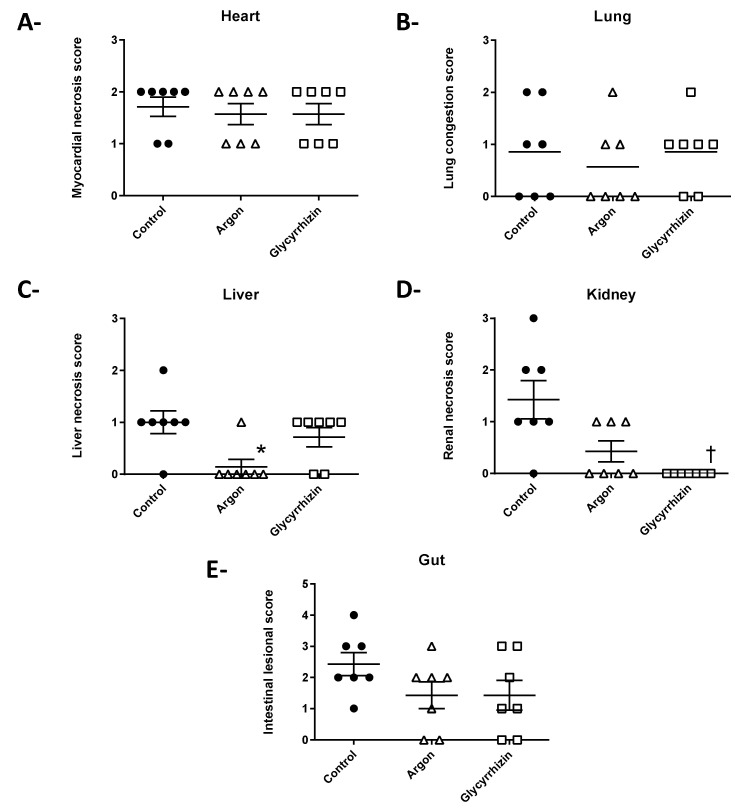
Argon inhalation attenuates multiorgan failure (MOF) after experimental ischemic injury. We hypothesized that this protection could involve decreased High Mobility Group Box 1 (HMGB1) systemic release. We investigated this issue in an animal model of MOF induced by aortic cross-clamping. Anesthetized rabbits were submitted to supra-coeliac aortic cross-clamping for 30 min, followed by 300 min of reperfusion. They were randomly divided into three groups ( = 7/group). The Control group inhaled nitrogen (70%) and oxygen (30%). The Argon group was exposed to a mixture of argon (70%) and oxygen (30%). The last group inhaled nitrogen/oxygen (70/30%) with an administration of the HMGB1 inhibitor glycyrrhizin (4 mg/kg i.v.) 5 min before aortic unclamping. At the end of follow-up, cardiac output was significantly higher in Argon and Glycyrrhizin vs. Control (60 ± 4 and 49 ± 4 vs. 33 ± 8 mL/kg/min, respectively). Metabolic acidosis was attenuated in Argon and Glycyrrhizin vs. Control, along with reduced amount of norepinephrine to reverse arterial hypotension. This was associated with reduced interleukin-6 and HMGB1 plasma concentration in Argon and Glycyrrhizin vs. Control. End-organ damages were also attenuated in the liver and kidney in Argon and Glycyrrhizin vs. Control, respectively. Argon inhalation reduced HMGB1 blood level after experimental aortic cross-clamping and provided similar benefits to direct HMGB1 inhibition.
氩气吸入可减轻实验性缺血损伤后的多器官衰竭(MOF)。我们假设这种保护可能涉及减少高迁移率族蛋白 B1(HMGB1)的全身释放。我们在由主动脉夹闭引起的 MOF 动物模型中研究了这个问题。麻醉兔接受了 30 分钟的腹腔上主动脉夹闭,然后进行了 300 分钟的再灌注。它们被随机分为三组(每组 n = 7)。对照组吸入氮气(70%)和氧气(30%)。氩气组暴露于氩气(70%)和氧气(30%)的混合物中。最后一组吸入氮/氧(70/30%),并在主动脉松解前 5 分钟给予 HMGB1 抑制剂甘草酸(4 mg/kg 静脉注射)。在随访结束时,与对照组相比,Argon 和 Glycyrrhizin 组的心输出量明显更高(60 ± 4 和 49 ± 4 比 33 ± 8 mL/kg/min)。Argon 和 Glycyrrhizin 组的代谢性酸中毒减轻,逆转动脉低血压所需的去甲肾上腺素减少。这与 Argon 和 Glycyrrhizin 组的白细胞介素-6 和 HMGB1 血浆浓度降低有关。Argon 和 Glycyrrhizin 组的肝和肾的终末器官损伤也减轻。实验性主动脉夹闭后,氩气吸入降低了 HMGB1 的血液水平,并提供了与直接 HMGB1 抑制相似的益处。