Zhang Jiongshan, Liu Wei, Bi Mingmin, Xu Jinwen, Yang Hongzhi, Zhang Yaxing
Department of Traditional Chinese Medicine, The Third Affiliated Hospital, Sun Yat-sen University, Guangzhou, China.
Institute of Integrated Traditional Chinese and Western Medicine, Sun Yat-sen University, Guangzhou, China.
Front Cardiovasc Med. 2022 Mar 16;9:802783. doi: 10.3389/fcvm.2022.802783. eCollection 2022.
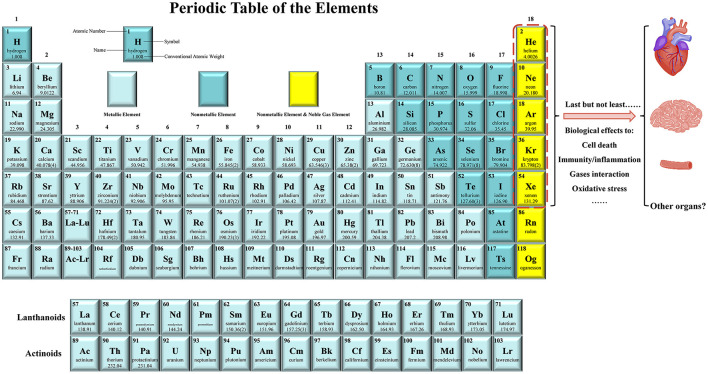
Cardiocerebrovascular diseases (CCVDs) are the leading cause of death worldwide; therefore, to deeply explore the pathogenesis of CCVDs and to find the cheap and efficient strategies to prevent and treat CCVDs, these are of great clinical and social significance. The discovery of nitric oxide (NO), as one of the endothelium-derived relaxing factors and its successful utilization in clinical practice for CCVDs, provides new ideas for us to develop drugs for CCVDs: "gas medicine" or "medical gases." The endogenous gas molecules such as carbon monoxide (CO), hydrogen sulfide (HS), sulfur dioxide (SO), methane (CH), and hydrogen (H) have essential biological effects on modulating cardiocerebrovascular homeostasis and CCVDs. Moreover, it has been shown that noble gas atoms such as helium (He), neon (Ne), argon (Ar), krypton (Kr), and xenon (Xe) display strong cytoprotective effects and therefore, act as the exogenous pharmacologic preventive and therapeutic agents for CCVDs. Mechanistically, besides the competitive inhibition of N-methyl-D-aspartate (NMDA) receptor in nervous system by xenon, the key and common mechanisms of noble gases are involved in modulation of cell death and inflammatory or immune signals. Moreover, gases interaction and reduction in oxidative stress are emerging as the novel biological mechanisms of noble gases. Therefore, to investigate the precise actions of noble gases on redox signals, gases interaction, different cell death forms, and the emerging field of gasoimmunology, which focus on the effects of gas atoms/molecules on innate immune signaling or immune cells under both the homeostatic and perturbed conditions, these will help us to uncover the mystery of noble gases in modulating CCVDs.
心脑血管疾病(CCVDs)是全球主要的死亡原因;因此,深入探究CCVDs的发病机制并找到廉价且有效的预防和治疗策略,具有重大的临床和社会意义。一氧化氮(NO)作为内皮源性舒张因子之一的发现及其在CCVDs临床实践中的成功应用,为我们开发治疗CCVDs的药物提供了新思路:“气体药物”或“医用气体”。内源性气体分子如一氧化碳(CO)、硫化氢(HS)、二氧化硫(SO)、甲烷(CH)和氢气(H)对调节心脑血管稳态和CCVDs具有重要的生物学作用。此外,已表明氦(He)、氖(Ne)、氩(Ar)、氪(Kr)和氙(Xe)等惰性气体原子具有强大的细胞保护作用,因此可作为CCVDs的外源性药理预防和治疗剂。从机制上讲,除了氙对神经系统中N-甲基-D-天冬氨酸(NMDA)受体的竞争性抑制外,惰性气体的关键和共同机制还涉及细胞死亡以及炎症或免疫信号的调节。此外,气体相互作用和氧化应激的减轻正在成为惰性气体的新型生物学机制。因此,研究惰性气体在氧化还原信号、气体相互作用、不同细胞死亡形式以及气体免疫学新兴领域中的精确作用,该领域关注气体原子/分子在稳态和扰动条件下对先天免疫信号或免疫细胞的影响,这将有助于我们揭开惰性气体在调节CCVDs方面的奥秘。