Department of Internal Medicine, University Medical Center Hamburg-Eppendorf, 20246 Hamburg, Germany.
German Center for Infection Research (DZIF), Hamburg-Lübeck-Borstel-Riems Site, Germany.
Viruses. 2021 Mar 31;13(4):588. doi: 10.3390/v13040588.
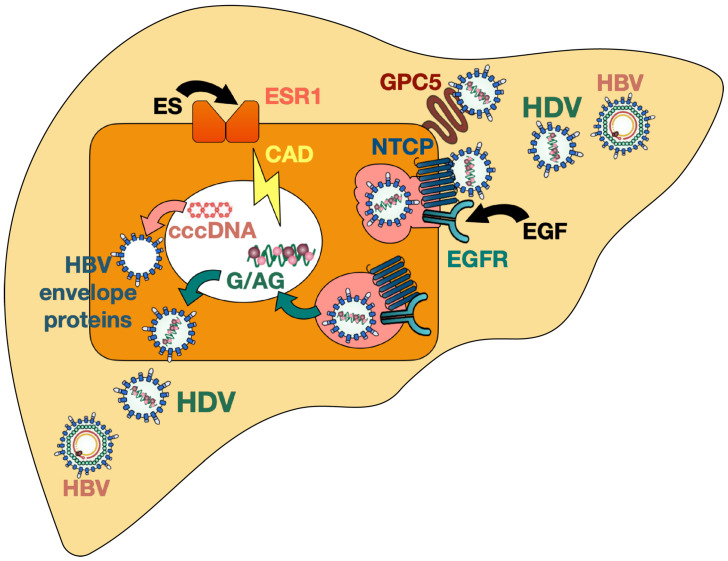
The discovery of sodium taurocholate co-transporting polypeptide (NTCP) as a hepatitis B (HBV) and delta virus (HDV) entry receptor has encouraged the development of new animal models of infection. This review provides an overview of the different in vivo models that are currently available to study HDV either in the absence or presence of HBV. By presenting new advances and remaining drawbacks, we will discuss human host factors which, in addition to NTCP, need to be investigated or identified to enable a persistent HDV infection in murine hepatocytes. Detailed knowledge on species-specific factors involved in HDV persistence also shall contribute to the development of therapeutic strategies.
牛磺胆酸钠共转运多肽(NTCP)作为乙型肝炎(HBV)和丁型肝炎(HDV)病毒进入受体的发现,鼓励了新的感染动物模型的发展。本综述概述了目前可用于研究无 HBV 或有 HBV 情况下 HDV 的不同体内模型。通过介绍新的进展和仍然存在的缺陷,我们将讨论除 NTCP 外,还需要研究或鉴定的人类宿主因素,以使鼠肝细胞能够持续感染 HDV。对涉及 HDV 持续感染的种特异性因素的详细了解也将有助于治疗策略的发展。