Guo Hongbo, Urban Stephan, Wang Wenshi
Department of Pathogen Biology and Immunology; Jiangsu Key Laboratory of Immunity and Metabolism, Xuzhou Medical University, Xuzhou, China.
Jiangsu International Laboratory of Immunity and Metabolism, Xuzhou Medical University, Xuzhou, China.
Front Microbiol. 2023 Apr 5;14:1169770. doi: 10.3389/fmicb.2023.1169770. eCollection 2023.
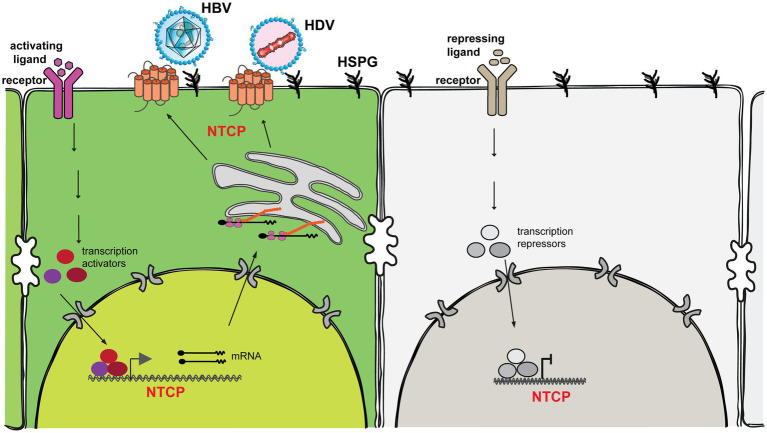
Chronic infection with the hepatitis B virus (HBV) and hepatitis D virus (HDV) can cause a major global health burden. Current medication regimens can repress viral replication and help to control disease progression, but a complete cure is hardly achieved due to the difficulties to eradicate viral templates (cccDNA and integrates). To develop novel curative antiviral therapies for HBV/HDV infection, it is vital to precisely understand the details of the molecular biology of both viruses and the virus-host interactions. One important prerequisite for gaining this aim is the availability of suitable models that support HBV/HDV infection, replicate both viruses their authentic template and allow to adequately study host cell responses. The discovery of sodium taurocholate cotransporting polypeptide (NTCP) receptor as the most crucial host factor promoted HBV/HDV research to a new era. Recently, the structure of human NTCP was solved, gaining a deeper understanding of HBV recognition as the receptor. After decades of continuous efforts, new progress has been achieved in the development of cell culture models supporting HBV/HDV study. This review summarizes the cell culture models currently available, discusses the advantages and disadvantages of each model, and highlights their future applications in HBV and HDV research.
慢性感染乙型肝炎病毒(HBV)和丁型肝炎病毒(HDV)会造成重大的全球健康负担。目前的药物治疗方案可以抑制病毒复制并有助于控制疾病进展,但由于难以根除病毒模板(共价闭合环状DNA和整合体),几乎无法实现完全治愈。为了开发针对HBV/HDV感染的新型治愈性抗病毒疗法,精确了解两种病毒的分子生物学细节以及病毒与宿主的相互作用至关重要。实现这一目标的一个重要前提是要有合适的模型,该模型要支持HBV/HDV感染,以其真实模板复制两种病毒,并能充分研究宿主细胞反应。牛磺胆酸钠共转运多肽(NTCP)受体作为最关键的宿主因子的发现,将HBV/HDV研究推进到了一个新时代。最近,人类NTCP的结构得以解析,从而对HBV作为受体的识别有了更深入的了解。经过数十年的持续努力,在支持HBV/HDV研究的细胞培养模型开发方面取得了新进展。本综述总结了目前可用的细胞培养模型,讨论了每种模型的优缺点,并突出了它们在HBV和HDV研究中的未来应用。