Nearchou Ines P, Ueno Hideki, Kajiwara Yoshiki, Lillard Kate, Mochizuki Satsuki, Takeuchi Kengo, Harrison David J, Caie Peter D
Quantitative and Digital Pathology, School of Medicine, University of St Andrews, St Andrews KY16 9TF, UK.
Department of Surgery, National Defense Medical College, 3-2 Namiki, Tokorozawa, Saitama 359-8513, Japan.
Cancers (Basel). 2021 Mar 31;13(7):1615. doi: 10.3390/cancers13071615.
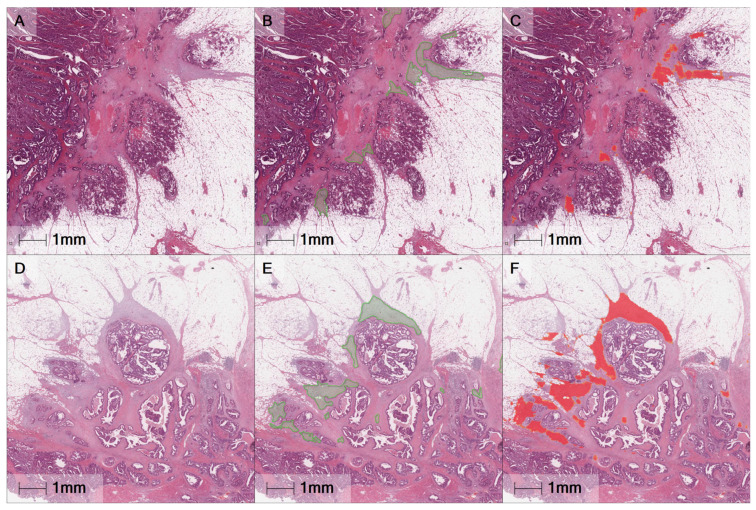
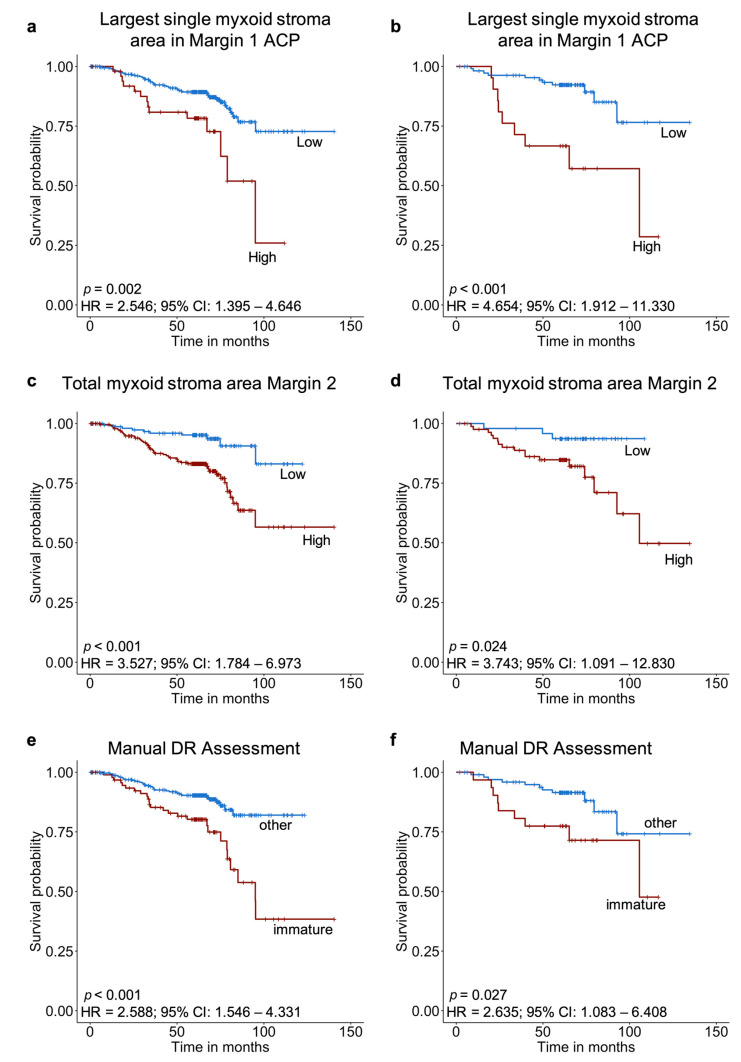
The categorisation of desmoplastic reaction (DR) present at the colorectal cancer (CRC) invasive front into mature, intermediate or immature type has been previously shown to have high prognostic significance. However, the lack of an objective and reproducible assessment methodology for the assessment of DR has been a major hurdle to its clinical translation. In this study, a deep learning algorithm was trained to automatically classify immature DR on haematoxylin and eosin digitised slides of stage II and III CRC cases ( = 41). When assessing the classifier's performance on a test set of patient samples ( = 40), a Dice score of 0.87 for the segmentation of myxoid stroma was reported. The classifier was then applied to the full cohort of 528 stage II and III CRC cases, which was then divided into a training ( = 396) and a test set ( = 132). Automatically classed DR was shown to have superior prognostic significance over the manually classed DR in both the training and test cohorts. The findings demonstrated that deep learning algorithms could be applied to assist pathologists in the detection and classification of DR in CRC in an objective, standardised and reproducible manner.
先前已表明,将存在于结直肠癌(CRC)浸润前沿的促纤维增生性反应(DR)分类为成熟型、中间型或未成熟型具有很高的预后意义。然而,缺乏用于评估DR的客观且可重复的评估方法一直是其临床转化的主要障碍。在本研究中,训练了一种深度学习算法,以自动对II期和III期CRC病例(n = 41)苏木精和伊红数字化切片上的未成熟DR进行分类。在评估分类器对患者样本测试集(n = 40)的性能时,报告了黏液样基质分割的Dice评分为0.87。然后将该分类器应用于528例II期和III期CRC病例的完整队列,该队列随后分为训练集(n = 396)和测试集(n = 132)。在训练和测试队列中,自动分类的DR均显示出比手动分类的DR具有更好的预后意义。研究结果表明,深度学习算法可应用于以客观、标准化和可重复的方式协助病理学家检测和分类CRC中的DR。