Skerniškytė Jūratė, Karazijaitė Emilija, Lučiūnaitė Asta, Sužiedėlienė Edita
Life Sciences Center, Institute of Biosciences, Vilnius University, Saulėtekio Ave. 7, LT-10257 Vilnius, Lithuania.
UPR 9002, Architecture et Réactivité de l'ARN, Université de Strasbourg, CNRS, F-67000 Strasbourg, France.
Pathogens. 2021 Mar 31;10(4):407. doi: 10.3390/pathogens10040407.
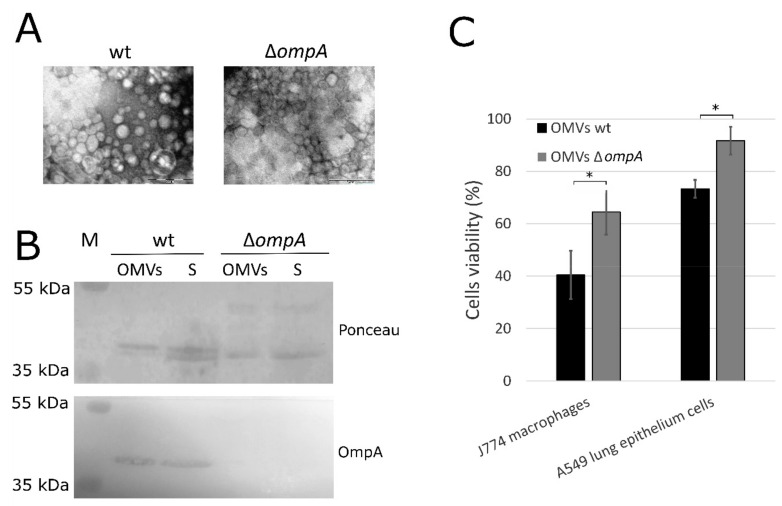
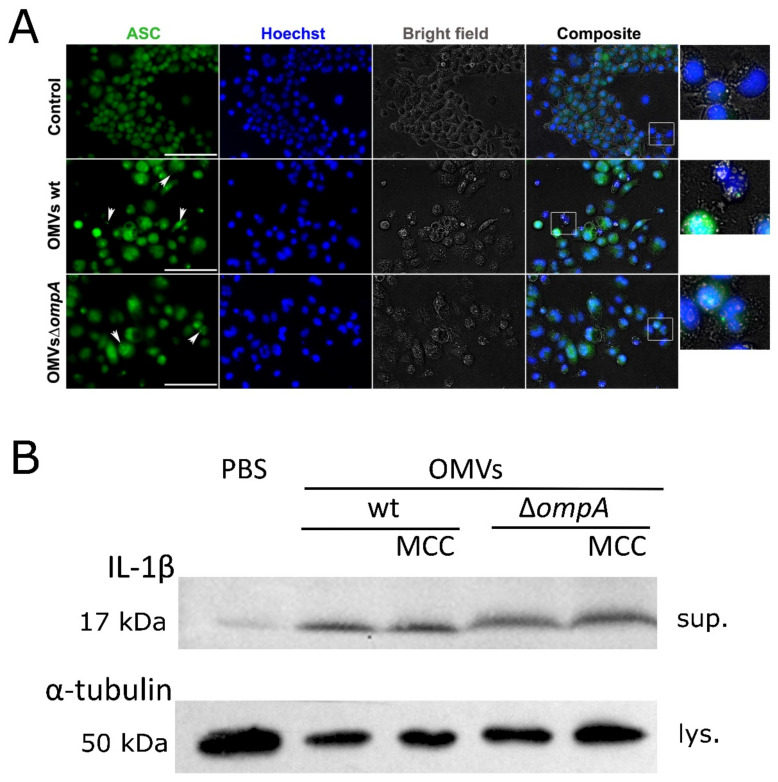
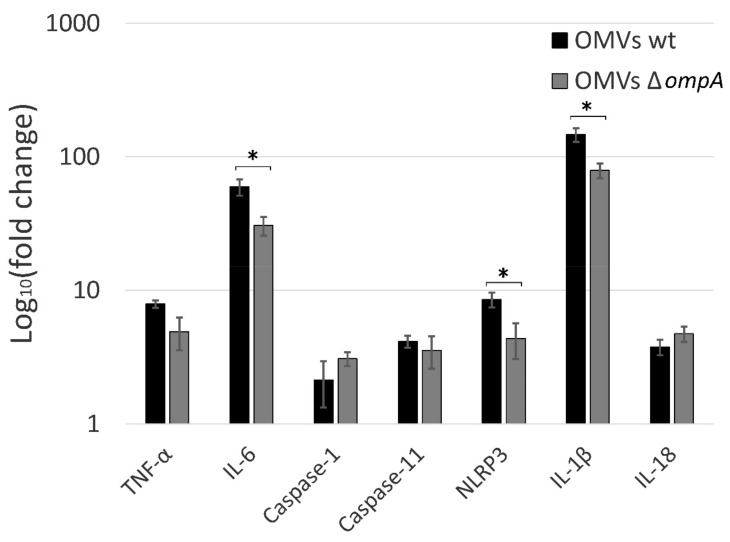
Multidrug resistant shows a growing number of nosocomial infections worldwide during the last decade. The outer membrane vesicles (OMVs) produced by this bacterium draw increasing attention as a possible treatment target. OMVs have been implicated in the reduction of antibiotic level in the surrounding environment, transfer of virulence factors into the host cells, and induction of inflammatory response. Although the evidence on the involvement of OMVs in pathogenesis is currently growing, their role during inflammation is insufficiently explored. It is likely that bacteria, by secreting OMVs, can expand the area of their exposure and prepare surrounding matrix for infection. Here, we investigated the impact of OMVs on activation of macrophages in vitro. We show that OmpA protein present in OMVs substantially contributes to the proinflammatory response in J774 murine macrophages and to the cell death in both lung epithelium cells and macrophages. The loss of OmpA protein in OMVs, obtained from ∆ mutant, resulted in the altered expression of genes coding for IL-6, NLRP3 and IL-1β proinflammatory molecules in macrophages in vitro. These results imply that OmpA protein in bacterial OMVs could trigger a more intense proinflammatory response.
在过去十年中,耐多药菌导致全球医院感染的数量不断增加。这种细菌产生的外膜囊泡(OMVs)作为一种可能的治疗靶点,越来越受到关注。OMVs与周围环境中抗生素水平的降低、毒力因子向宿主细胞的转移以及炎症反应的诱导有关。尽管目前关于OMVs参与发病机制的证据越来越多,但它们在炎症过程中的作用仍未得到充分探索。细菌可能通过分泌OMVs来扩大其暴露面积,并为感染准备周围基质。在此,我们研究了OMVs对体外巨噬细胞激活的影响。我们发现,OMVs中存在的OmpA蛋白在很大程度上促成了J774小鼠巨噬细胞中的促炎反应以及肺上皮细胞和巨噬细胞中的细胞死亡。从∆突变体获得的OMVs中OmpA蛋白的缺失,导致体外巨噬细胞中编码IL-6、NLRP3和IL-1β促炎分子的基因表达发生改变。这些结果表明,细菌OMVs中的OmpA蛋白可能引发更强烈的促炎反应。