Gómez Claudia Taborda, Lairion Fabiana, Repetto Marisa, Ettcheto Miren, Merelli Amalia, Lazarowski Alberto, Auzmendi Jerónimo
Departamento de Bioquímica Clínica, Facultad de Farmacia y Bioquímica, Instituto de Fisiopatología y Bioquímica Clínica (INFIBIOC), Universidad de Buenos Aires, Buenos Aires C1120AAF, Argentina.
Departamento de Química Analítica y Fisicoquímica, Facultad de Farmacia y Bioquímica, Instituto de Bioquímica y Medicina Molecular, Consejo Nacional de Investigaciones Científicas y Técnicas (CONICET), Universidad de Buenos Aires, (IBIMOL, UBA-CONICET), Buenos Aires C1113AAD, Argentina.
Pharmaceuticals (Basel). 2021 Mar 5;14(3):220. doi: 10.3390/ph14030220.
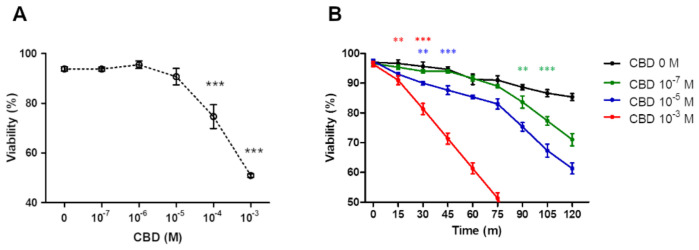
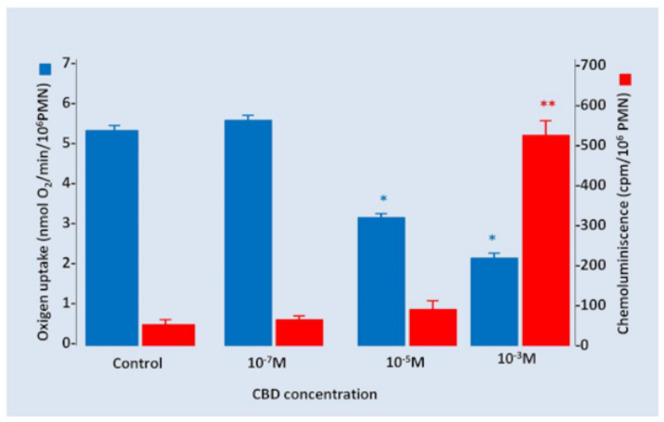
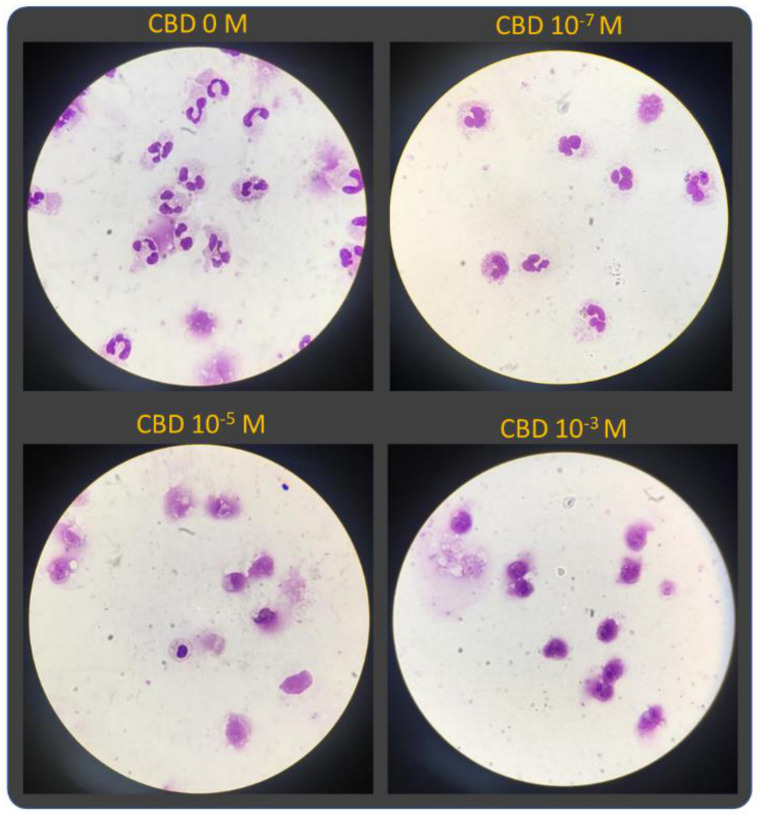
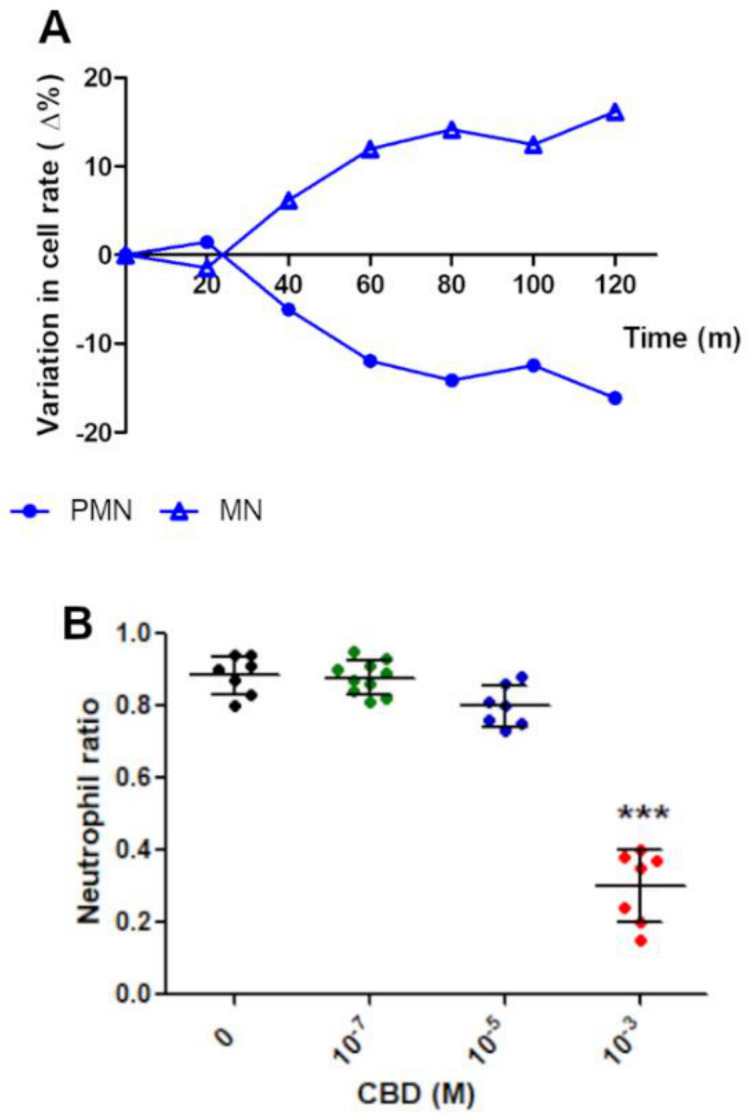
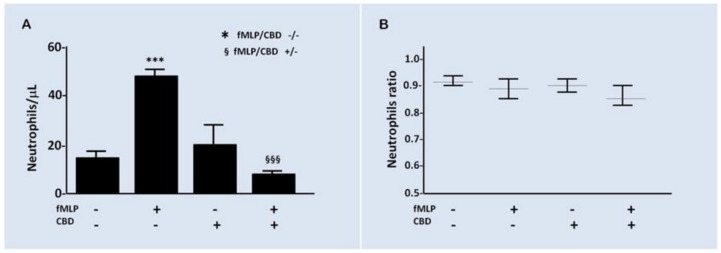
Cannabidiol (CBD), a lipophilic cannabinoid compound without psychoactive effects, has emerged as adjuvant of anti-epileptic drugs (AEDs) in the treatment of refractory epilepsy (RE), decreasing the severity and/or frequency of seizures. CBD is considered a multitarget drug that could act throughout the canonical endocannabinoid receptors (CB1-CB2) or multiple non-canonical pathways. Despite the fact that the CBD mechanism in RE is still unknown, experiments carried out in our laboratory showed that CBD has an inhibitory role on P-glycoprotein excretory function, highly related to RE. Since CB2 is expressed mainly in the immune cells, we hypothesized that CBD treatment could alter the activity of polymorphonuclear neutrophils (PMNs) in a similar way that it does with microglia/macrophages and others circulating leukocytes. In vitro, CBD induced PMN cytoplasmatic vacuolization and proapoptotic nuclear condensation, associated with a significantly decreased viability in a concentration-dependent manner, while low CBD concentration decreased PMN viability in a time-dependent manner. At a functional level, CBD reduced the chemotaxis and oxygen consumption of PMNs related with superoxide anion production, while the singlet oxygen level was increased suggesting oxidative stress damage. These results are in line with the well-known CBD anti-inflammatory effect and support a potential immunosuppressor role on PMNs that could promote an eventual defenseless state during chronic treatment with CBD in RE.
大麻二酚(CBD)是一种无精神活性作用的亲脂性大麻素化合物,已成为抗癫痫药物(AEDs)治疗难治性癫痫(RE)的辅助药物,可降低癫痫发作的严重程度和/或频率。CBD被认为是一种多靶点药物,可通过经典的内源性大麻素受体(CB1 - CB2)或多种非经典途径发挥作用。尽管CBD在RE中的作用机制尚不清楚,但我们实验室进行的实验表明,CBD对与RE高度相关的P - 糖蛋白排泄功能具有抑制作用。由于CB2主要在免疫细胞中表达,我们推测CBD治疗可能会以类似于其对小胶质细胞/巨噬细胞和其他循环白细胞的作用方式改变多形核中性粒细胞(PMN)的活性。在体外,CBD诱导PMN细胞质空泡化和促凋亡核浓缩,与浓度依赖性的存活率显著降低相关,而低浓度CBD则以时间依赖性方式降低PMN存活率。在功能水平上,CBD降低了与超氧阴离子产生相关的PMN趋化性和氧消耗,同时单线态氧水平升高,提示氧化应激损伤。这些结果与众所周知的CBD抗炎作用一致,并支持其对PMN具有潜在免疫抑制作用,这可能会在RE患者长期使用CBD治疗期间导致最终的防御缺失状态。