Nichols James M, Kaplan Barbara L F
Department of Basic Sciences, Center for Environmental Health Sciences, College of Veterinary Medicine, Mississippi State University, Mississippi State, Mississippi.
Cannabis Cannabinoid Res. 2020 Feb 27;5(1):12-31. doi: 10.1089/can.2018.0073. eCollection 2020 Mar 1.
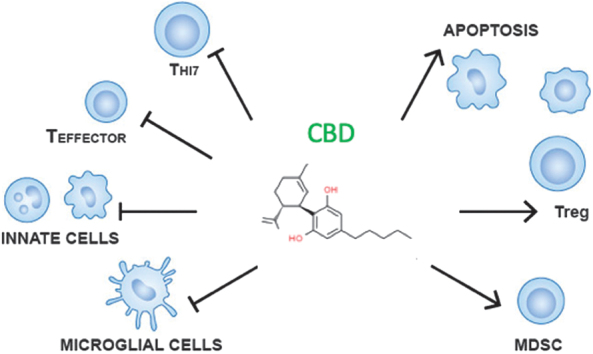
Cannabidiol (CBD) as Epidiolex (GW Pharmaceuticals) was recently approved by the U.S. Food and Drug Administration (FDA) to treat rare forms of epilepsy in patients 2 years of age and older. Together with the increased societal acceptance of recreational cannabis and CBD oil for putative medical use in many states, the exposure to CBD is increasing, even though all of its biological effects are not understood. Once such example is the ability of CBD to be anti-inflammatory and immune suppressive, so the purpose of this review is to summarize effects and mechanisms of CBD in the immune system. It includes a consideration of reports identifying receptors through which CBD acts, since the "CBD receptor," if a single one exists, has not been definitively identified for the myriad immune system effects. The review then provides a summary of and effects in the immune system, in autoimmune models, with a focus on experimental autoimmune encephalomyelitis, and ends with identification of knowledge gaps. Overall, the data overwhelmingly support the notion that CBD is immune suppressive and that the mechanisms involve direct suppression of activation of various immune cell types, induction of apoptosis, and promotion of regulatory cells, which, in turn, control other immune cell targets.
大麻二酚(CBD)作为 Epidiolex(GW 制药公司)最近获得了美国食品药品监督管理局(FDA)的批准,用于治疗 2 岁及以上患者的罕见癫痫形式。随着社会对娱乐性大麻和 CBD 油在许多州用于假定医疗用途的接受度不断提高,尽管尚未完全了解其所有生物学效应,但人们接触 CBD 的情况正在增加。其中一个例子是 CBD 具有抗炎和免疫抑制能力,因此本综述的目的是总结 CBD 在免疫系统中的作用和机制。这包括对确定 CBD 作用所通过的受体的报告进行考量,因为对于免疫系统的众多效应而言,“CBD 受体”(如果存在单一受体的话)尚未得到明确鉴定。本综述接着总结了 CBD 在免疫系统、自身免疫模型中的作用,重点是实验性自身免疫性脑脊髓炎,并以确定知识空白作为结尾。总体而言,数据压倒性地支持 CBD 具有免疫抑制作用这一观点,其机制包括直接抑制各种免疫细胞类型的激活、诱导细胞凋亡以及促进调节性细胞,而调节性细胞又反过来控制其他免疫细胞靶点。