Forrer Anja, Schoenrath Felix, Torzewski Michael, Schmid Jens, Franke Urlich F W, Göbel Nora, Aujesky Drahomir, Matter Christian M, Lüscher Thomas F, Mach Francois, Nanchen David, Rodondi Nicolas, Falk Volkmar, von Eckardstein Arnold, Gawinecka Joanna
Institute of Clinical Chemistry, University Hospital of Zurich, University of Zurich, 8091 Zurich, Switzerland.
Department of Cardiothoracic and Vascular Surgery, German Heart Center Berlin, 13353 Berlin, Germany.
Diagnostics (Basel). 2021 Mar 30;11(4):615. doi: 10.3390/diagnostics11040615.
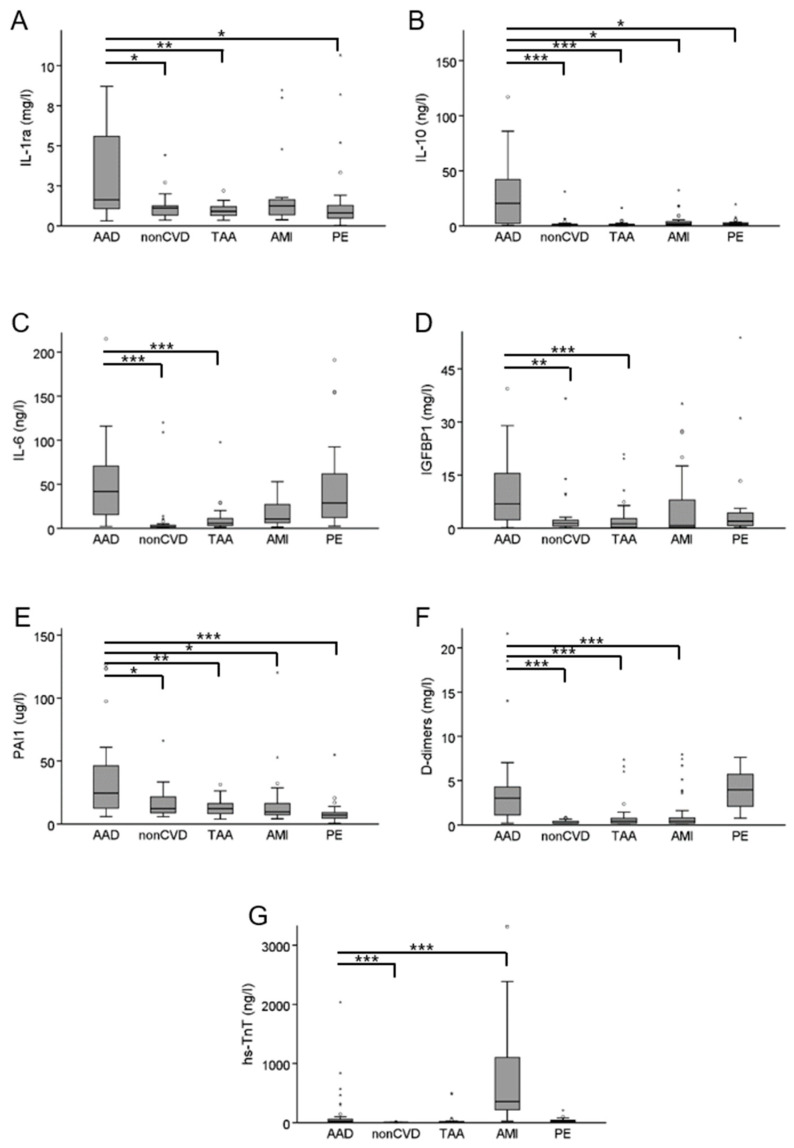
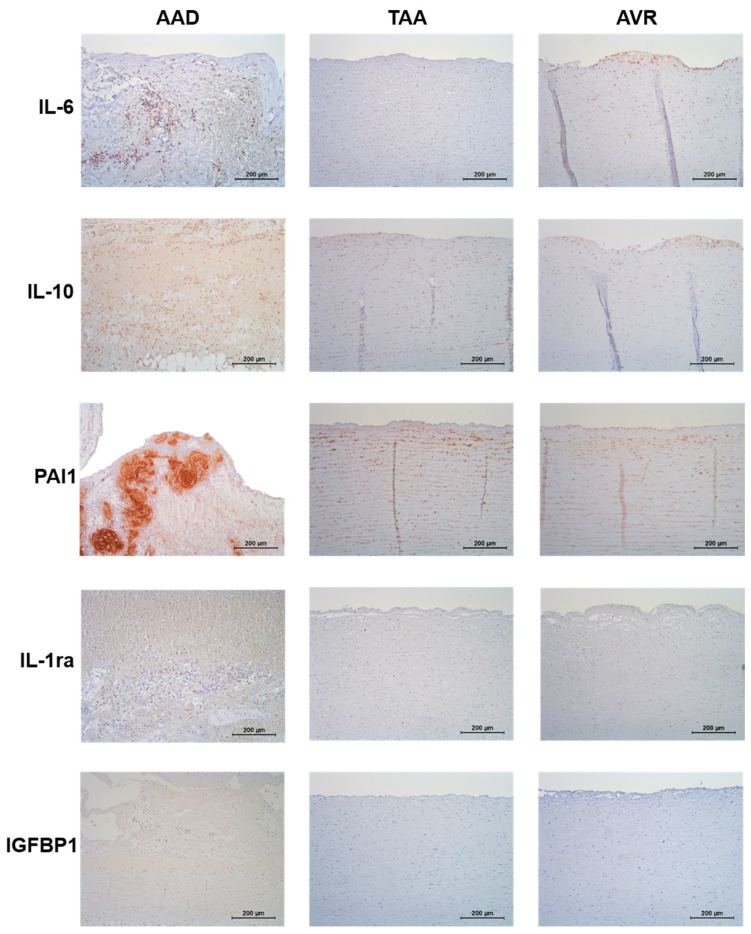
Acute aortic dissection (AAD) is a rare condition, but together with acute myocardial infarction (AMI) and pulmonary embolism (PE) it belongs to the most relevant and life-threatening causes of acute chest pain. Until now, there has been no specific blood test in the diagnostic workup of AAD. To identify clinically relevant biomarkers for AAD, we applied Proseek Multiplex assays to plasma samples from patients with AAD, AMI, PE, thoracic aortic aneurysm (TAA), and non-cardiovascular chest pain (nonCVD). Subsequently, we validated top hits using conventional immunoassays and examined their expression in the aortic tissue. Interleukin 10 (IL-10) alone showed the best performance with a sensitivity of 55% and a specificity of 98% for AAD diagnosis. The combination of D-dimers, high-sensitive troponin T (hs-TnT), interleukin 6 (IL-6), and plasminogen activator inhibitor 1 (PAI1) correctly classified 75% of AAD cases, delivering a sensitivity of 83% and specificity of 95% for its diagnosis. Moreover, this model provided the correct classification of 77% of all analyzed cases. Our data suggest that IL-10 shows potential to be a rule-in biomarker for AAD. Moreover, the addition of PAI1 and IL-6 to hs-TnT and D-dimers may improve the discrimination of suspected AAD, AMI, and PE in patients presenting with acute chest pain.
急性主动脉夹层(AAD)是一种罕见病症,但它与急性心肌梗死(AMI)和肺栓塞(PE)一样,属于急性胸痛最相关且危及生命的病因。到目前为止,在AAD的诊断检查中尚无特异性血液检测方法。为了识别AAD临床相关的生物标志物,我们将Proseek多重检测法应用于AAD、AMI、PE、胸主动脉瘤(TAA)和非心血管性胸痛(nonCVD)患者的血浆样本。随后,我们使用传统免疫测定法对筛选出的关键指标进行验证,并检测它们在主动脉组织中的表达。单独的白细胞介素10(IL-10)在诊断AAD时表现最佳,灵敏度为55%,特异性为98%。D-二聚体、高敏肌钙蛋白T(hs-TnT)、白细胞介素6(IL-6)和纤溶酶原激活物抑制剂1(PAI1)的联合检测能正确分类75%的AAD病例,诊断灵敏度为83%,特异性为95%。此外,该模型对所有分析病例的正确分类率为77%。我们的数据表明,IL-10有潜力成为AAD的确诊生物标志物。此外,在hs-TnT和D-二聚体检测中加入PAI1和IL-6,可能会提高对急性胸痛患者中疑似AAD、AMI和PE的鉴别能力。