Yang Xiaojuan, Annaert Wim
VIB Center for Brain and Disease Research and KU Leuven, Department of Neurosciences, Gasthuisberg, B-3000 Leuven, Belgium.
Membranes (Basel). 2021 Mar 30;11(4):248. doi: 10.3390/membranes11040248.
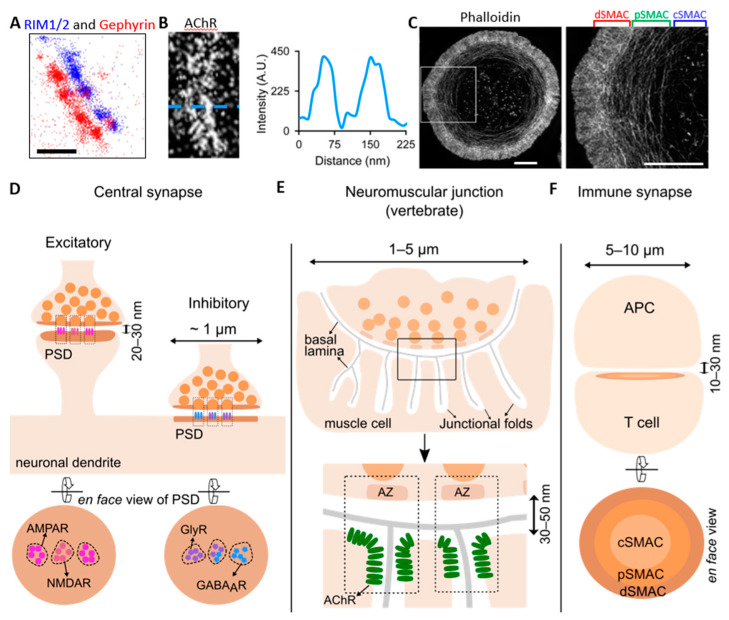
Synapse structures, including neuronal and immunological synapses, can be seen as the plasma membrane contact sites between two individual cells where information is transmitted from one cell to the other. The distance between the two plasma membranes is only a few tens of nanometers, but these areas are densely populated with functionally different proteins, including adhesion proteins, receptors, and transporters. The narrow space between the two plasma membranes has been a barrier for resolving the synaptic architecture due to the diffraction limit in conventional microscopy (~250 nm). Various advanced super-resolution microscopy techniques, such as stimulated emission depletion (STED), structured illumination microscopy (SIM), and single-molecule localization microscopy (SMLM), bypass the diffraction limit and provide a sub-diffraction-limit resolving power, ranging from 10 to 100 nm. The studies using super-resolution microscopy have revealed unprecedented details of the nanoscopic organization and dynamics of synaptic molecules. In general, most synaptic proteins appear to be heterogeneously distributed and form nanodomains at the membranes. These nanodomains are dynamic functional units, playing important roles in mediating signal transmission through synapses. Herein, we discuss our current knowledge on the super-resolution nanoscopic architecture of synapses and their functional implications, with a particular focus on the neuronal synapses and immune synapses.
突触结构,包括神经元突触和免疫突触,可以被看作是两个单个细胞之间的质膜接触位点,信息从一个细胞传递到另一个细胞。两个质膜之间的距离只有几十纳米,但这些区域密集分布着功能各异的蛋白质,包括黏附蛋白、受体和转运蛋白。由于传统显微镜的衍射极限(约250纳米),两个质膜之间的狭窄空间一直是解析突触结构的障碍。各种先进的超分辨率显微镜技术,如受激发射损耗显微镜(STED)、结构照明显微镜(SIM)和单分子定位显微镜(SMLM),绕过了衍射极限,提供了10到100纳米的亚衍射极限分辨率。使用超分辨率显微镜的研究揭示了突触分子纳米级组织和动力学的前所未有的细节。一般来说,大多数突触蛋白似乎是异质分布的,并在膜上形成纳米结构域。这些纳米结构域是动态功能单元,在介导通过突触的信号传递中发挥重要作用。在此,我们讨论我们目前关于突触超分辨率纳米结构及其功能意义的知识,特别关注神经元突触和免疫突触。