Török Bibiána, Fodor Anna, Zsebők Sándor, Sipos Eszter, Zelena Dóra
Institute of Experimental Medicine, 1085 Budapest, Hungary.
János Szentágothai School of Neurosciences, Semmelweis University, 1085 Budapest, Hungary.
Brain Sci. 2021 Mar 30;11(4):444. doi: 10.3390/brainsci11040444.
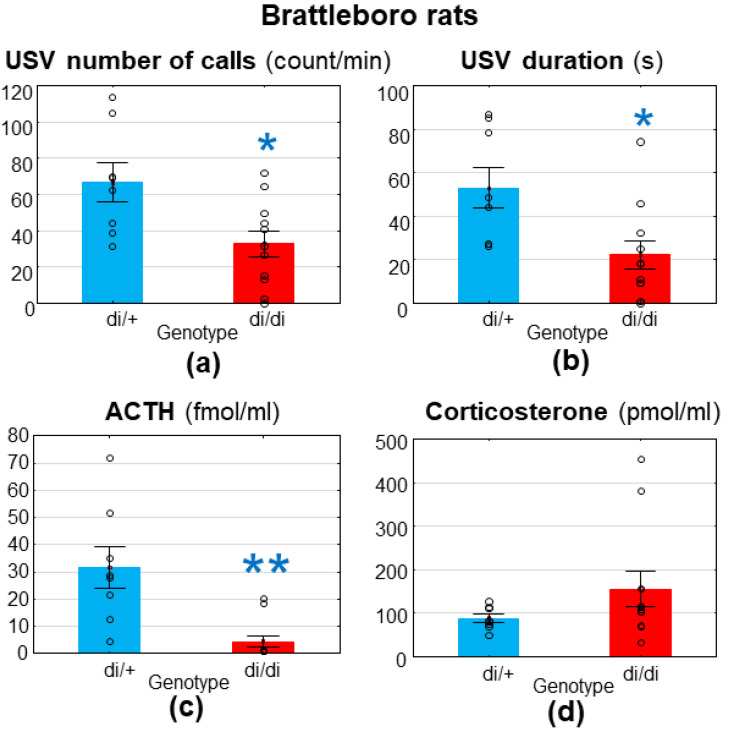
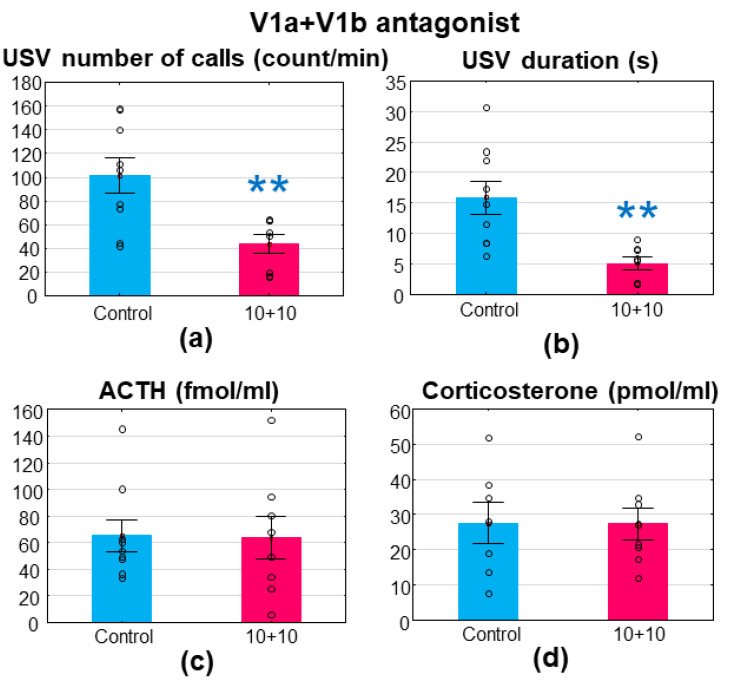
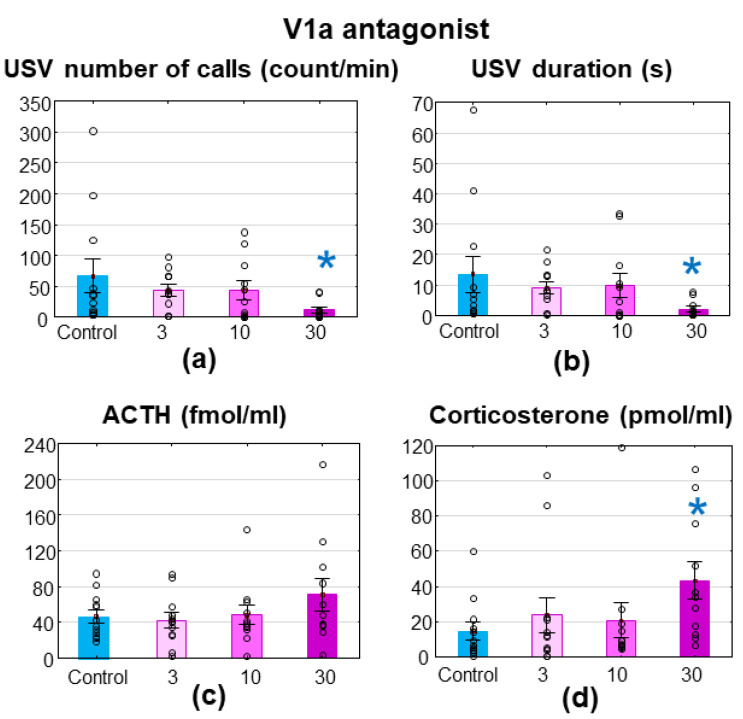
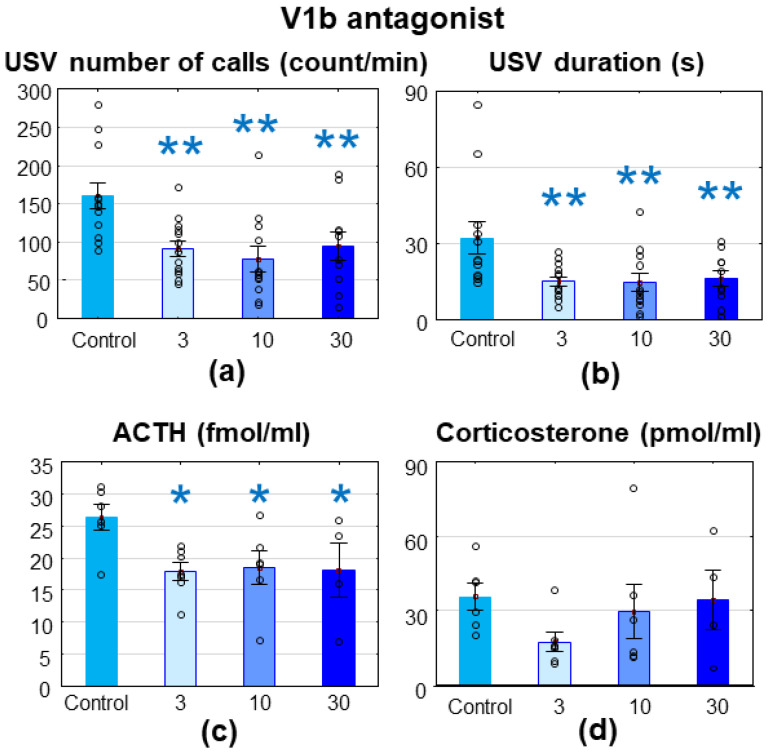
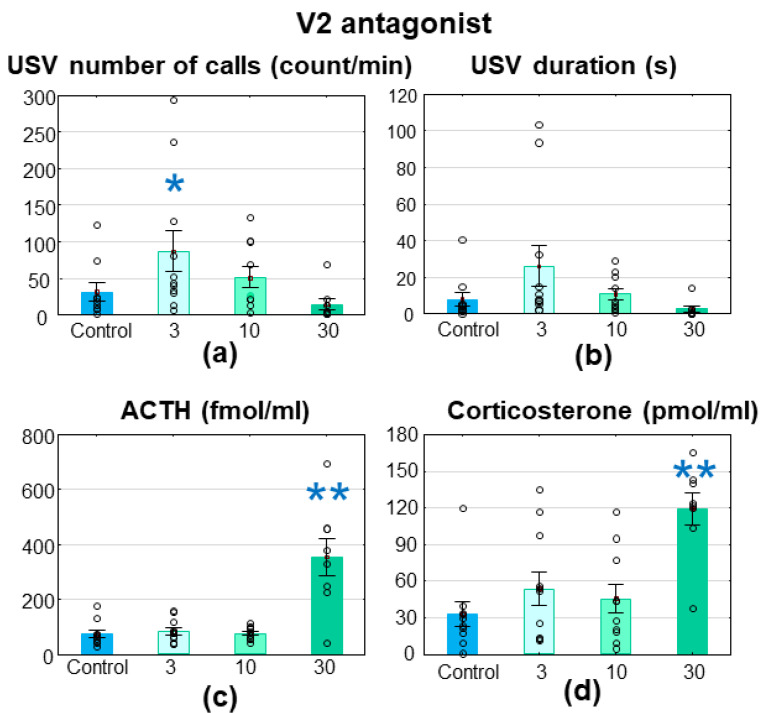
In adults, vasopressin exerts an anxiogenic effect, but less is known about the perinatal period. As a sign of distress, rat pups emit ultrasonic vocalizations when they are separated from their mothers, known as maternal separation-induced ultrasonic vocalization (MS-USV). Previously, reduced MS-USV was reported in 7-8-day-old genetically vasopressin-deficient Brattleboro rats. Here, we aimed to examine the contributing vasopressin receptor (VR) subtypes using Wistar pups. MS-USV was recorded for 10 min, 30 min after vasopressin (V) 1aR, V1bR or V2R antagonist treatment (SR49059, SSR149415, SR121463B; 3, 10 and 30 mg/kg, intraperitoneal). Sedation was studied by the righting reflex and negative geotaxis, and finally, the stress hormone levels were measured by radioimmunoassay. The vasopressin-deficient pups showed decreased MS-USV and adrenocorticotropin levels even after a saline injection, with unchanged corticosterone levels. Thirty mg/kg of V1aR-antagonist increased the corticosterone levels. All V1bR antagonist doses decreased the MS-USV and adrenocorticotropin, while 10 + 10 mg/kg of V1aR and V1bR antagonists decreased MS-USV without influencing the stress hormones. Three mg/kg of V2R antagonist enhanced MS-USV, while 30 mg/kg increased the stress hormone levels. We confirmed that vasopressin deficiency already caused anxiolytic effects in pups. V1bRs are the most important player in connection with their adrenocorticotropin (ACTH)-regulatory role, but a combination of V1aR and V1bR antagonists might be also beneficial through other mechanisms, reducing the possibility of side effects. In contrast, antagonizing the V2Rs may be stressful due to an induction of imbalance in saltwater homeostasis.
在成年个体中,血管加压素具有致焦虑作用,但围产期的情况了解较少。作为痛苦的一种表现,大鼠幼崽在与母亲分离时会发出超声波叫声,即母源分离诱导的超声波发声(MS-USV)。此前有报道称,7 - 8日龄的遗传性血管加压素缺乏的布拉特洛维大鼠的MS-USV减少。在此,我们旨在使用Wistar幼崽研究起作用的血管加压素受体(VR)亚型。在给予血管加压素1a型受体(V1aR)、V1b型受体(V1bR)或V2型受体(V2R)拮抗剂(SR49059、SSR149415、SR121463B;3、10和30 mg/kg,腹腔注射)30分钟后,记录10分钟的MS-USV。通过翻正反射和负趋地性研究镇静情况,最后通过放射免疫测定法测量应激激素水平。血管加压素缺乏的幼崽即使在注射生理盐水后,MS-USV和促肾上腺皮质激素水平也会降低,而皮质酮水平不变。30 mg/kg的V1aR拮抗剂会增加皮质酮水平。所有剂量的V1bR拮抗剂都会降低MS-USV和促肾上腺皮质激素水平,而10 + 10 mg/kg的V1aR和V1bR拮抗剂会降低MS-USV,但不影响应激激素。3 mg/kg的V2R拮抗剂会增强MS-USV,而30 mg/kg会增加应激激素水平。我们证实血管加压素缺乏已在幼崽中产生抗焦虑作用。V1bR与其促肾上腺皮质激素(ACTH)调节作用相关,是最重要的因素,但V1aR和V1bR拮抗剂的联合使用可能通过其他机制也有益处,可降低副作用的可能性。相比之下,拮抗V2R可能会因诱导盐水稳态失衡而产生应激反应。