
快速高强度与传统光固化方案对牙科复合材料选定性能的影响。
Impact of Fast High-Intensity versus Conventional Light-Curing Protocol on Selected Properties of Dental Composites.
作者信息
Garoushi Sufyan, Lassila Lippo, Vallittu Pekka K
机构信息
Department of Biomaterials Science, Turku Clinical Biomaterial Center-TCBC, Institute of Dentistry, University of Turku, 20500 Turku, Finland.
Welfare Division, Oral Health Care, 20101 Turku, Finland.
出版信息
Materials (Basel). 2021 Mar 12;14(6):1381. doi: 10.3390/ma14061381.
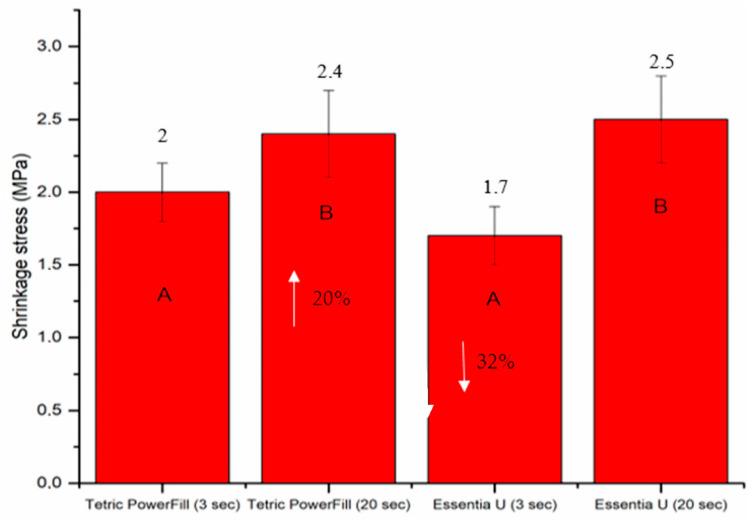
To study the influence of fast high-intensity (3-s) and conventional (20-s) light curing protocols on certain physical properties including light-transmission and surface wear of two nano-hybrid composite resins (Tetric PowerFill and Essentia U) specifically designed for both curing protocols. According to ISO standards, the following properties were investigated: flexural properties, fracture toughness and water sorption/solubility. FTIR-spectrometry was used to calculate the double bond conversion (DC%). A wear test using a chewing simulator was performed with 15,000 chewing cycles. A tensilometer was used to measure the shrinkage stress. Light transmission through various thicknesses (1, 2, 3 and 4 mm) of composite resins was quantified. The Vickers indenter was utilized for evaluating surface microhardness (VH) at the top and the bottom sides. Scanning electron microscopy was utilized to investigate the microstructure of each composite resin. The light curing protocol did not show a significant ( > 0.05) effect on the mechanical properties of tested composite resins and differences were material-dependent. Shrinkage stress, DC% and VH of both composite resins significantly increased with the conventional 20 s light curing protocol ( < 0.05). Light curing conventional composite resin with the fast high-intensity (3-s) curing protocol resulted in inferior results for some important material properties.
为研究快速高强度(3秒)和传统(20秒)光固化方案对两种专门为这两种固化方案设计的纳米混合复合树脂(Tetric PowerFill和Essentia U)的某些物理性能(包括透光率和表面磨损)的影响。根据ISO标准,研究了以下性能:弯曲性能、断裂韧性和吸水性/溶解性。使用傅里叶变换红外光谱仪(FTIR)计算双键转化率(DC%)。使用咀嚼模拟器进行了15000次咀嚼循环的磨损试验。使用拉伸计测量收缩应力。对复合树脂不同厚度(1、2、3和4毫米)的透光率进行了量化。使用维氏压头评估复合树脂顶部和底部的表面显微硬度(VH)。利用扫描电子显微镜研究每种复合树脂的微观结构。光固化方案对测试复合树脂的机械性能没有显著(>0.05)影响,差异取决于材料。两种复合树脂的收缩应力、DC%和VH在传统的20秒光固化方案下均显著增加(<0.05)。采用快速高强度(3秒)固化方案对传统复合树脂进行光固化,在一些重要材料性能方面会导致较差的结果。




 Zotero 插件