Teixeira Ana, Teixeira Maribel, Herdeiro Maria Teresa, Vasconcelos Viviana, Correia Rita, Bahia Maria Fernanda, Almeida Isabel F, Vidal Diogo Guedes, Sousa Hélder Fernando Pedrosa E, Dinis Maria Alzira Pimenta, Almeida Vera
CESPU, Institute of Research and Advanced Training in Health Sciences and Technologies, Rua Central de Gandra 1317, 4585-116 Gandra, Portugal.
UCIBIO/REQUIMTE, MedTech-Laboratory of Pharmaceutical Technology, Department of Drug Sciences, Faculty of Pharmacy, University of Porto, Rua de Jorge Viterbo Ferreira 228, 4050-313 Porto, Portugal.
Int J Environ Res Public Health. 2021 Mar 12;18(6):2928. doi: 10.3390/ijerph18062928.
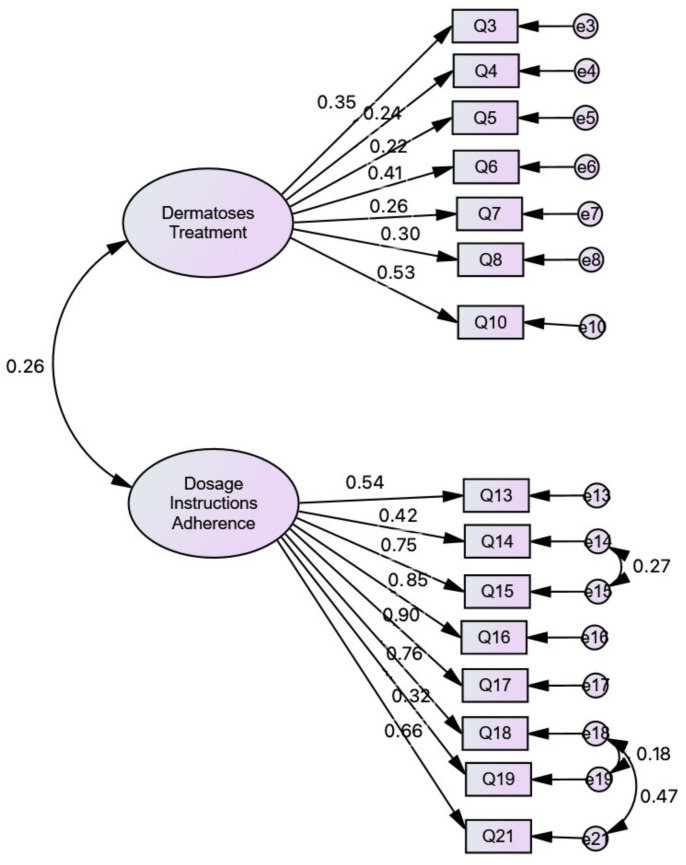
The connection between pharmacists' knowledge and practice on the provided information to patients about dermatoses and their treatment is insufficiently characterized. Furthermore, pharmacists' contributions in counselling and in promoting adherence to topical treatment is not fully understood. This study has three main objectives. It aims to identify the knowledge and practices of pharmacists about dermatoses and their treatment, and to compare the perspective of pharmacists with that of patients regarding treatment information, with the future goal of establishing guidelines on the communication of dosage regimen instructions to dermatological patients and promotion of adherence to treatment, filling a gap. A cross-sectional, exploratory, and descriptive study was carried out. Based on experts' prior knowledge and extensive collected literature information, two questionnaire protocols, one for pharmacists and another one for patients, were designed. Exploratory factor analysis (EFA) and confirmatory factor analysis (CFA) were carried out in relation to the pharmacists' questionnaire for instrument validation. The results indicate that knowledge of pharmacists regarding dermatoses and their treatment is considered acceptable. Most of the pharmacists were reported to provide information to patients. Oppositely, patients reported not to have receive it. This is an important issue because pharmacists play a primary role in the management of several diseases. As non-adherence can be triggered by poor understanding of the dosing instructions, pharmacists' communication practices play an important role in improving this hinderance. Results from this study identified pharmacist-patient communication gaps, so the development of guidelines to improve the transmission of clear dosage regimen instructions and knowledge about patient's disease are of paramount importance. Training programs for continuous education of pharmacist should be implemented to solve the identified communication problems found in this study.
药剂师在向患者提供有关皮肤病及其治疗的信息方面,其知识与实践之间的联系尚未得到充分描述。此外,药剂师在咨询以及促进患者坚持局部治疗方面的贡献也未被完全理解。本研究有三个主要目标。其旨在确定药剂师关于皮肤病及其治疗的知识与实践,并将药剂师与患者在治疗信息方面的观点进行比较,最终目标是制定关于向皮肤病患者传达给药方案说明以及促进坚持治疗的指南,填补这一空白。开展了一项横断面、探索性和描述性研究。基于专家的先验知识和广泛收集的文献信息,设计了两份问卷方案,一份针对药剂师,另一份针对患者。针对药剂师问卷进行了探索性因素分析(EFA)和验证性因素分析(CFA)以进行工具验证。结果表明,药剂师关于皮肤病及其治疗的知识被认为是可接受的。据报道,大多数药剂师会向患者提供信息。相反,患者表示未收到此类信息。这是一个重要问题,因为药剂师在多种疾病的管理中发挥着主要作用。由于对给药说明理解不足可能导致不依从,药剂师的沟通实践在改善这一障碍方面起着重要作用。本研究结果确定了药剂师与患者之间的沟通差距,因此制定指南以改善清晰给药方案说明的传达以及关于患者疾病的知识至关重要。应实施药剂师继续教育培训项目,以解决本研究中发现的已确定的沟通问题。