Turai Peter Istvan, Nyírő Gábor, Butz Henriett, Patócs Attila, Igaz Peter
Department of Endocrinology, Department of Internal Medicine and Oncology, Faculty of Medicine, Semmelweis University, Korányi str. 2/a, H-1083 Budapest, Hungary.
MTA-SE Molecular Medicine Research Group, H-1083 Budapest, Hungary.
Cancers (Basel). 2021 Mar 26;13(7):1522. doi: 10.3390/cancers13071522.
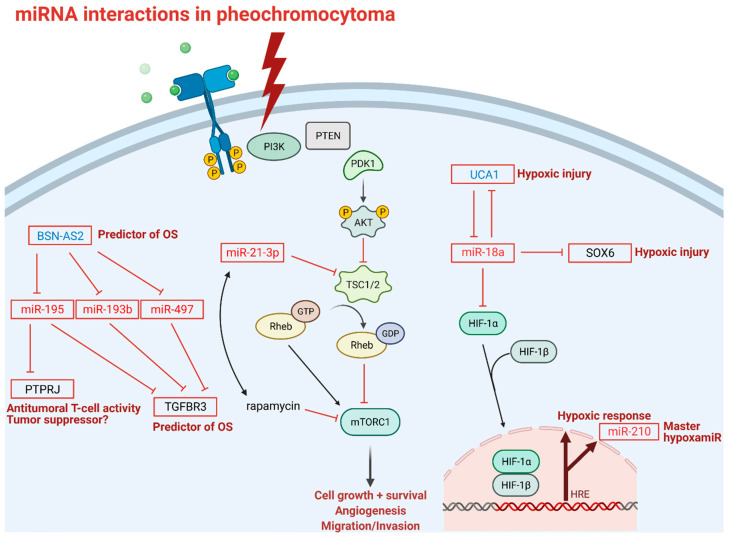
Around 40% of pheochromocytomas/paragangliomas (PPGL) harbor germline mutations, representing the highest heritability among human tumors. All PPGL have metastatic potential, but metastatic PPGL is overall rare. There is no available molecular marker for the metastatic potential of these tumors, and the diagnosis of metastatic PPGL can only be established if metastases are found at "extra-chromaffin" sites. In the era of precision medicine with individually targeted therapies and advanced care of patients, the treatment options for metastatic pheochromocytoma/paraganglioma are still limited. With this review we would like to nurture the idea of the quest for non-coding ribonucleic acids as an area to be further investigated in tumor biology. Non-coding RNA molecules encompassing microRNAs, long non-coding RNAs, and circular RNAs have been implicated in the pathogenesis of various tumors, and were also proposed as valuable diagnostic, prognostic factors, and even potential treatment targets. Given the fact that the pathogenesis of tumors including pheochromocytomas/paragangliomas is linked to epigenetic dysregulation, it is reasonable to conduct studies related to their epigenetic expression profiles and in this brief review we present a synopsis of currently available findings on the relevance of these molecules in these tumors highlighting their diagnostic potential.
约40%的嗜铬细胞瘤/副神经节瘤(PPGL)存在种系突变,这在人类肿瘤中遗传性最高。所有PPGL都有转移潜能,但转移性PPGL总体上较为罕见。目前尚无针对这些肿瘤转移潜能的分子标志物,只有在“嗜铬外”部位发现转移灶时才能确诊转移性PPGL。在精准医疗时代,针对患者的个体化靶向治疗和高级护理不断发展,但转移性嗜铬细胞瘤/副神经节瘤的治疗选择仍然有限。通过本综述,我们希望倡导将寻找非编码核糖核酸作为肿瘤生物学中一个有待进一步研究的领域。包括微小RNA、长链非编码RNA和环状RNA在内的非编码RNA分子已被证明与多种肿瘤的发病机制有关,并且也被提议作为有价值的诊断、预后因素,甚至潜在的治疗靶点。鉴于包括嗜铬细胞瘤/副神经节瘤在内的肿瘤发病机制与表观遗传失调有关,开展与其表观遗传表达谱相关的研究是合理的,在本简要综述中,我们概述了目前关于这些分子在这些肿瘤中的相关性的现有发现,突出了它们的诊断潜力。