Zahid Nisar Ahmad, Jaafar Hawa Z E, Hakiman Mansor
Department of Crop Science, Faculty of Agriculture, University Putra Malaysia, Serdang 43400 UPM, Selangor, Malaysia.
Department of Horticulture, Faculty of Plant Sciences, Afghanistan National Agricultural Sciences and Technology University, Kandahar 3801, Afghanistan.
Plants (Basel). 2021 Mar 26;10(4):630. doi: 10.3390/plants10040630.
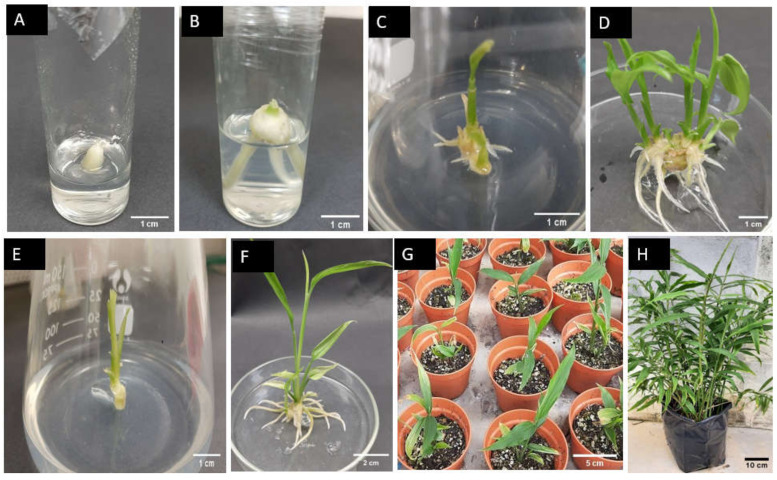
'Bentong' ginger is the most popular variety of in Malaysia. It is vegetatively propagated and requires a high proportion of rhizomes as starting planting materials. Besides, ginger vegetative propagation using its rhizomes is accompanied by several types of soil-borne diseases. Plant tissue culture techniques have been applied in many plant species to produce their disease-free planting materials. As 'Bentong' ginger is less known for its micropropagation, this study was conducted to investigate the effects of Clorox (5.25% sodium hypochlorite (NaOCl)) on explant surface sterilization, effects of plant growth regulators, and basal media on shoots' multiplication and rooting. The secondary metabolites and antioxidant activities of the micropropagated plants were evaluated in comparison with conventionally propagated plants. Rhizome sprouted buds were effectively sterilized in 70% Clorox for 30 min by obtaining 75% contamination-free explants. Murashige and Skoog (MS) supplemented with 10 µM of zeatin was the suitable medium for shoot multiplication, which resulted in the highest number of shoots per explant (4.28). MS medium supplemented with 7.5 µM 1-naphthaleneacetic acid (NAA) resulted in the highest number of roots per plantlet. The in vitro-rooted plantlets were successfully acclimatized with a 95% survival rate in the ex vitro conditions. The phytochemical analysis showed that total phenolic acid and total flavonoid content and antioxidant activities of the micropropagated plants were not significantly different from the conventionally propagated plants of 'Bentong' ginger. In conclusion, the present study's outcome can be adopted for large-scale propagation of disease-free planting materials of 'Bentong' ginger.
“本通”姜是马来西亚最受欢迎的姜品种。它通过营养繁殖,需要高比例的根茎作为起始种植材料。此外,利用根茎进行姜的营养繁殖会伴随着几种土传病害。植物组织培养技术已应用于许多植物物种,以生产其无病种植材料。由于“本通”姜在微繁殖方面鲜为人知,本研究旨在探讨高乐氏(5.25%次氯酸钠(NaOCl))对外植体表面消毒的效果、植物生长调节剂和基础培养基对芽增殖和生根的影响。与传统繁殖的植物相比,对微繁殖植物的次生代谢产物和抗氧化活性进行了评估。通过获得75%无污染外植体,根茎萌发芽在70%高乐氏中有效消毒30分钟。添加10 µM玉米素的Murashige和Skoog(MS)培养基是芽增殖的适宜培养基,每个外植体产生的芽数最多(4.28个)。添加7.5 µM 1-萘乙酸(NAA)的MS培养基使每株幼苗的根数最多。离体生根的幼苗在离体条件下成功驯化,成活率达95%。植物化学分析表明,微繁殖的“本通”姜植物的总酚酸和总黄酮含量以及抗氧化活性与传统繁殖的植物没有显著差异。总之,本研究的结果可用于大规模繁殖“本通”姜的无病种植材料。