Xue Yimeng, Nie Ding, Wang Lin-Jian, Qiu Han-Cheng, Ma Long, Dong Ming-Xin, Tu Wen-Jun, Zhao Jizong
1Department of Neurosurgery, Beijing Tiantan Hospital, Capital Medical University, Beijing, China.
2Savaid Medical School, University of Chinese Academy of Sciences, Beijing, China.
Aging Dis. 2021 Apr 1;12(2):466-479. doi: 10.14336/AD.2020.0701. eCollection 2021 Apr.
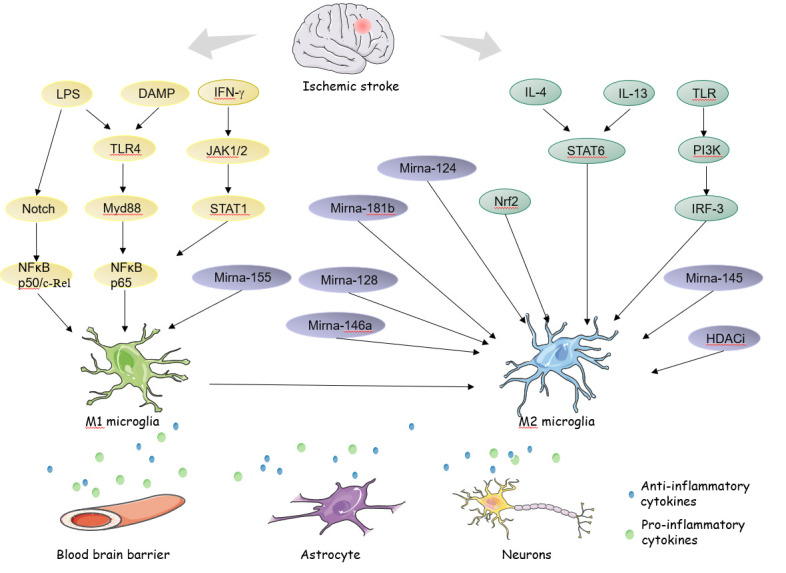
Ischemic stroke, which is the second highest cause of death and the leading cause of disability, represents ~71% of all strokes globally. Some studies have found that the key elements of the pathobiology of stroke is immunity and inflammation. Microglia are the first line of defense in the nervous system. After stroke, the activated microglia become a double-edged sword, with distinct phenotypic changes to the deleterious M1 types and neuroprotective M2 types. Therefore, ways to promote microglial polarization toward M2 phenotype after stroke have become the focus of attention in recent years. In this review, we discuss the process of microglial polarization, summarize the alternation of signaling pathways and epigenetic regulation that control microglial polarization in ischemic stroke, aiming to find the potential mechanisms by which microglia can be transformed into the M2 polarized phenotype.
缺血性中风是全球第二大致死原因和主要致残原因,约占所有中风病例的71%。一些研究发现,中风病理生物学的关键要素是免疫和炎症。小胶质细胞是神经系统的第一道防线。中风后,活化的小胶质细胞成为一把双刃剑,表现出向有害的M1型和神经保护的M2型的明显表型变化。因此,促进中风后小胶质细胞向M2表型极化的方法已成为近年来的关注焦点。在这篇综述中,我们讨论了小胶质细胞极化的过程,总结了控制缺血性中风中小胶质细胞极化的信号通路和表观遗传调控的变化,旨在寻找小胶质细胞可转化为M2极化表型的潜在机制。