Azhdari Mamaghani Hadi, Jabbarzadeh Tabrizi Faranak, Seyedrasooli Alehe, Sarbakhsh Parvin, Badri Gargari Rahim, Zamanzadeh Vahid, Zanboori Vahdat
Department of Medical Surgical Nursing, Faculty of Nursing and Midwifery, Tabriz University of Medical Sciences, Tabriz, Iran.
Department of Statistics and Epidemiology, Faculty of Health Science, Tabriz University of Medical Sciences, Tabriz, Iran.
J Caring Sci. 2021 Mar 1;10(1):22-28. doi: 10.34172/jcs.2021.001. eCollection 2021 Mar.
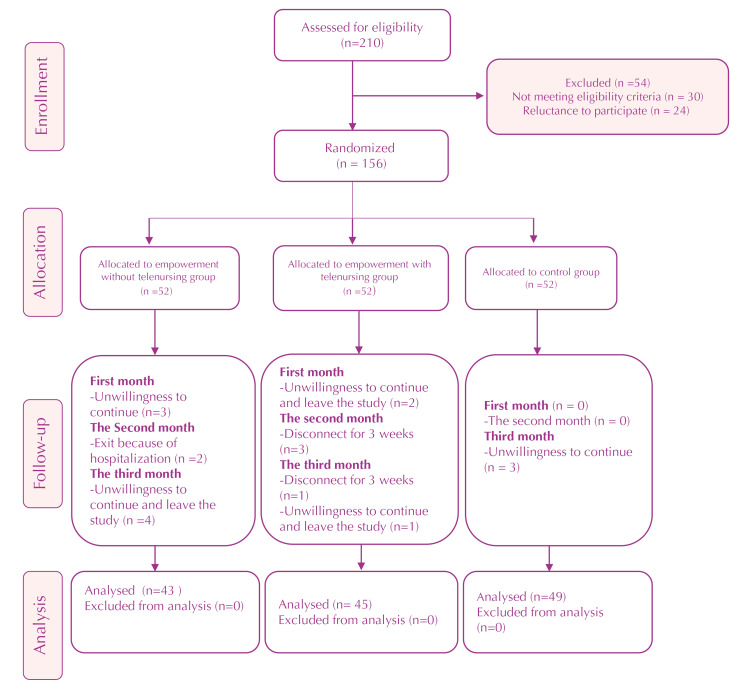
Developing new training methods for improving the health of diabetic patients has always been a concern for nurses. The present study aims to investigate the effects of empowerment-based interventions with or without telenursing on self-efficacy and HbA1c level in diabetic patients. In this randomized clinical trial, 156 patients with type-2 diabetes were randomly assigned into two intervention groups (empowerment with/without telenursing) and one control group. All subjects in the intervention groups participated in two sessions of the empowerment program. However, only the group of empowerment with telenursing received telephone counseling for 12 weeks. The patients in the control group did not receive any intervention programs. Self-efficacy was measured by diabetes-specific self-efficacy scale. The HbA1c level was measured using Bionic kit. Data were analyzed using SPSS Statistics for Windows, version 13.0 (SPSS Inc., Chicago, Ill., USA). After 14 weeks, while the changes in self-efficacy scores of the control group were not statistically significant, they were significant in the two intervention groups. Comparison of the two intervention groups showed that self-efficacy was higher in the group of empowerment with telenursing. It was only in the empowerment with telenursing group that the reduction of HbA1 c was significant. Training based on empowerment models and emphasis on the strengths of clients in solving their own problems can play a major role in increasing self-efficacy and reduction of HbA1c level. In addition, a continuous training program, along with telephone follow-ups can result in higher self-efficacy and lower HbA1c level.
开发改善糖尿病患者健康状况的新培训方法一直是护士们关注的问题。本研究旨在调查基于赋权的干预措施(有无远程护理)对糖尿病患者自我效能感和糖化血红蛋白(HbA1c)水平的影响。在这项随机临床试验中,156名2型糖尿病患者被随机分为两个干预组(有/无远程护理的赋权组)和一个对照组。干预组的所有受试者都参加了两期赋权项目。然而,只有有远程护理的赋权组接受了为期12周的电话咨询。对照组的患者没有接受任何干预项目。自我效能感通过糖尿病特异性自我效能感量表进行测量。HbA1c水平使用仿生试剂盒进行测量。数据使用Windows版SPSS Statistics 13.0(美国伊利诺伊州芝加哥市SPSS公司)进行分析。14周后,虽然对照组自我效能感得分的变化无统计学意义,但在两个干预组中具有统计学意义。两个干预组的比较显示,有远程护理的赋权组自我效能感更高。只有在有远程护理的赋权组中,HbA1c的降低才具有统计学意义。基于赋权模式的培训以及强调患者自身解决问题的能力,在提高自我效能感和降低HbA1c水平方面可以发挥重要作用。此外,持续的培训项目以及电话随访可以带来更高的自我效能感和更低的HbA1c水平。