Zhou Yong, Deng Mingsi, Su Jiqing, Zhang Wei, Liu Dongbiao, Wang Zhengguang
Department of Orthopaedics, The Third Xiangya Hospital of Central South University, Changsha, China.
Department of Stomatology, Changsha Stomatological Hospital, Changsha, China.
Front Cell Dev Biol. 2021 Mar 18;9:633974. doi: 10.3389/fcell.2021.633974. eCollection 2021.
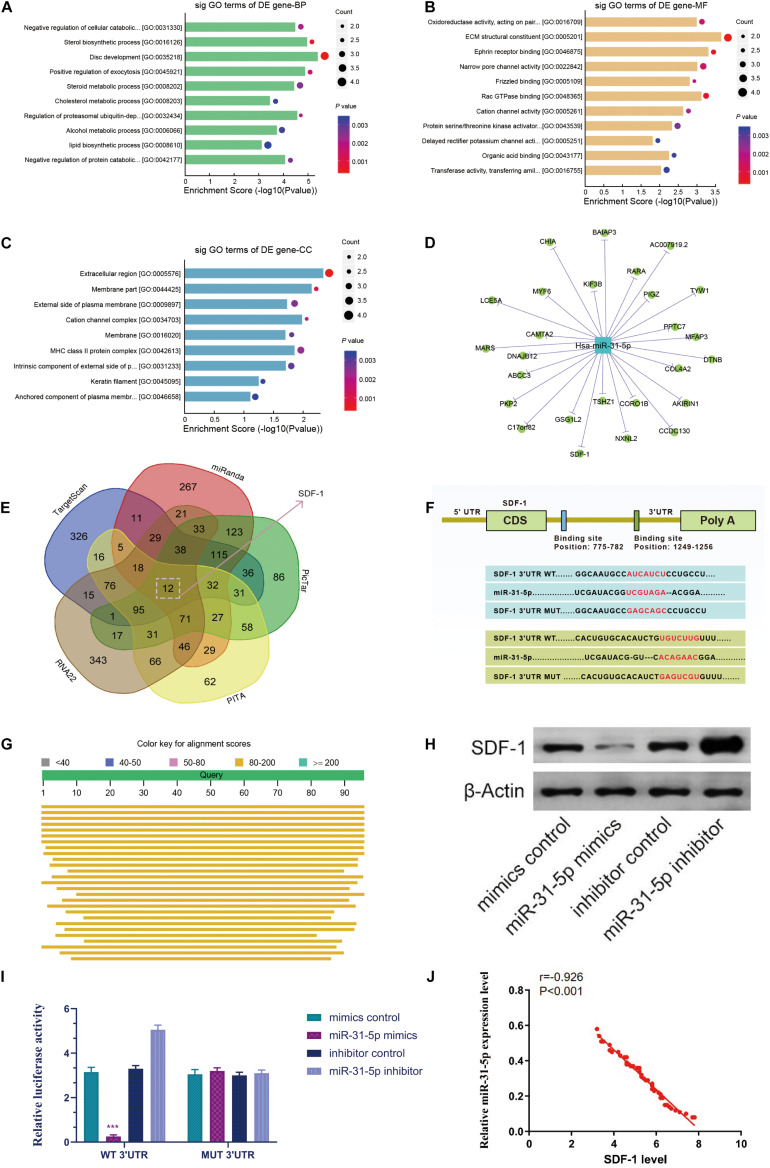
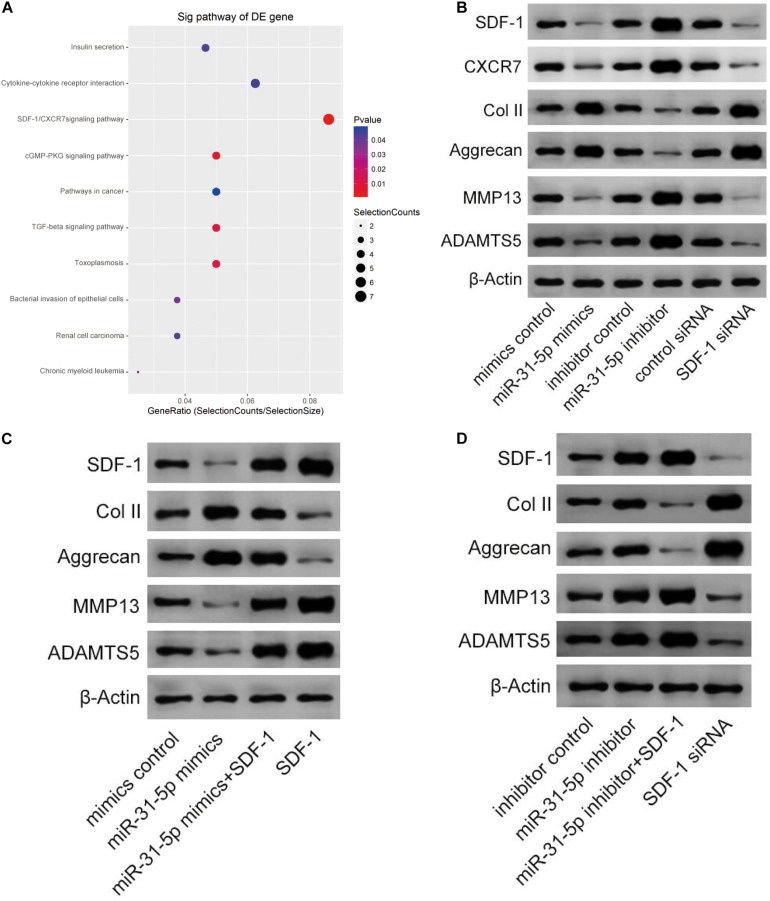
Intervertebral disc degeneration (IDD) refers to the abnormal response of cell-mediated progressive structural failure. In order to understand the molecular mechanism of the maintenance and destruction of the intervertebral disc, new IDD treatment methods are developed. Here, we first analyzed the key regulators of IDD through microRNAs microarrays. Then, the level of miR-31-5p was evaluated by qRT-PCR. The association between miR-31-5p and Stromal cell-derived factor 1 (SDF-1)/CXCR7 axis was assessed by 3'-untranslated region (UTR) cloning and luciferase assay. The apoptosis of cells under different treatments was evaluated by flow cytometer. The cell proliferation was assessed by EdU assay. After IDD model establishment, the discs of mice tail were harvested for histological and radiographic evaluation in each group. Finally, the protein levels of SDF-1, CXCR7, ADAMTS-5, Col II, Aggrecan, and MMP13 were assessed by western blot. The results show that miR-31-5p is a key regulator of IDD and its level is down-regulated in IDD. Overexpression of miR-31-5p facilitates nucleus pulposus cell proliferation, inhibits apoptosis, facilitates ECM formation, and inhibits the level of matrix degrading enzymes in NP cells. The SDF-1/CXCR7 axis is the direct target of miR-31-5p. miR-31-5p acts on IDD by regulating SDF-1/CXCR7. experiments further verified that the up-regulation of miR-31-5p prevented the development of IDD. In conclusion, overexpression of miR-31-5p can inhibit IDD by regulating SDF-1/CXCR7.
椎间盘退变(IDD)是指细胞介导的渐进性结构破坏的异常反应。为了了解椎间盘维持和破坏的分子机制,人们开发了新的IDD治疗方法。在此,我们首先通过微小RNA微阵列分析了IDD的关键调节因子。然后,通过qRT-PCR评估miR-31-5p的水平。通过3'-非翻译区(UTR)克隆和荧光素酶测定评估miR-31-5p与基质细胞衍生因子1(SDF-1)/CXCR7轴之间的关联。通过流式细胞仪评估不同处理下细胞的凋亡情况。通过EdU测定评估细胞增殖。建立IDD模型后,每组收集小鼠尾巴的椎间盘进行组织学和影像学评估。最后,通过蛋白质印迹法评估SDF-1、CXCR7、ADAMTS-5、II型胶原、聚集蛋白聚糖和MMP13的蛋白水平。结果表明,miR-31-5p是IDD的关键调节因子,其水平在IDD中下调。miR-31-5p的过表达促进髓核细胞增殖,抑制凋亡,促进细胞外基质形成,并抑制NP细胞中基质降解酶的水平。SDF-1/CXCR7轴是miR-31-5p的直接靶点。miR-31-5p通过调节SDF-1/CXCR7作用于IDD。实验进一步证实,miR-31-5p的上调可阻止IDD的发展。总之,miR-31-5p的过表达可通过调节SDF-1/CXCR7抑制IDD。