Ettl Florian, Fischer Eva, Losert Heidrun, Stumpf Dominik, Ristl Robin, Ruetzler Kurt, Greif Robert, Fischer Henrik
Department of Emergency Medicine, Medical University of Vienna, Vienna, Austria.
Department of Anaesthesiology and Intensive Care, Klinik Donaustadt, Vienna, Austria.
Front Med (Lausanne). 2021 Mar 17;8:640721. doi: 10.3389/fmed.2021.640721. eCollection 2021.
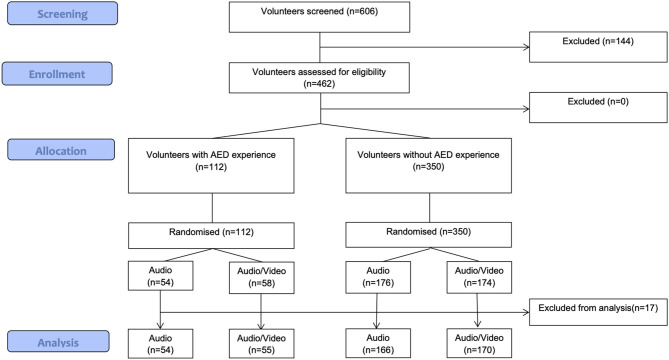
The aim was to compare cardiopulmonary resuscitation (CPR) quality of an automated external defibrillator (AED) with and without additional video instruction during basic life support (BLS) by laypersons. First-year medical students were randomized either to an AED with audio only or audio with additional video instructions during CPR. Each student performed 4 min of single-rescuer chest compression only BLS on a manikin (Ambu Man C, Ballerup, Denmark) using the AED. The primary outcome was the effective compression ratio during this scenario. This combined parameter was used to evaluate the quality of chest compressions by multiplying compressions with correct depth, correct hand position, and complete decompression by flow time. Secondary outcomes were percentages of incomplete decompression and hand position, mean compression rate, time-related parameters, and subjective assessments. Effective compression ratio did not differ between study groups in the overall sample ( = 0.337) or in students with ( = 0.953) or without AED experience ( = 0.278). Additional video instruction led to a higher percentage of incorrect decompressions ( = 0.014). No significant differences could be detected in time-related resuscitation parameters. An additional video was subjectively rated as more supporting ( = 0.001). Audio-video instructions did not significantly improve resuscitation quality in these laypersons despite that it was felt more supportive. An additional video to the verbal AED prompts might lead to cognitive overload. Therefore, future studies might target the influence of the video content and the potential benefits of video instructions in specific populations.
目的是比较在非专业人员进行基础生命支持(BLS)期间,有和没有额外视频指导的自动体外除颤器(AED)的心肺复苏(CPR)质量。一年级医学生被随机分为在心肺复苏期间仅使用音频AED组或使用带有额外视频指导的音频AED组。每个学生使用AED在模拟人(丹麦巴勒鲁普的Ambu Man C)上进行4分钟的单施救者仅胸外按压的基础生命支持。主要结局是在此场景下的有效按压比例。这个综合参数用于通过将具有正确深度、正确手部位置以及完全放松的按压次数乘以按压持续时间来评估胸外按压的质量。次要结局包括不完全放松和手部位置的百分比、平均按压速率、时间相关参数以及主观评估。在总体样本中(P = 0.337),在有AED经验的学生中(P = 0.953)以及没有AED经验的学生中(P = 0.278),研究组之间的有效按压比例没有差异。额外的视频指导导致不正确放松的百分比更高(P = 0.014)。在时间相关的复苏参数方面未检测到显著差异。额外的视频在主观上被评为更具支持性(P = 0.001)。尽管感觉更具支持性,但视听指导并未显著提高这些非专业人员的复苏质量。在AED语音提示的基础上增加视频可能会导致认知过载。因此,未来的研究可能会针对视频内容的影响以及视频指导在特定人群中的潜在益处。