Li Ya-Jing, Hu Qing-Ping
School of Life Sciences, Shanxi Normal University, 1 Gongyuan Street, Linfen City, 041004, China.
Open Life Sci. 2020 Oct 14;15(1):553-560. doi: 10.1515/biol-2020-0062. eCollection 2020.
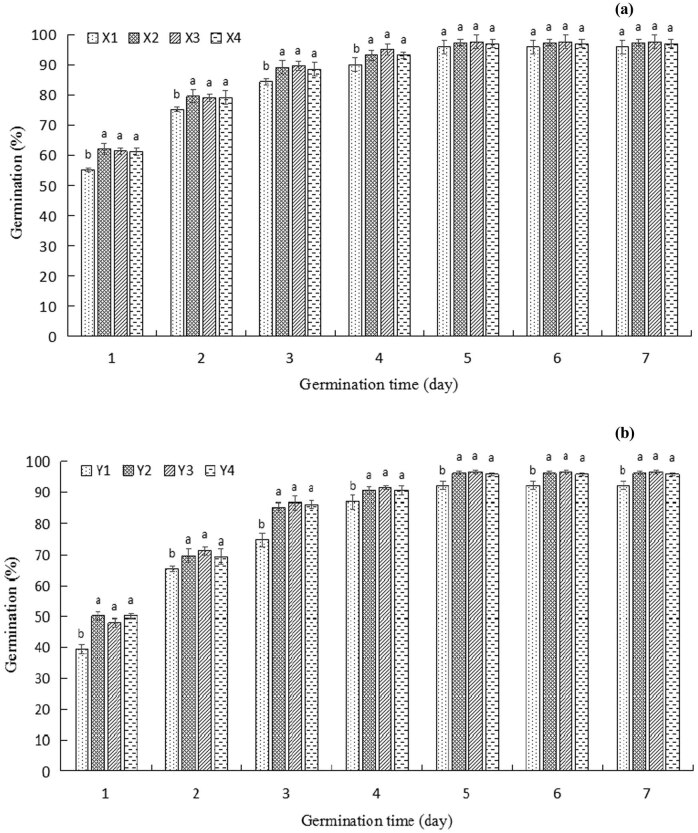
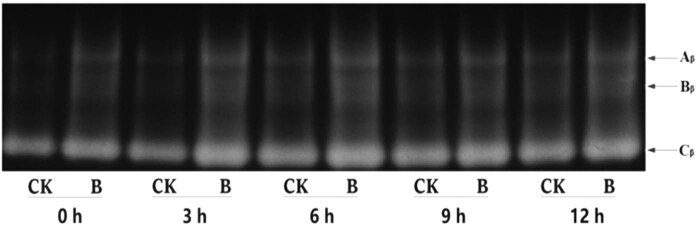
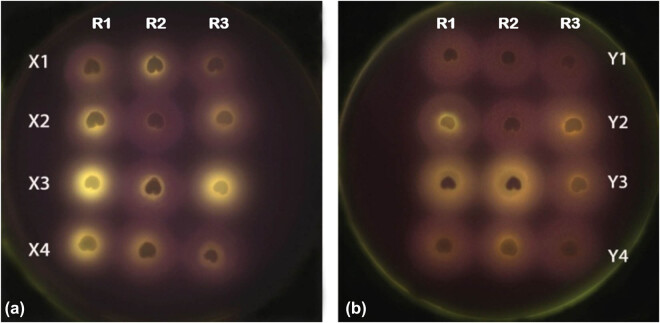
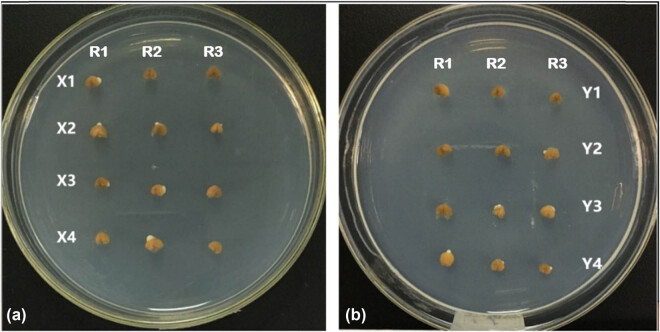
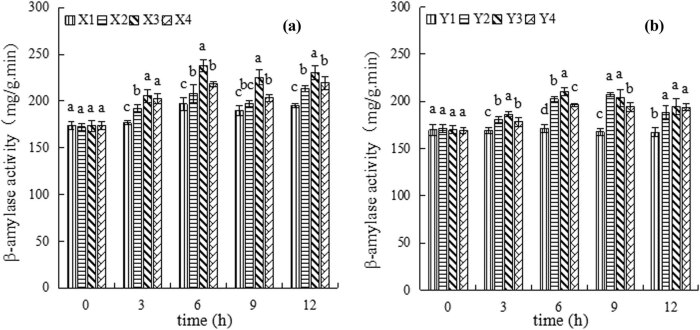
The response of β-amylase in early stage germination of wheat seeds to QM3 was mainly focused on to elucidate the promotion mechanism of QM3. The results showed that the changes in apparent activity of amylase and endosperm liquefaction after the strain QM3 treatment were much more obvious than that of the control group; the activity of β-amylase treated with the different concentrations of the strain QM3 increased significantly ( < 0.05) by 4% (10 CFU/mL) and 18.5% (10 CFU/mL) at the germination 6 h. Moreover, after presoaking with α-cyclodextrin, the activity of β-amylase increased significantly ( < 0.05) by 18.5% (10 CFU/mL) and 23.4% (10 CFU/mL) at the same stage of germination; the electrophoretogram of β-amylase isoenzymes showed that there is a growing trend in brightness and width of the band during the early germination from 3 to 6 h of wheat seed treated by the strain QM3 (10 CFU/mL). The increase in activity and isoenzyme expression of β-amylase may be one of the important reasons to promote the germination of wheat seeds after being treated by QM3.
研究小麦种子萌发早期β-淀粉酶对QM3的响应,主要是为了阐明QM3的促生机制。结果表明,QM3处理后淀粉酶表观活性变化及胚乳液化程度均比对照组明显;不同浓度QM3处理的β-淀粉酶活性在萌发6 h时显著增加(<0.05),10⁶ CFU/mL增加4%,10⁷ CFU/mL增加18.5%。此外,经α-环糊精浸种后,β-淀粉酶活性在相同萌发阶段显著增加(<0.05),10⁶ CFU/mL增加18.5%,10⁷ CFU/mL增加23.4%;β-淀粉酶同工酶电泳图谱显示,QM3(10⁷ CFU/mL)处理的小麦种子在萌发3至6 h早期,条带亮度和宽度呈增加趋势。β-淀粉酶活性和同工酶表达增加可能是QM3处理促进小麦种子萌发的重要原因之一。