From the Department of Internal Medicine, King Faisal Specialist Hospital and Research Centre, Riyadh, Saudi Arabia.
From the Department of Microbiology, King Saud Medical City, Riyadh, Saudi Arabia.
Ann Saudi Med. 2021 Mar-Apr;41(2):63-70. doi: 10.5144/0256-4947.2021.63. Epub 2021 Apr 1.
Carbapenems are the antibiotics of last-resort for the treatment of bacterial infections caused by multidrug-resistant organisms. The emergence of resistance is a critical and worrisome problem for clinicians and patients. Carbapenem-resistant (CRE) are spreading globally, are associated with an increased frequency of reported outbreaks in many regions, and are becoming endemic in many others.
Determine the molecular epidemiology of CRE isolates from various regions of Saudi Arabia to identify the genes encoding resistance and their clones for a better understanding of the epidemio-logical origin and national spread.
Multicenter, cross-sectional, laboratory-based study.
Samples were collected from 13 Ministry of Health tertiary-care hospitals from five different regions of Saudi Arabia.
Isolates were tested using the GeneXpert molecular platform to classify CRE.
Prevalence of various types of CRE in Saudi Arabia.
519 carbapenem-resistant isolates.
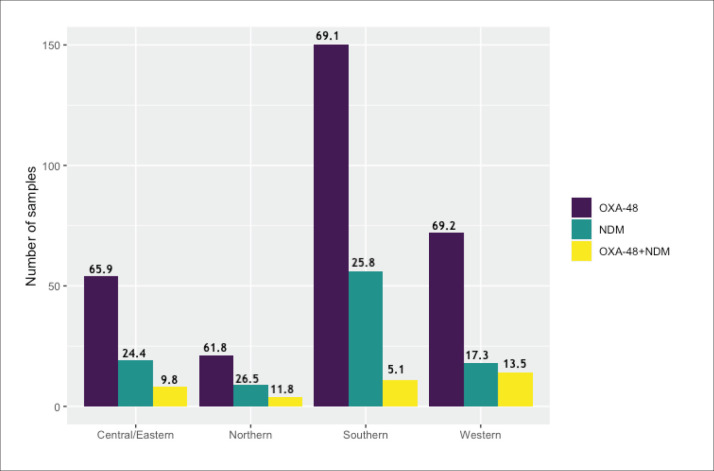
Of 519 isolates, 440 (84.7%) were positive for CRE, with (410/456, 90%) being the most commonly isolated pathogen. The distribution of the CRE-positive resistance genes was as follows: OXA-48 (n=292, 71.2%), NDM-1 (n=85, 20.7%), and NDM+OXA-48 (n=33, 8%). The highest percentage of a single blaOXA-48 gene was detected in the central and eastern regions (77%), while the bla-gene was the predominant type in the northern region (27%). The southern regions showed the lowest percentages for harboring both blaOXA-48 and bla genes (4%), while the western region isolates showed the highest percentage of harboring both genes (14%).
The results illustrate the importance of molecular characterization of CRE isolates for patient care and infection prevention and control. Larger multicenter studies are needed to critically evaluate the risk factors and trends over time to understand the dynamics of spread and effective methods of control.
Lack of phenotypic susceptibility and clinical data.
None.
碳青霉烯类抗生素是治疗多重耐药菌引起的细菌感染的最后手段。耐药性的出现是临床医生和患者面临的一个关键且令人担忧的问题。碳青霉烯类耐药菌(CRE)在全球范围内传播,与许多地区报告的暴发频率增加有关,并在许多其他地区成为地方病。
确定来自沙特阿拉伯不同地区的 CRE 分离株的分子流行病学,以确定编码耐药性的基因及其克隆,从而更好地了解流行病学起源和国家传播。
多中心、横断面、基于实验室的研究。
样本取自沙特阿拉伯五个不同地区的 13 家卫生部三级保健医院。
使用 GeneXpert 分子平台检测分离株以分类 CRE。
沙特阿拉伯各种类型 CRE 的流行率。
519 株碳青霉烯类耐药菌。
519 株分离株中,440 株(84.7%)为 CRE 阳性,其中(410/456,90%)最常分离到的病原体。CRE 阳性株耐药基因的分布如下:OXA-48(n=292,71.2%)、NDM-1(n=85,20.7%)和 NDM+OXA-48(n=33,8%)。中央和东部地区单个 blaOXA-48 基因的检出率最高(77%),而北部地区主要为 bla 基因(27%)。南部地区携带 blaOXA-48 和 bla 基因的比例最低(4%),而西部地区携带这两种基因的比例最高(14%)。
结果表明对 CRE 分离株进行分子特征分析对患者护理和感染预防与控制非常重要。需要进行更大规模的多中心研究,以批判性评估随时间推移的危险因素和趋势,以了解传播动态和有效的控制方法。
缺乏表型药敏和临床数据。
无。