Dibello Vittorio, Lozupone Madia, Manfredini Daniele, Dibello Antonio, Zupo Roberta, Sardone Rodolfo, Daniele Antonio, Lobbezoo Frank, Panza Francesco
Department of Orofacial Pain and Dysfunction, Academic Centre for Dentistry Amsterdam (ACTA), University of Amsterdam and Vrije Universiteit Amsterdam, Amsterdam, The Netherlands.
Neurodegenerative Disease Unit, Department of Basic Medicine, Neuroscience, and Sense Organs, University of Bari Aldo Moro, Bari, Italy.
Neural Regen Res. 2021 Nov;16(11):2149-2153. doi: 10.4103/1673-5374.310672.
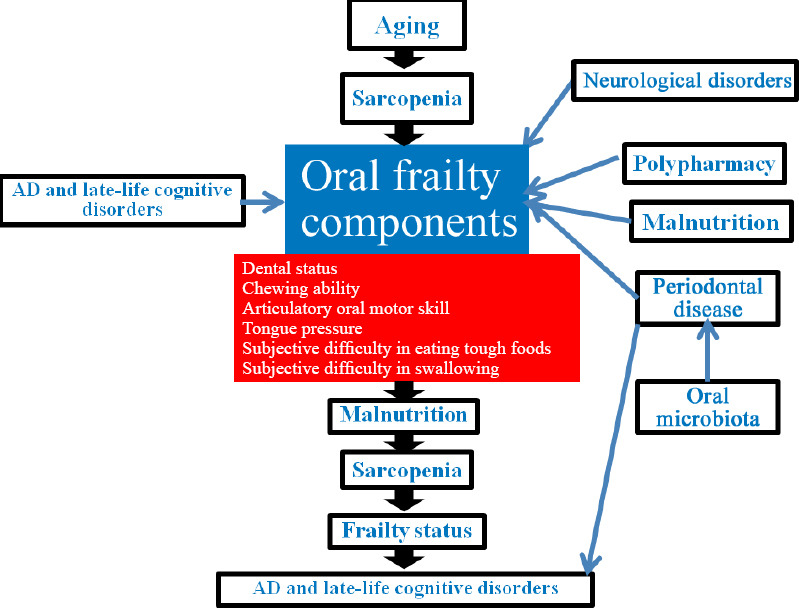
Frailty is a critical intermediate status of the aging process with a multidimensional and multisystem nature and at higher risk for adverse health-related outcomes, including falls, disability, hospitalizations, institutionalization, mortality, dementia, and Alzheimer's disease. Among different frailty phenotypes, oral frailty has been recently suggested as a novel construct defined as a decrease in oral function with a coexisting decline in cognitive and physical functions. We briefly reviewed existing evidence on operational definitions of oral frailty, assessment and screening tools, and possible relationships among oral frailty, oral microbiota, and Alzheimer's disease neurodegeneration. Several underlying mechanism may explain the oral health-frailty links including undernutrition, sarcopenia linked to both poor nutrition and frailty, psychosocial factors, and the chronic inflammation typical of oral disease. Oral microbiota may influence Alzheimer's disease risk through circulatory or neural access to the brain and the interplay with periodontal disease, often causing tooth loss also linked to an increased Alzheimer's disease risk. On this bases, COR388, a bacterial protease inhibitor targeting Porphyromonas gingivalis implicated in periodontal disease, is now being tested in a double-blind, placebo-controlled Phase II/III study in mild-to-moderate Alzheimer's disease. Therefore, oral status may be an important contributor to general health, including Alzheimer's disease and late-life cognitive disorders, suggesting the central role of preventive strategies targeting the novel oral frailty phenotype and including maintenance and improvement of oral function and nutritional status to reduce the burden of both oral dysfunction and frailty.
衰弱是衰老过程中的一种关键中间状态,具有多维度和多系统性质,且出现与健康相关不良后果的风险更高,这些后果包括跌倒、残疾、住院、入住养老院、死亡、痴呆和阿尔茨海默病。在不同的衰弱表型中,口腔衰弱最近被认为是一种新的概念,定义为口腔功能下降且同时伴有认知和身体功能衰退。我们简要回顾了关于口腔衰弱的操作定义、评估和筛查工具,以及口腔衰弱、口腔微生物群和阿尔茨海默病神经退行性变之间可能关系的现有证据。几种潜在机制可以解释口腔健康与衰弱之间的联系,包括营养不良、与营养不良和衰弱均相关的肌肉减少症、心理社会因素以及口腔疾病典型的慢性炎症。口腔微生物群可能通过血液循环或神经通路进入大脑以及与牙周病的相互作用来影响患阿尔茨海默病的风险,牙周病通常还会导致牙齿脱落,这也与患阿尔茨海默病风险增加有关。基于此,COR388,一种针对与牙周病有关的牙龈卟啉单胞菌的细菌蛋白酶抑制剂,目前正在一项针对轻度至中度阿尔茨海默病的双盲、安慰剂对照的II/III期研究中进行测试。因此,口腔状况可能是总体健康的一个重要因素,包括对阿尔茨海默病和晚年认知障碍而言,这表明针对新型口腔衰弱表型的预防策略具有核心作用,这些策略包括维持和改善口腔功能以及营养状况,以减轻口腔功能障碍和衰弱的负担。