Amsterdam UMC, University of Amsterdam, Emma Children's Hospital, Room H8-247, Meibergdreef 9, 1105, AZ, Amsterdam, The Netherlands.
Child and Adolescent Psychiatry and de Bascule, Academic Medical Center Amsterdam, Amsterdam, The Netherlands.
Eur J Pediatr. 2021 Aug;180(8):2345-2357. doi: 10.1007/s00431-021-04055-6. Epub 2021 Apr 5.
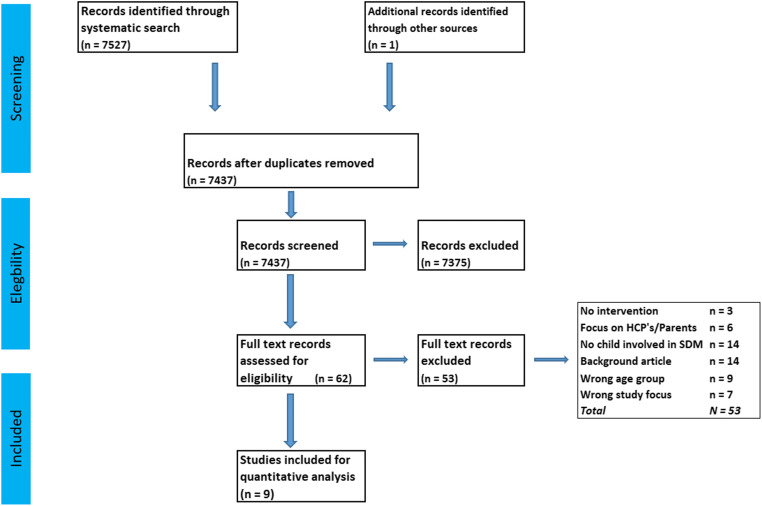
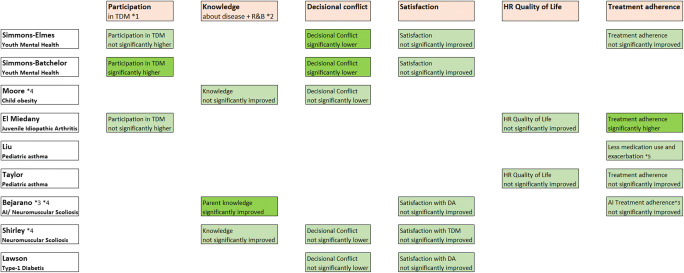
Based on the United Nations Conventions on the Rights of the Child (CRC), it is a child's right to participate in all matters concerning its wellbeing. Little is known about chronically and/or critically ill children's participation in pediatric shared decision-making (SDM). We explored medical literature to see if and how these children participate in pediatric SDM. We searched relevant medical databases published between January 2008 and January 2020 for studies targeting children aged 4-18 years old, suffering from a chronic and/or critical disease. We found 9 relevant studies. SDM interventions mostly used were decision aids (n=8), questionnaires for caretakers/parents and children (n=4), and a SDM toolkit (n=2). Perceived involvement in SDM and knowledge increased amongst children, adolescents, and caretakers following these interventions. Decisional conflict measured using the 0-100 point DCS scale (higher scores indicate more decisional conflict) was reduced by 15.9 points in one study (p<0.01) and 17.8 points in another (95%CI: 13.3-22.9). Lower scores were associated with higher satisfaction with the decision aid by children, caretakers, and clinicians.Conclusion: Stakeholders should advocate initiatives to facilitate a child's participation preferences regarding pediatric SDM since decision support tools help chronically ill children to be more involved in SDM as they increase the children's knowledge and satisfaction and reduce decisional conflicts. What is Known: • Decision aids can help improve participation, knowledge, satisfaction, and health outcomes. • Quality and consistency of the information exchange impact quality and outcome of SDM. What is New: • Depending on a child's age, evolving capacities, and communication and participation preferences, more evidence is needed on which tools are suitable for chronically ill children to ensure their preferred participation in pediatric SDM. • Pediatricians adopt healthcare SDM tools and techniques that do not always take into account that a child's right to participate in pediatric SDM including the tendency to use interventions that are not specifically designed for pediatrics.
基于《联合国儿童权利公约》(CRC),儿童有权参与与其福祉有关的一切事务。对于患有慢性和/或危重病的儿童在儿科共同决策(SDM)中的参与情况,我们知之甚少。我们查阅了医学文献,以了解这些儿童是否以及如何参与儿科 SDM。我们在 2008 年 1 月至 2020 年 1 月期间搜索了相关的医学数据库,以寻找针对 4-18 岁患有慢性和/或危重病的儿童的研究。我们找到了 9 项相关研究。干预措施主要使用决策辅助工具(n=8)、护理人员/父母和儿童问卷(n=4)以及 SDM 工具包(n=2)。干预后,儿童、青少年和护理人员的参与感和知识有所提高。在一项研究中(p<0.01),使用 0-100 点 DCS 量表测量的决策冲突减少了 15.9 分,在另一项研究中(95%CI:13.3-22.9)减少了 17.8 分。分数越低,儿童、护理人员和临床医生对决策辅助工具的满意度越高。结论:利益相关者应倡导倡议,以促进儿童参与儿科 SDM 的偏好,因为决策支持工具可以帮助慢性疾病儿童更多地参与 SDM,因为它们可以提高儿童的知识和满意度,减少决策冲突。已知内容:•决策辅助工具可以帮助提高参与度、知识、满意度和健康结果。•信息交流的质量和一致性会影响 SDM 的质量和结果。新内容:•根据儿童的年龄、不断发展的能力以及沟通和参与偏好,需要更多证据来证明哪些工具适合慢性疾病儿童,以确保他们在儿科 SDM 中偏好的参与。•儿科医生采用医疗保健 SDM 工具和技术,但并不总是考虑到儿童参与儿科 SDM 的权利,包括倾向于使用并非专门为儿科设计的干预措施。