School of Health and Related Research, University of Sheffield, Sheffield, UK.
Department of Psychology, University of Sheffield, Sheffield, UK.
Ann Behav Med. 2022 Jan 1;56(1):64-77. doi: 10.1093/abm/kaab019.
A greater understanding of the mechanisms of action of weight-management interventions is needed to inform the design of effective interventions.
To investigate whether dietary restraint, habit strength, or diet self-regulation mediated the impact of a behavioral weight-management intervention on weight loss and weight loss maintenance.
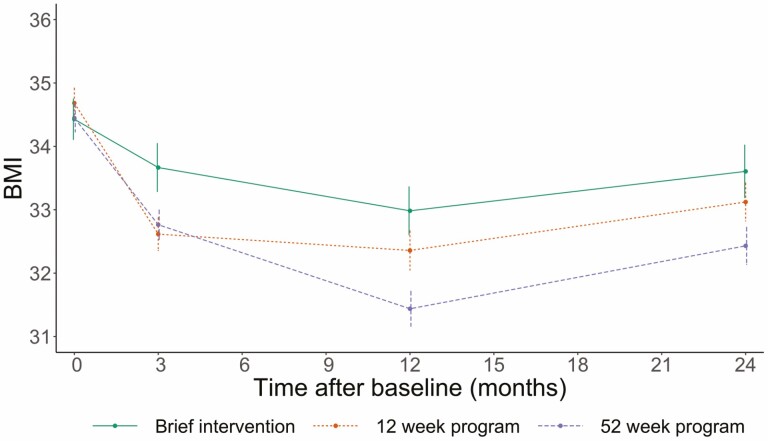
Latent growth curve analysis (LGCA) was conducted on trial data in which adults (N = 1,267) with a body mass index (BMI) ≥28 kg/m2 were randomized to either a brief intervention (booklet on losing weight), a 12 week weight-management program or the same program for 52 weeks. LGCA estimated the trajectory of the variables over four time points (baseline and 3, 12 and 24 months) to assess whether potential mechanisms of action mediated the impact of the weight-management program on BMI.
Participants randomized to the 12 and 52 week programs had a significantly greater decrease in BMI than the brief intervention. This direct effect became nonsignificant when dietary restraint, habit strength, and autonomous diet self-regulation were controlled for. The total indirect effect was significant for both the 12 (estimate = -1.33, standard error [SE] = 0.41, p = .001) and 52 week (estimate = -2.13, SE = 0.52, p < .001) program. Only the individual indirect effect for dietary restraint was significant for the 12 week intervention, whereas all three indirect effects were significant for the 52 week intervention.
Behavior change techniques that target dietary restraint, habit strength, and autonomous diet self-regulation should be considered when designing weight loss and weight loss maintenance interventions. Longer interventions may need to target both deliberative and automatic control processes to support successful weight management.
为了设计有效的干预措施,需要更深入地了解体重管理干预措施的作用机制。
探讨饮食克制、习惯强度或饮食自我调节是否在行为体重管理干预对体重减轻和体重维持的影响中起中介作用。
对一项试验数据进行潜在增长曲线分析(LGCA),该试验中,BMI≥28kg/m2的成年人(N=1267)被随机分配到简短干预(减肥手册)、12 周体重管理计划或相同计划 52 周。LGCA 在四个时间点(基线和 3、12 和 24 个月)上估计变量的轨迹,以评估潜在的作用机制是否在体重管理计划对 BMI 的影响中起中介作用。
与简短干预相比,随机分配到 12 周和 52 周计划的参与者 BMI 显著下降。当控制饮食克制、习惯强度和自主饮食自我调节时,这种直接效应变得不显著。对于 12 周(估计值=-1.33,标准误[SE]=0.41,p=0.001)和 52 周(估计值=-2.13,SE=0.52,p<.001)计划,总间接效应均显著。仅 12 周干预的饮食克制的个体间接效应显著,而 52 周干预的所有三个间接效应均显著。
在设计减肥和减肥维持干预措施时,应考虑针对饮食克制、习惯强度和自主饮食自我调节的行为改变技术。较长的干预措施可能需要同时针对深思熟虑和自动控制过程,以支持成功的体重管理。