Wang Zhicheng, Lin Leesa, Guo Yan, Xiong Huayi, Tang Kun
Vanke School of Public Health, Tsinghua University, Beijing, China.
School of Medicine, Tsinghua University, Beijing, China.
J Med Internet Res. 2021 Apr 20;23(4):e23311. doi: 10.2196/23311.
During the COVID-19 response, nonclinical essential workers usually worked overtime and experienced significant work stress, which subsequently increased their risk of mortality due to cardiovascular diseases, stroke, and pre-existing conditions. Deaths on duty, including deaths due to overwork, during the COVID-19 response were usually reported on web-based platforms for public recognition and solidarity. Although no official statistics are available for these casualties, a list of on-duty deaths has been made publicly available on the web by crowdsourcing.
This study aims to understand the trends and characteristics of deaths related to overwork among the frontline nonclinical essential workers participating in nonpharmaceutical interventions during the first wave of COVID-19 in China.
Based on a web-based crowdsourced list of deaths on duty during the first wave of the COVID-19 response in China, we manually verified all overwork-related death records against the full-text web reports from credible sources. After excluding deaths caused by COVID-19 infection and accidents, a total of 340 deaths related to overwork among nonclinical essential workers were attributed to combatting the COVID-19 crisis. We coded the key characteristics of the deceased workers, including sex, age at death, location, causes of death, date of incidence, date of death, containment duties, working area, and occupation. The temporal and spatial correlations between deaths from overwork and COVID-19 cases in China were also examined using Pearson correlation coefficient.
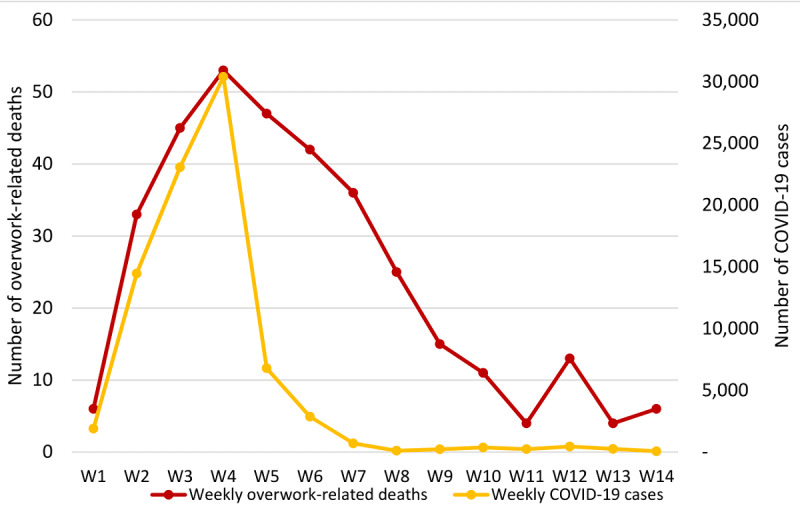
From January 20 to April 26, 2020, at least 340 nonclinical frontline workers in China were reported to have died as a result of overwork while combatting COVID-19. The weekly overwork mortality was positively correlated with weekly COVID-19 cases (r=0.79, P<.001). Two-thirds of deceased workers (230/340, 67.6%) were under 55 years old, and two major causes of deaths related to overwork were cardiovascular diseases (138/340, 40.6%) and cerebrovascular diseases (73/340, 21.5%). Outside of Hubei province, there were almost 2.5 times as many deaths caused by COVID-19-related overwork (308/340, 90.6%) than by COVID-19 itself (n=120).
The high number of deaths related to overwork among nonclinical essential workers at the frontline of the COVID-19 epidemic is alarming. Policies for occupational health protection against work hazards should therefore be prioritized and enforced.
在应对新冠疫情期间,非临床一线工作者通常加班加点,承受着巨大的工作压力,这进而增加了他们因心血管疾病、中风及原有疾病而死亡的风险。在新冠疫情应对期间,包括过劳死在内的因公死亡事件通常会在网络平台上报道,以获得公众的认可与支持。尽管尚无这些伤亡情况的官方统计数据,但通过众包方式在网上公布了一份因公死亡人员名单。
本研究旨在了解中国新冠疫情第一波期间参与非药物干预的一线非临床一线工作者中过劳死的趋势和特征。
基于中国新冠疫情第一波应对期间网上众包的因公死亡人员名单,我们对照可靠来源的全文网络报道,人工核实了所有与过劳相关的死亡记录。在排除因新冠感染和事故导致的死亡后,共有340例非临床一线工作者的过劳死归因于抗击新冠疫情。我们对已故工作者的关键特征进行了编码,包括性别、死亡年龄、地点、死因、发病日期、死亡日期、防控职责、工作地区和职业。还使用Pearson相关系数检验了中国过劳死与新冠病例之间的时间和空间相关性。
2020年1月20日至4月日26日,据报道中国至少有340名非临床一线工作者在抗击新冠疫情期间因过劳死亡。每周过劳死亡率与每周新冠病例数呈正相关(r=0.79,P<0.001)。三分之二的已故工作者(230/340,67.6%)年龄在55岁以下,过劳相关的两大主要死因是心血管疾病(138/340,40.6%)和脑血管疾病(73/340,21.5%)。在湖北省以外,与新冠相关的过劳死亡人数(308/340,90.6%)几乎是新冠本身导致死亡人数(n=120)的2.5倍。
新冠疫情一线非临床一线工作者中过劳死人数众多,令人担忧。因此,应优先制定并实施针对职业健康危害的防护政策。