Health Service and Population Research Department, Institute of Psychiatry, Psychology and Neuroscience, King's College London, London, United Kingdom.
Centre for Implementation Science, Institute of Psychiatry, Psychology and Neuroscience, King's College London, London, United Kingdom.
PLoS One. 2021 Apr 6;16(4):e0248844. doi: 10.1371/journal.pone.0248844. eCollection 2021.
In this study we aimed to 1) describe healthy ageing trajectory patterns, 2) examine the association between multimorbidity and patterns of healthy ageing trajectories, and 3) evaluate how different groups of diseases might affect the projection of healthy ageing trajectories over time.
Our study was based on 130880 individuals from the Ageing Trajectories of Health: Longitudinal Opportunities and Synergies (ATHLOS) harmonised dataset, as well as 9171 individuals from Waves 2-7 of the English Longitudinal Study of Ageing (ELSA).
Using a healthy ageing index score, which comprised 41 items, covering various domains of health and ageing, as outcome, we employed the growth mixture model approach to identify the latent classes of individuals with different healthy ageing trajectories. A multinomial logistic regression was conducted to assess if and how multimorbidity status and multimorbidity patterns were associated with changes in healthy ageing, controlled for sociodemographic and lifestyle risk factors.
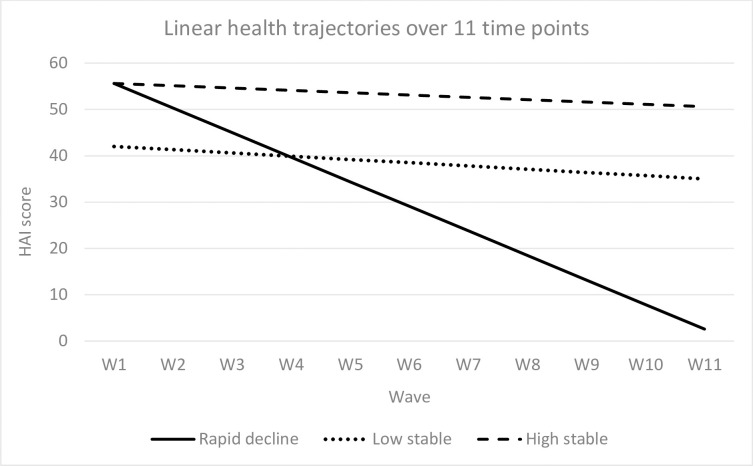
Three similar patterns of healthy ageing trajectories were identified in the ATHLOS and ELSA datasets: 1) a 'high stable' group (76% in ATHLOS, 61% in ELSA), 2) a 'low stable' group (22% in ATHLOS, 36% in ELSA) and 3) a 'rapid decline' group (2% in ATHLOS, 3% in ELSA). Those with multimorbidity were 1.7 times (OR = 1.7, 95% CI: 1.4-2.1) more likely to be in the 'rapid decline' group and 11.7 times (OR = 11.7 95% CI: 10.9-12.6) more likely to be in the 'low stable' group, compared with people without multimorbidity. The cardiorespiratory/arthritis/cataracts group was associated with both the 'rapid decline' and the 'low stable' groups (OR = 2.1, 95% CI: 1.2-3.8 and OR = 9.8, 95% CI: 7.5-12.7 respectively).
Healthy ageing is heterogeneous. While multimorbidity was associated with higher odds of having poorer healthy ageing trajectories, the extent to which healthy ageing trajectories were projected to decline depended on the specific patterns of multimorbidity.
本研究旨在:1)描述健康老龄化轨迹模式,2)研究多病共存与健康老龄化轨迹模式之间的关联,以及 3)评估不同疾病组如何影响健康老龄化轨迹随时间的演变。
我们的研究基于来自年龄轨迹健康:纵向机遇和协同作用(ATHLOS)的 130880 名个体的综合数据集,以及来自英国老龄化纵向研究(ELSA)第 2-7 波的 9171 名个体。
使用健康老龄化指数评分作为结果,该评分由 41 个项目组成,涵盖健康和老龄化的各个领域,我们采用增长混合模型方法来识别具有不同健康老龄化轨迹的个体的潜在类别。进行多变量逻辑回归以评估多病共存状态和多病共存模式是否与健康老龄化的变化相关,并控制社会人口统计学和生活方式风险因素。
在 ATHLOS 和 ELSA 数据集中识别出三种相似的健康老龄化轨迹模式:1)“高稳定”组(ATHLOS 中为 76%,ELSA 中为 61%),2)“低稳定”组(ATHLOS 中为 22%,ELSA 中为 36%)和 3)“快速下降”组(ATHLOS 中为 2%,ELSA 中为 3%)。多病共存者处于“快速下降”组的可能性是无多病共存者的 1.7 倍(比值比[OR] = 1.7,95%置信区间[CI]:1.4-2.1),处于“低稳定”组的可能性是无多病共存者的 11.7 倍(OR = 11.7,95% CI:10.9-12.6)。与心血管/关节炎/白内障组相关的是“快速下降”组和“低稳定”组(比值比[OR] = 2.1,95%置信区间[CI]:1.2-3.8 和 OR = 9.8,95% CI:7.5-12.7)。
健康老龄化是异质的。虽然多病共存与更差的健康老龄化轨迹的可能性增加有关,但健康老龄化轨迹预计下降的程度取决于多病共存的具体模式。