Department of Health Service and Population Research, King's College London, Institute of Psychiatry, Psychology and Neuroscience, London, UK.
Department of Infectious Disease Epidemiology, London School of Hygiene & Tropical Medicine, Faculty of Epidemiology and Population Health, London, UK.
Sci Rep. 2019 Jul 30;9(1):11041. doi: 10.1038/s41598-019-47238-w.
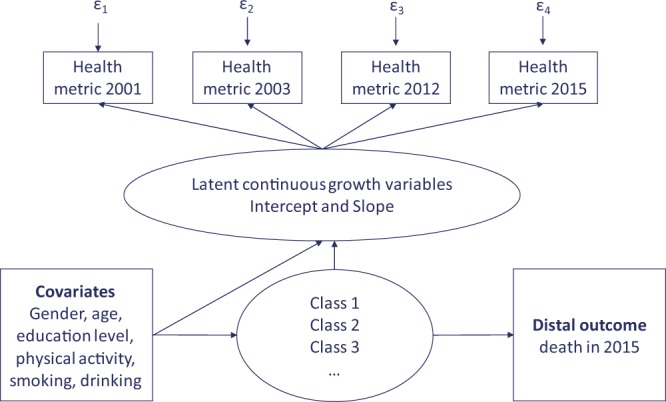
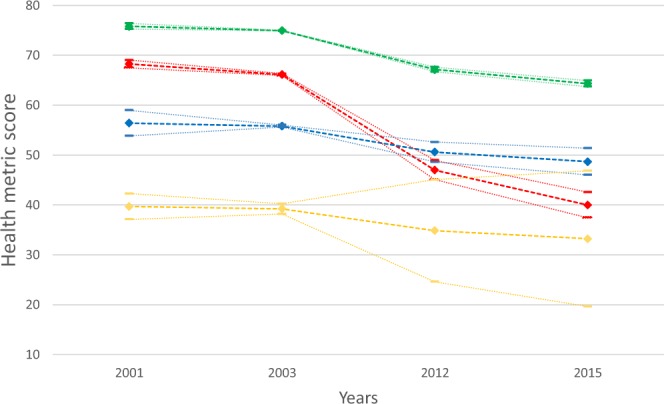
Projections show that the number of people above 60 years old will triple by 2050 in Mexico. Nevertheless, ageing is characterised by great variability in the health status. In this study, we aimed to identify trajectories of health and their associations with lifestyle factors in a national representative cohort study of older Mexicans. We used secondary data of 14,143 adults from the Mexican Health and Aging Study (MHAS). A metric of health, based on the conceptual framework of functional ability, was mapped onto four waves (2001, 2003, 2012, 2015) and created by applying Bayesian multilevel Item Response Theory (IRT). Conditional Growth Mixture Modelling (GMM) was used to identify latent classes of individuals with similar trajectories and examine the impact of physical activity, smoking and alcohol on those. Conditional on sociodemographic and lifestyle behaviour four latent classes were suggested: high-stable, moderate-stable, low-stable and decliners. Participants who did not engage in physical activity, were current or previous smokers and did not consume alcohol at baseline were more likely to be in the trajectory with the highest deterioration (i.e. decliners). This study confirms ageing heterogeneity and the positive influence of a healthy lifestyle. These results provide the ground for new policies.
预测显示,到 2050 年,墨西哥 60 岁以上人口数量将增至三倍。然而,老年人的健康状况存在很大的差异。在这项研究中,我们旨在通过对墨西哥全国有代表性的老年人群体进行的一项队列研究,确定健康轨迹及其与生活方式因素的关联。我们使用了墨西哥健康与老龄化研究(MHAS)的 14143 名成年人的二级数据。健康指标是基于功能能力的概念框架映射到四个波次(2001 年、2003 年、2012 年、2015 年),并通过应用贝叶斯多级项目反应理论(IRT)创建。条件增长混合模型(GMM)用于识别具有相似轨迹的个体的潜在类别,并检查身体活动、吸烟和饮酒对这些轨迹的影响。在考虑社会人口统计学和生活方式行为的情况下,提出了四个潜在类别:高稳定、中稳定、低稳定和下降。在基线时不进行身体活动、当前或曾经吸烟以及不饮酒的参与者更有可能处于恶化程度最高的轨迹(即下降者)。这项研究证实了老龄化的异质性和健康生活方式的积极影响。这些结果为新政策提供了依据。