Department of Cardio-Thoracic Surgery, Shanghai Tenth People's Hospital, Tongji University School of Medicine, Shanghai, China.
J Int Med Res. 2021 Apr;49(4):3000605211004512. doi: 10.1177/03000605211004512.
Acute aortic dissection (AAD) is a common life-threatening cardiovascular disease. This retrospective study was conducted to analyze the plasma concentration of S100A1 and its diagnostic value for AAD through receiver operating characteristic (ROC) curve and logistic regression analyses.
Seventy-eight patients with AAD and 77 healthy controls were included, and the relevant clinical data for each group were collected. According to the Stanford classification, the AAD patients were divided into types A and B. The plasma levels of S100A1, D-dimer, hypersensitive C-reactive protein, and cardiac troponin T were detected by enzyme-linked immunosorbent assays.
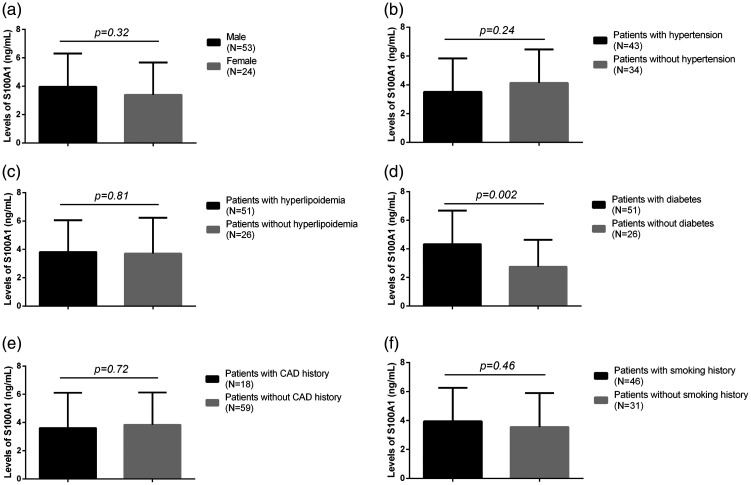
The S100A1 concentrations in the healthy control, Stanford A, and Stanford B groups were 0.7 ± 0.6, 4.9 ± 2.6, and 3.5 ± 2.2 ng/mL, respectively. The concentration of S100A1 was increased in patients with AAD complicated with aortic regurgitation, pericardial effusion, or in-hospital death. ROC curve analysis showed that the area under the curve was 0.89. Logistic regression analysis revealed that the S100A1 level was an important risk factor for the development of AAD.
Plasma S100A1 is significantly elevated in patients with AAD, and its concentration has potential clinical value for diagnosing AAD.
急性主动脉夹层(AAD)是一种常见的危及生命的心血管疾病。本回顾性研究旨在通过接收者操作特征(ROC)曲线和逻辑回归分析,分析 S100A1 血浆浓度及其对 AAD 的诊断价值。
纳入 78 例 AAD 患者和 77 名健康对照者,收集各组的相关临床资料。根据斯坦福分类,将 AAD 患者分为 A 型和 B 型。采用酶联免疫吸附试验检测 S100A1、D-二聚体、高敏 C 反应蛋白和心肌肌钙蛋白 T 的血浆水平。
健康对照组、Stanford A 组和 Stanford B 组的 S100A1 浓度分别为 0.7±0.6、4.9±2.6 和 3.5±2.2ng/ml。S100A1 在伴有主动脉瓣反流、心包积液或院内死亡的 AAD 患者中浓度升高。ROC 曲线分析显示,曲线下面积为 0.89。逻辑回归分析显示,S100A1 水平是 AAD 发生的重要危险因素。
AAD 患者 S100A1 血浆浓度显著升高,其浓度对 AAD 的诊断具有潜在的临床价值。