Johnson Kory D, Beiglböck Mathias, Eder Manuel, Grass Annemarie, Hermisson Joachim, Pammer Gudmund, Polechová Jitka, Toneian Daniel, Wölfl Benjamin
Vienna University of Economics and Business, Welthandelsplatz 1, Vienna, 1020, Austria.
University of Vienna, Oskar-Morgenstern-Platz 1, Vienna, 1090, Austria.
Infect Dis Model. 2021;6:706-728. doi: 10.1016/j.idm.2021.03.006. Epub 2021 Apr 2.
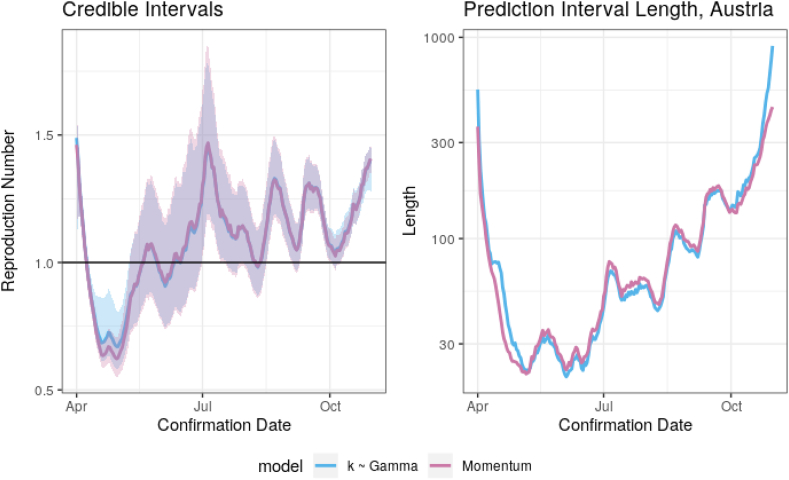
A primary quantity of interest in the study of infectious diseases is the average number of new infections that an infected person produces. This so-called reproduction number has significant implications for the disease progression. There has been increasing literature suggesting that superspreading, the significant variability in number of new infections caused by individuals, plays an important role in the spread of SARS-CoV-2. In this paper, we consider the effect that such superspreading has on the estimation of the reproduction number and subsequent estimates of future cases. Accordingly, we employ a simple extension to models currently used in the literature to estimate the reproduction number and present a case-study of the progression of COVID-19 in Austria. Our models demonstrate that the estimation uncertainty of the reproduction number increases with superspreading and that this improves the performance of prediction intervals. Of independent interest is the derivation of a transparent formula that connects the extent of superspreading to the width of credible intervals for the reproduction number. This serves as a valuable heuristic for understanding the uncertainty surrounding diseases with superspreading.
传染病研究中一个主要的关注量是感染者产生的新感染的平均数量。这个所谓的繁殖数对疾病进展具有重要意义。越来越多的文献表明,超级传播,即个体引起的新感染数量的显著变异性,在SARS-CoV-2的传播中起着重要作用。在本文中,我们考虑这种超级传播对繁殖数估计以及未来病例后续估计的影响。因此,我们对文献中目前用于估计繁殖数的模型进行了简单扩展,并给出了奥地利COVID-19进展的案例研究。我们的模型表明,繁殖数的估计不确定性随着超级传播而增加,并且这提高了预测区间的性能。一个独立有趣的方面是推导了一个透明公式,该公式将超级传播的程度与繁殖数可信区间的宽度联系起来。这对于理解具有超级传播的疾病周围的不确定性是一个有价值的启发式方法。