University of Ottawa, ON, Canada.
Canadian Partnership for Stroke Recovery, Ottawa, ON, Canada.
Neurorehabil Neural Repair. 2021 Jun;35(6):471-485. doi: 10.1177/15459683211005019. Epub 2021 Apr 7.
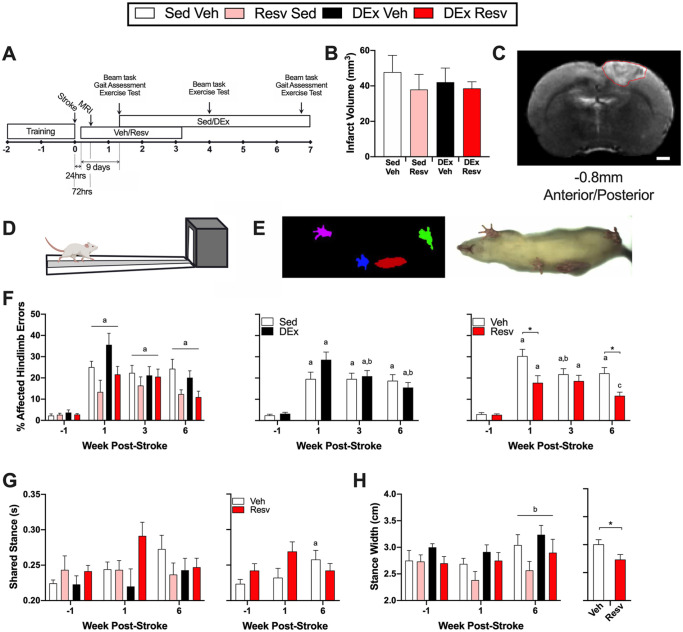
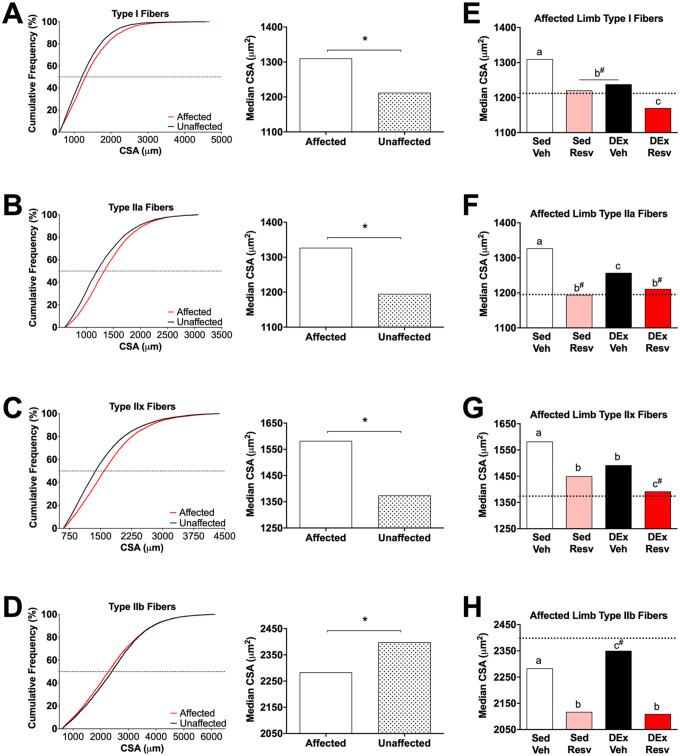
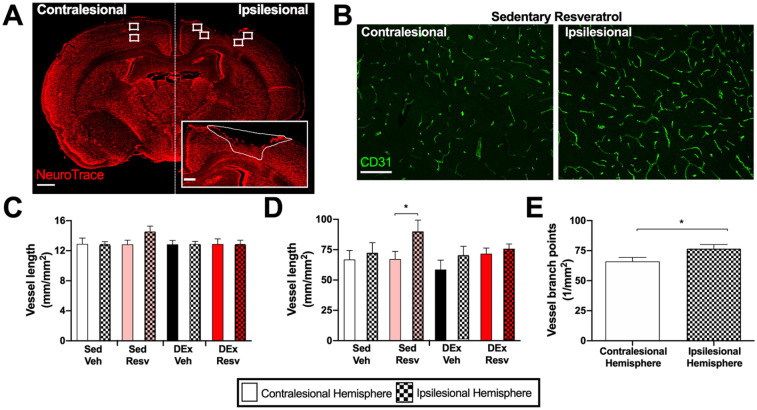
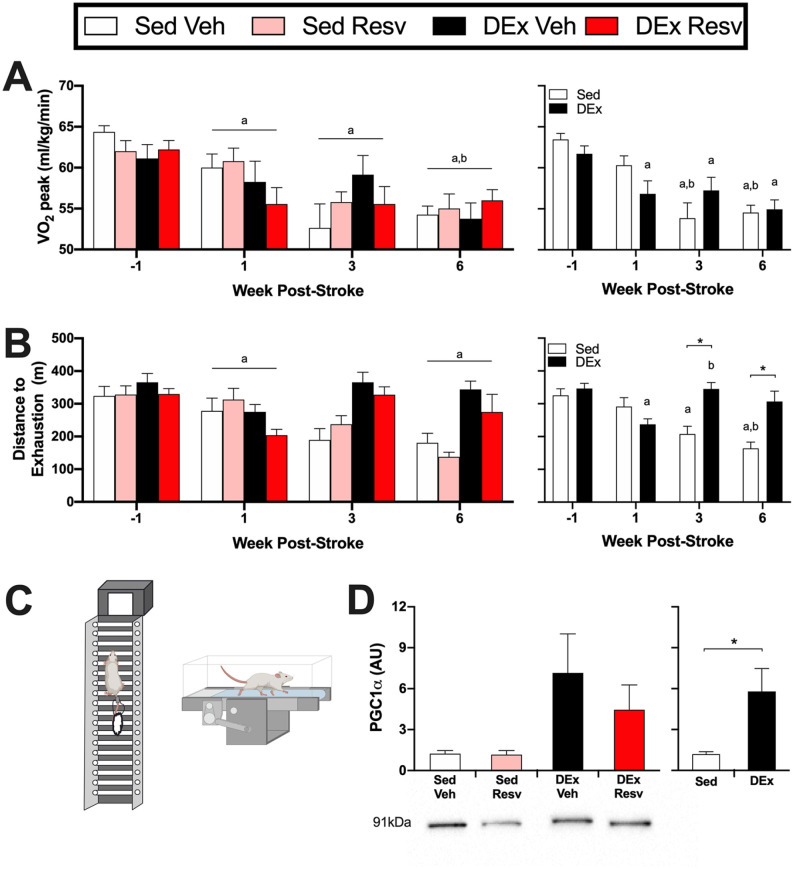
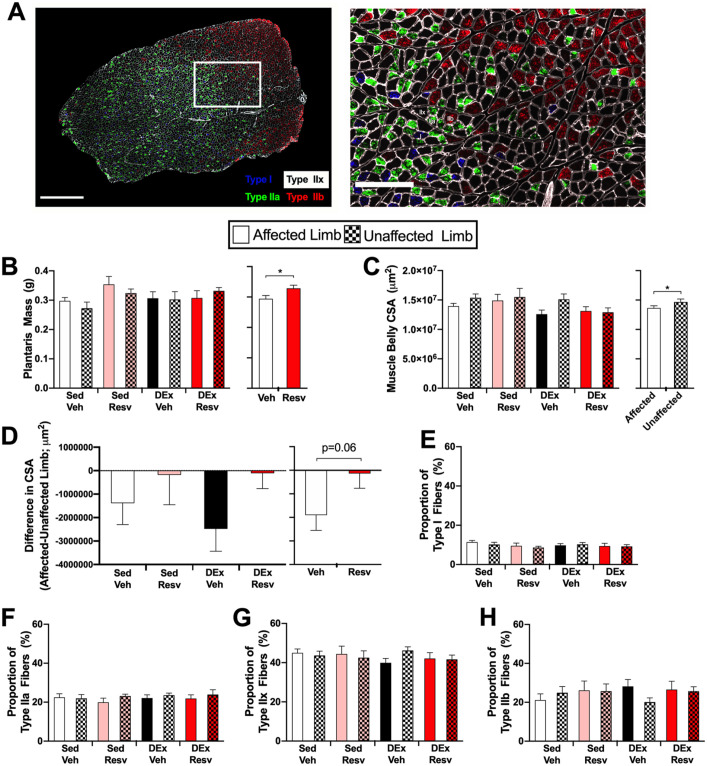
Evidence supports early rehabilitation after stroke to limit disability. However, stroke survivors are typically sedentary and experience significant cardiovascular and muscular deconditioning. Despite growing consensus that preclinical and clinical stroke recovery research should be aligned, there have been few attempts to incorporate cardiovascular and skeletal muscle deconditioning into animal models of stroke. Here, we demonstrate in rats that a hindlimb sensorimotor cortex stroke results in both cardiovascular and skeletal muscle deconditioning and impairments in gait akin to those observed in humans. To reduce poststroke behavioral, cardiovascular, and skeletal muscle perturbations, we then used a combinatorial intervention consisting of aerobic and resistance exercise in conjunction with administration of resveratrol (RESV), a drug with exercise mimetic properties. A combination of aerobic and resistance exercise mitigated decreases in cardiovascular fitness and attenuated skeletal muscle abnormalities. RESV, beginning 24 hours poststroke, reduced acute hindlimb impairments, improved recovery in hindlimb function, increased vascular density in the perilesional cortex, and attenuated skeletal muscle fiber changes. Early RESV treatment and aerobic and resistance exercise independently provided poststroke benefits, at a time when individuals are rapidly becoming deconditioned as a result of inactivity. Although no additive effects were observed in these experiments, this approach represents a promising strategy to reduce poststroke behavioral impairments and minimize deconditioning. As such, this treatment regime has potential for enabling patients to engage in more intensive rehabilitation at an earlier time following stroke when mechanisms of neuroplasticity are most prevalent.
证据支持中风后早期康复以限制残疾。然而,中风幸存者通常久坐不动,经历显著的心血管和肌肉功能下降。尽管越来越多的人认为临床前和临床中风恢复研究应该一致,但很少有人试图将心血管和骨骼肌功能下降纳入中风动物模型。在这里,我们在大鼠中证明,后肢感觉运动皮层中风会导致心血管和骨骼肌功能下降,以及类似于人类观察到的步态障碍。为了减少中风后的行为、心血管和骨骼肌紊乱,我们随后使用了一种组合干预措施,包括有氧运动和阻力运动,以及使用白藜芦醇(RESV),一种具有运动模拟特性的药物。有氧运动和阻力运动的结合减轻了心血管健康的下降,并减轻了骨骼肌异常。RESV 于中风后 24 小时开始使用,可减轻急性后肢损伤,改善后肢功能恢复,增加病灶周围皮层的血管密度,并减轻骨骼肌纤维变化。早期 RESV 治疗以及有氧运动和阻力运动独立地提供了中风后的益处,此时由于不活动,个体正迅速变得功能下降。尽管在这些实验中没有观察到附加效应,但这种方法代表了一种有前途的策略,可以减少中风后的行为障碍并最大限度地减少功能下降。因此,这种治疗方案有可能使患者在中风后神经可塑性机制最普遍的早期阶段,更积极地进行更密集的康复治疗。