The Ambulance Medical Service in Stockholm (AISAB), Lindetorpsvägen 11, SE-121 18 Johanneshov, Stockholm, Sweden.
Academic EMS, Stockholm, Sweden.
BMC Emerg Med. 2021 Apr 7;21(1):44. doi: 10.1186/s12873-021-00435-1.
When in need of emergency care and ambulance services, the ambulance nurse is often the first point of contact for the patient with healthcare. This role requires comprehensive knowledge of the ambulance nurse to be able to assign the right level of care and, if necessary, to provide self-care advice for patients with no further conveyance to hospital. Recently, an application was developed for transmitting real-time video to facilitate consultation between ambulance nurses and prehospital physicians in the role of regional medical support (RMS) for ambulance care. The use of video communication as a complement of medical support when referring to self-care is still an unexplored method in a prehospital setting. Our study aimed to elucidate ambulance nurses' experience of video consultation with RMS physician during the assessment of patients considered to be triaged to self-care.
We conducted a qualitative design study using semi-structured interviews with open questions. Twelve ambulance nurses were included in the study. To explore the ambulance nurses' experience of performing video consultation with RMS physician, in cases when a patient was assessed and triaged to self-care, a content analysis was performed.
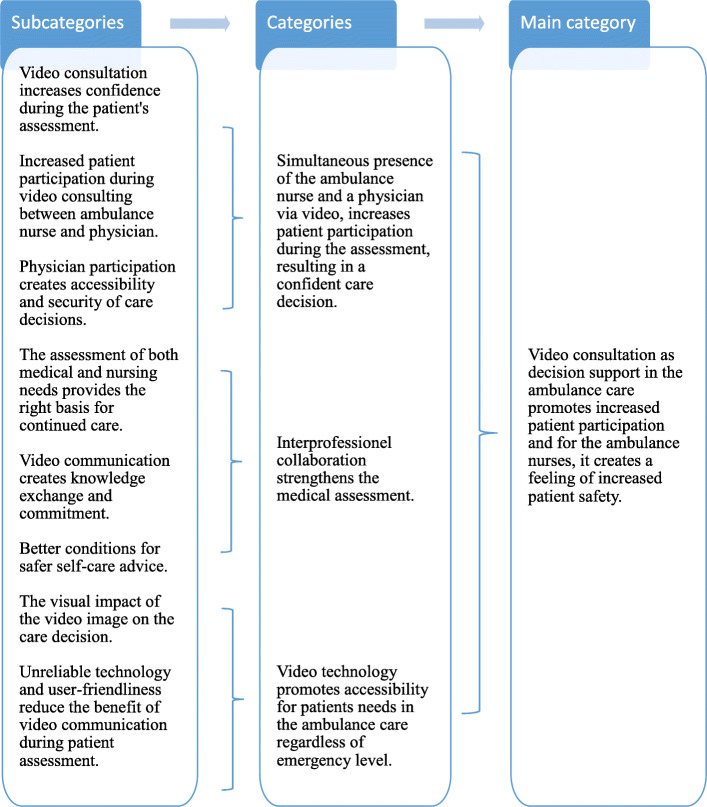
A main category emerged from the results: " Video consultation as decision support in the ambulance care promotes increased patient participation and for the ambulance nurses, it creates a feeling of increased patient safety ". The main category was based and formed on the following categories: " Simultaneous presence of ambulance nurse and a physician increases patient participation during the assessment resulting in a confident care decision ". "Interprofessional collaboration strengthens the medical assessment". "Video technology promotes accessibility for patients needs in the ambulance care regardless of emergency level".
Ambulance nurses experienced that the use of video consultation increases patient involvement and confidence in healthcare when both the ambulance nurse and the physician were present when deciding on self-care advice. The live imaging allowed the ambulance nurse and prehospital physician to reach a consensus on the patient's current medical care needs, which in turn led to a feeling of increased patient safety for the ambulance nurses.
当需要紧急护理和救护车服务时,救护车护士通常是患者与医疗保健的第一个联系点。这个角色需要救护车护士具备全面的知识,以便能够为患者分配适当的护理级别,如果需要,为没有进一步送往医院的患者提供自我护理建议。最近,开发了一种应用程序,用于实时传输视频,以促进救护车护士和现场医生之间的咨询,作为救护车护理的区域医疗支持 (RMS)。在院前环境中,将视频通信作为医疗支持的补充来提供自我护理建议仍然是一种未经探索的方法。我们的研究旨在阐明救护车护士在评估被认为分诊为自我护理的患者时与 RMS 医生进行视频咨询的经验。
我们使用半结构化访谈和开放式问题进行了定性设计研究。共纳入 12 名救护车护士。为了探讨救护车护士在对被评估和分诊为自我护理的患者进行视频咨询时的经验,我们对结果进行了内容分析。
结果产生了一个主要类别:“视频咨询作为救护车护理中的决策支持,促进了患者的参与度,并且让救护车护士感到患者的安全性增加”。主要类别是基于和形成于以下类别:“救护车护士和医生同时在场增加了评估过程中患者的参与度,从而做出自信的护理决策”。“ 跨专业合作加强了医疗评估”。“视频技术促进了患者在救护车护理中的需求的可及性,无论紧急程度如何”。
救护车护士的经验是,在决定自我护理建议时,当救护车护士和现场医生同时在场时,使用视频咨询可以增加患者对医疗保健的参与度和信心。实时成像使救护车护士和现场医生能够就患者当前的医疗护理需求达成共识,这反过来又让救护车护士感到患者的安全性增加。