Li Guangqin, Li Lingyu, Liu Dan, Qin Jiahong, Zhu Hongjun
College of International Trade and Economics, Anhui University of Finance and Economics, Bengbu, 233030, Anhui, People's Republic of China.
Institute of Finance and Economics Research, Shanghai University of Finance and Economics, Shanghai, 200433, People's Republic of China.
Sci Rep. 2021 Apr 7;11(1):7596. doi: 10.1038/s41598-021-87218-7.
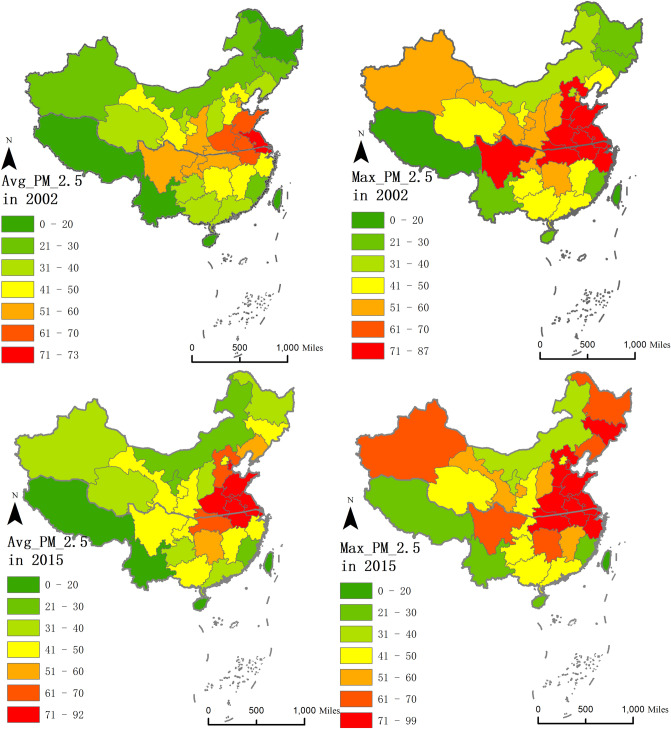
Using ArcGIS to analyze satellite derived PM estimates, this paper obtains the average concentration and maximum concentration of fine particulate matter (PM) in China's 31 provinces from 2002 to 2015. We adopt fixed effects model and spatial Durbin model to investigate the association between PM and perinatal mortality rates. The results indicate that PM has a significantly positive association with perinatal mortality rates. A 1% increase of log-transformed average concentration and maximum concentrations of PM is associated with 1.76‰ and 2.31‰ increase of perinatal mortality rates, respectively. In spatial econometrics analysis, we find PM has significant spatial autocorrelation characteristics. The concentrations of log-transformed average and maximum PM increase 1% is associated with a 2.49% increase in a 2.49‰ and 2.19‰ increase of perinatal mortality rates, respectively. The potential mechanism is that air pollution has an impact on infant weight to impact perinatal mortality rates.
利用ArcGIS分析卫星衍生的PM估计值,本文得出了2002年至2015年中国31个省份细颗粒物(PM)的平均浓度和最大浓度。我们采用固定效应模型和空间杜宾模型来研究PM与围产期死亡率之间的关联。结果表明,PM与围产期死亡率呈显著正相关。PM的对数转换平均浓度和最大浓度每增加1%,分别与围产期死亡率增加1.76‰和2.31‰相关。在空间计量经济学分析中,我们发现PM具有显著的空间自相关特征。对数转换后的平均PM浓度和最大PM浓度每增加1%,分别与围产期死亡率增加2.49‰和2.19‰以及增加2.49%相关。潜在机制是空气污染对婴儿体重产生影响,进而影响围产期死亡率。