Garzón-Martínez Gina A, García-Arias Francy L, Enciso-Rodríguez Felix E, Soto-Suárez Mauricio, González Carolina, Bombarely Aureliano, Barrero Luz Stella, Osorio Guarín Jaime A
Centro de Investigación Tibaitatá, Corporación Colombiana de Investigación Agropecuaria Agrosavia, Mosquera, Cundinamarca, Colombia.
Department of Bioscience, University of Milan, Milan, Lombardy, Italy.
PeerJ. 2021 Mar 22;9:e11135. doi: 10.7717/peerj.11135. eCollection 2021.
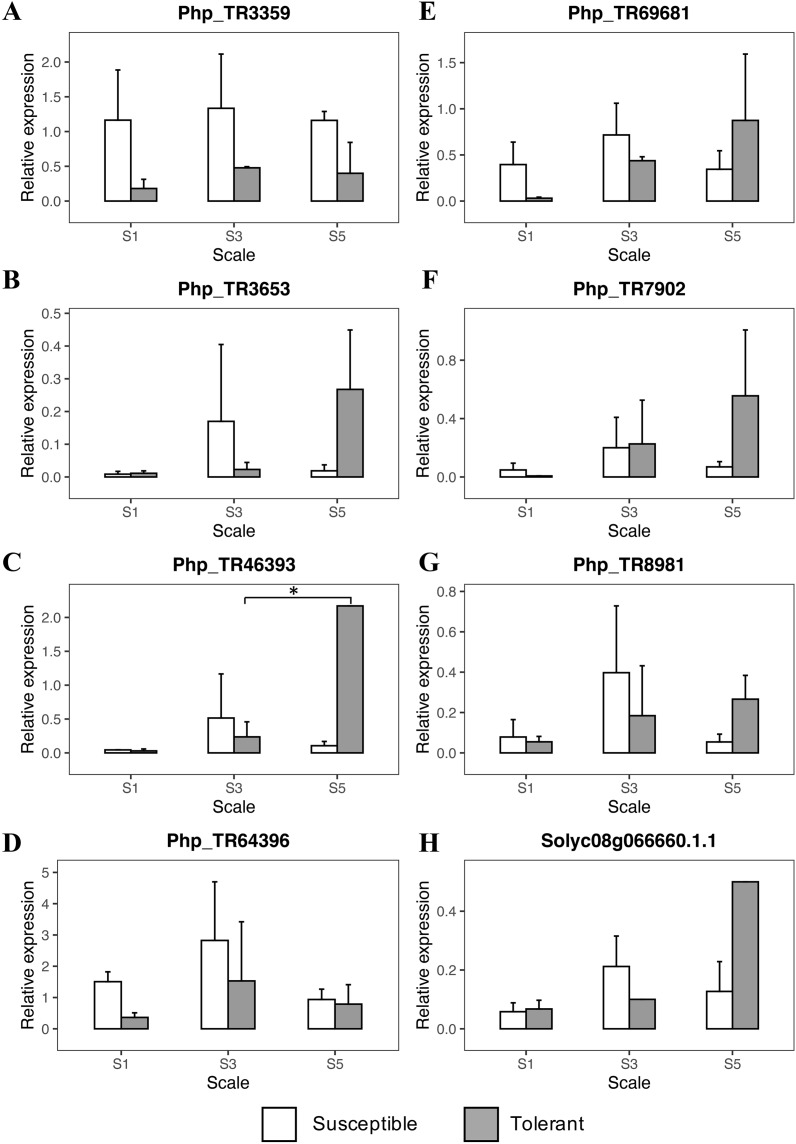
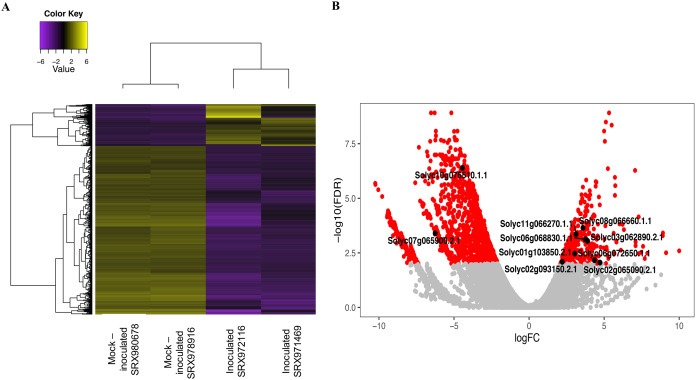
Vascular wilt, caused by the pathogen f. sp. (), is a major disease of cape gooseberry ( L.) in Andean countries. Despite the economic losses caused by this disease, there are few studies related to molecular mechanisms in the - pathosystem as a useful tool for crop improvement. This study evaluates eight candidate genes associated with this pathosystem, using real-time quantitative PCR (RT-qPCR). The genes were identified and selected from 1,653 differentially expressed genes (DEGs) derived from RNA-Seq analysis and from a previous genome-wide association study (GWAS) of this plant-pathogen interaction. Based on the RT-qPCR analysis, the tubuline () reference gene was selected for its highly stable expression in cape gooseberry. The RT-qPCR validation of the candidate genes revealed the biological variation in their expression according to their known biological function. Three genes related to the first line of resistance/defense responses were highly expressed earlier during infection in a susceptible genotype, while three others were overexpressed later, mostly in the tolerant genotype. These genes are mainly involved in signaling pathways after pathogen recognition, mediated by hormones such as ethylene and salicylic acid. This study provided the first insight to uncover the molecular mechanism from the - pathosystem. The genes validated here have important implications in the disease progress and allow a better understanding of the defense response in cape gooseberry at the molecular level. Derived molecular markers from these genes could facilitate the identification of tolerant/susceptible genotypes for use in breeding schemes.
由病原菌 f. sp. ()引起的维管束萎蔫病是安第斯国家灯笼果(酸浆属)的一种主要病害。尽管这种病害造成了经济损失,但关于该病原菌 - 寄主植物互作系统中分子机制作为作物改良有用工具的研究却很少。本研究使用实时定量PCR(RT-qPCR)评估了与该互作系统相关的八个候选基因。这些基因是从RNA测序分析得出的1653个差异表达基因(DEG)以及先前关于这种植物 - 病原菌互作的全基因组关联研究(GWAS)中鉴定和筛选出来的。基于RT-qPCR分析,选择了微管蛋白()参考基因,因为它在灯笼果中具有高度稳定的表达。候选基因的RT-qPCR验证揭示了它们根据已知生物学功能在表达上的生物学差异。与第一道抗性/防御反应相关的三个基因在感病基因型感染早期高表达,而另外三个基因在后期过度表达,主要是在耐病基因型中。这些基因主要参与病原菌识别后的信号传导途径,由乙烯和水杨酸等激素介导。本研究首次深入探究了该病原菌 - 寄主植物互作系统的分子机制。这里验证的基因对病害进展具有重要意义,并有助于在分子水平上更好地理解灯笼果的防御反应。从这些基因衍生的分子标记可以促进耐病/感病基因型的鉴定,用于育种计划。