Castaño Oscar, López-Mengual Ana, Reginensi Diego, Matamoros-Angles Andreu, Engel Elisabeth, Del Rio José Antonio
Electronics and Biomedical Engineering, Universitat de Barcelona, Barcelona, Spain.
Biomaterials for Regenerative Therapies, Institute of Bioengineering of Catalonia, Parc Cientific de Barcelona, Barcelona, Spain.
Front Bioeng Biotechnol. 2021 Mar 22;9:627805. doi: 10.3389/fbioe.2021.627805. eCollection 2021.
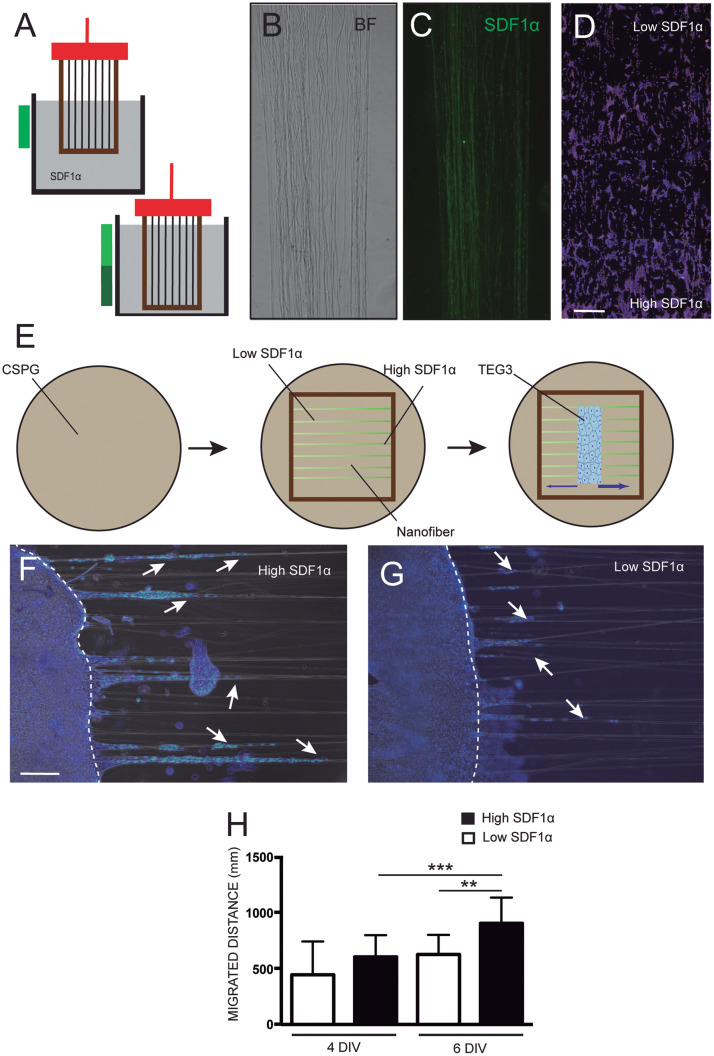
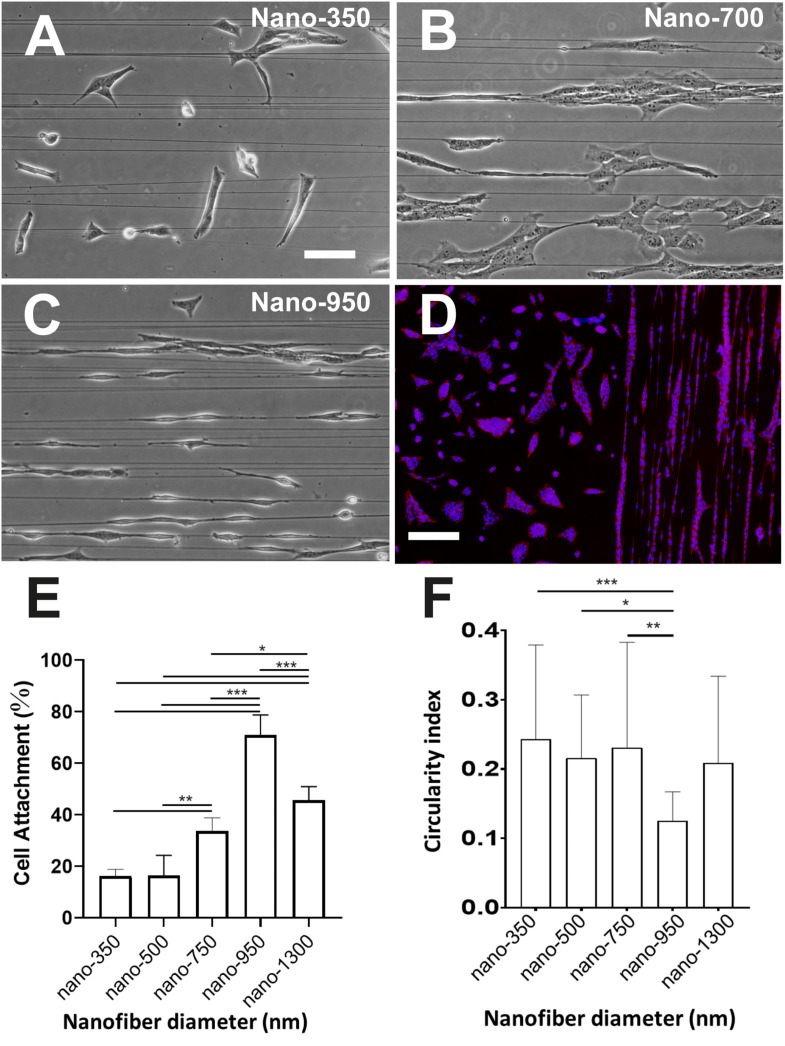
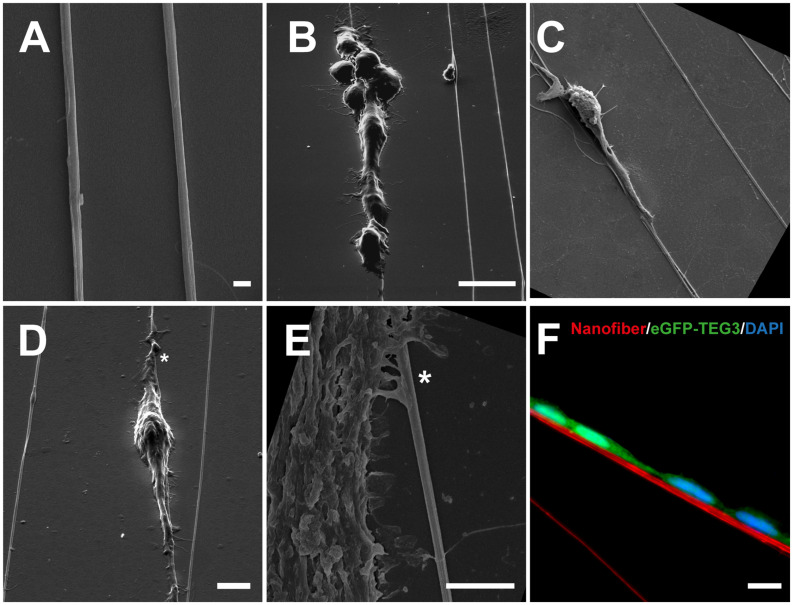
(Following spinal cord injury, olfactory ensheathing cell (OEC) transplantation is a promising therapeutic approach in promoting functional improvement. Some studies report that the migratory properties of OECs are compromised by inhibitory molecules and potentiated by chemical concentration differences. Here we compare the attachment, morphology, and directionality of an OEC-derived cell line, TEG3 cells, seeded on functionalized nanoscale meshes of Poly(l/dl-lactic acid; PLA) nanofibers. The size of the nanofibers has a strong effect on TEG3 cell adhesion and migration, with the PLA nanofibers having a 950 nm diameter being the ones that show the best results. TEG3 cells are capable of adopting a bipolar morphology on 950 nm fiber surfaces, as well as a highly dynamic behavior in migratory terms. Finally, we observe that functionalized nanofibers, with a chemical concentration increment of SDF-1α/CXCL12, strongly enhance the migratory characteristics of TEG3 cells over inhibitory substrates.
脊髓损伤后,嗅鞘细胞(OEC)移植是促进功能改善的一种有前景的治疗方法。一些研究报告称,OEC的迁移特性会受到抑制分子的影响,并因化学浓度差异而增强。在此,我们比较了接种在聚(l/dl-乳酸;PLA)纳米纤维功能化纳米级网格上的OEC衍生细胞系TEG3细胞的附着、形态和方向性。纳米纤维的尺寸对TEG3细胞的黏附和迁移有很大影响,直径为950 nm的PLA纳米纤维显示出最佳效果。TEG3细胞能够在950 nm纤维表面呈现双极形态,并且在迁移方面具有高度动态行为。最后,我们观察到,随着趋化因子-1α/基质细胞衍生因子12(SDF-1α/CXCL12)化学浓度的增加,功能化纳米纤维在抑制性底物上能显著增强TEG3细胞的迁移特性。