Department of Agro-Food Science and Technology, Centre of Foodomics, University of Bologna, Cesena, Italy.
Family Advisory Health Centres, Ravenna, Italy.
PLoS One. 2021 Apr 8;16(4):e0249925. doi: 10.1371/journal.pone.0249925. eCollection 2021.
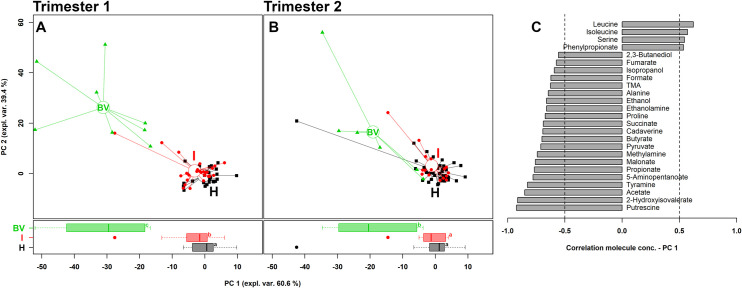
During pregnancy, the vaginal microbiome plays an important role in both maternal and neonatal health outcomes. Throughout pregnancy, the vaginal microbial composition undergoes significant changes, including a decrease in overall diversity and enrichment with Lactobacillus spp. In turn, the modifications in the microbial profiles are associated with shifts in the composition of vaginal metabolites. In this study, we characterized the vaginal metabolic profiles throughout pregnancy at two different gestational ages, correlating them with a microscopic evaluation of the vaginal bacterial composition. A total of 67 Caucasian pregnant women presenting to the Family Advisory Health Centres of Ravenna (Italy) were enrolled and a vaginal swab was collected at gestational ages 9-13 weeks (first trimester) and 20-24 weeks (second trimester). The composition of the vaginal microbiome was assessed by Nugent score and women were divided in 'H' (normal lactobacilli-dominated microbiota), 'I' (intermediate microbiota), and 'BV' (bacterial vaginosis) groups. Starting from the cell-free supernatants of the vaginal swabs, a metabolomic analysis was performed by means of a 1H-NMR spectroscopy. From the first to the second trimester, a greater number of women showed a normal lactobacilli-dominated microbiota, with a reduction of cases of dysbiosis. These microbial shifts were associated with profound changes in the vaginal metabolic profiles. Over the weeks, a significant reduction in the levels of BV-associated metabolites (e.g. acetate, propionate, tyramine, methylamine, putrescine) was observed. At the same time, the vaginal metabolome was characterized by higher concentrations of lactate and of several amino acids (e.g. tryptophan, threonine, isoleucine, leucine), typically found in healthy vaginal conditions. Over time, the vaginal metabolome became less diverse and more homogeneous: in the second trimester, women with BV showed metabolic profiles more similar to the healthy/intermediate groups, compared to the first trimester. Our data could help unravel the role of vaginal metabolites in the pathophysiology of pregnancy.
在妊娠期间,阴道微生物组在母婴健康结局中起着重要作用。在整个妊娠期间,阴道微生物组成发生了显著变化,包括总体多样性降低和乳酸杆菌属的富集。反过来,微生物谱的改变与阴道代谢物组成的变化有关。在这项研究中,我们在两个不同的妊娠周龄(9-13 周(孕早期)和 20-24 周(孕中期))对整个孕期的阴道代谢谱进行了描述,并将其与阴道细菌组成的显微镜评估相关联。共招募了 67 名就诊于意大利拉文纳家庭咨询健康中心的白种人孕妇,并在妊娠 9-13 周(孕早期)和 20-24 周(孕中期)时采集阴道拭子。阴道微生物组的组成通过 Nugent 评分进行评估,将女性分为“H”(正常乳杆菌为主的微生物群)、“I”(中间微生物群)和“BV”(细菌性阴道病)组。从阴道拭子的无细胞上清液开始,通过 1H-NMR 光谱进行代谢组学分析。从孕早期到孕中期,更多的女性表现出正常的乳杆菌为主的微生物群,菌群失调的病例减少。这些微生物的变化与阴道代谢谱的深刻变化有关。随着时间的推移,与 BV 相关的代谢物(例如乙酸盐、丙酸盐、酪胺、甲胺、腐胺)的水平显著降低。与此同时,阴道代谢组学的特征是乳酸和几种氨基酸(例如色氨酸、苏氨酸、异亮氨酸、亮氨酸)的浓度更高,这些通常存在于健康的阴道条件下。随着时间的推移,阴道代谢组变得不那么多样化,更加均匀:在孕中期,与健康/中间组相比,BV 患者的代谢谱更相似。我们的数据可以帮助揭示阴道代谢物在妊娠病理生理学中的作用。