Palacios-García Ismael, Silva Jaime, Villena-González Mario, Campos-Arteaga Germán, Artigas-Vergara Claudio, Luarte Nicolas, Rodríguez Eugenio, Bosman Conrado A
Laboratorio de Neurodinámica Básica y Aplicada, Escuela de Psicología, Pontificia Universidad Católica de Chile, Santiago, Chile.
Centro de Estudios en Neurociencia Humana y Neuropsicología, Facultad de Psicología, Universidad Diego Portales, Santiago, Chile.
Front Hum Neurosci. 2021 Mar 23;15:630813. doi: 10.3389/fnhum.2021.630813. eCollection 2021.
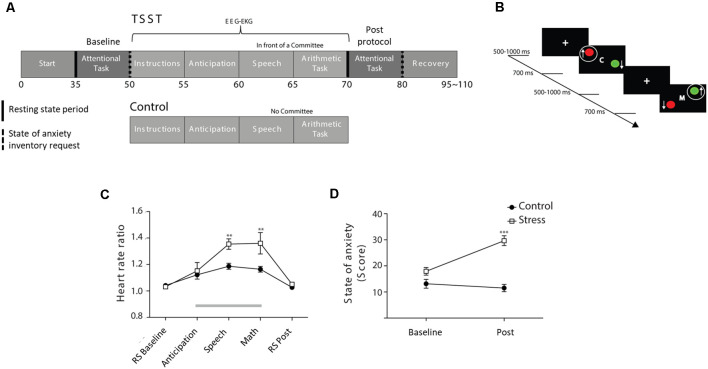
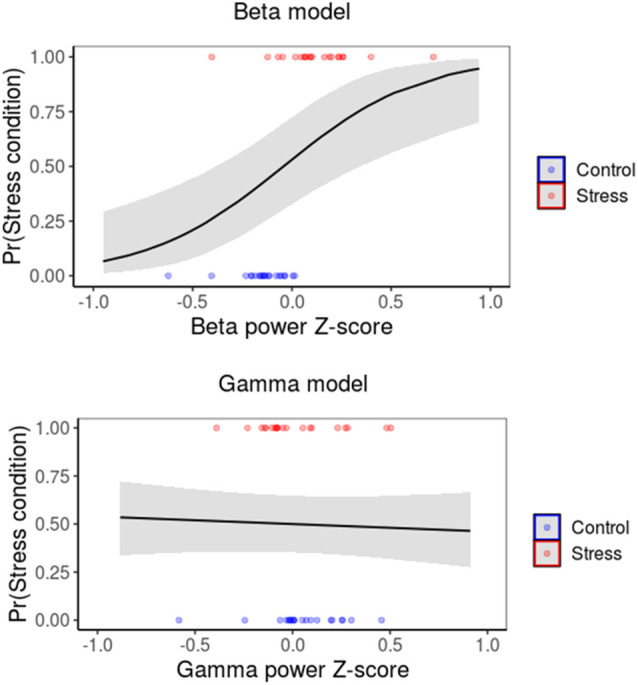
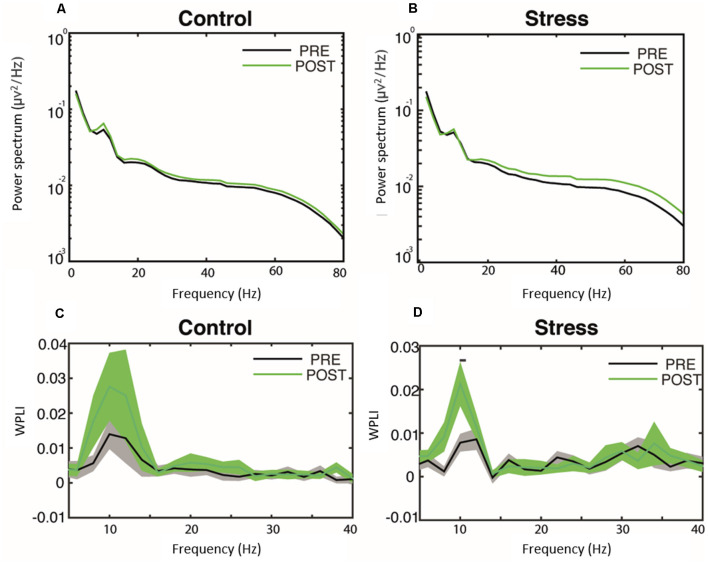
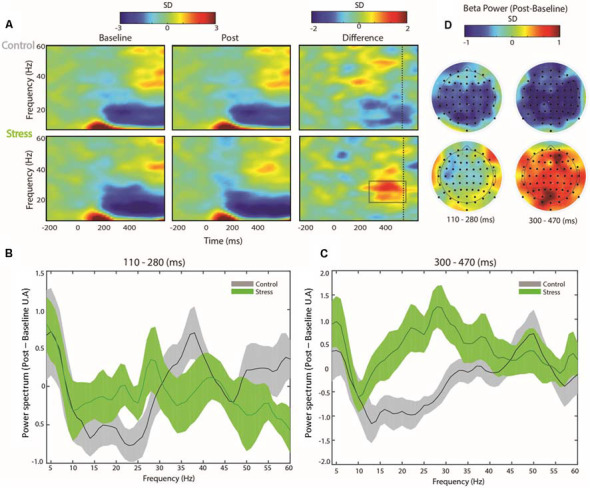
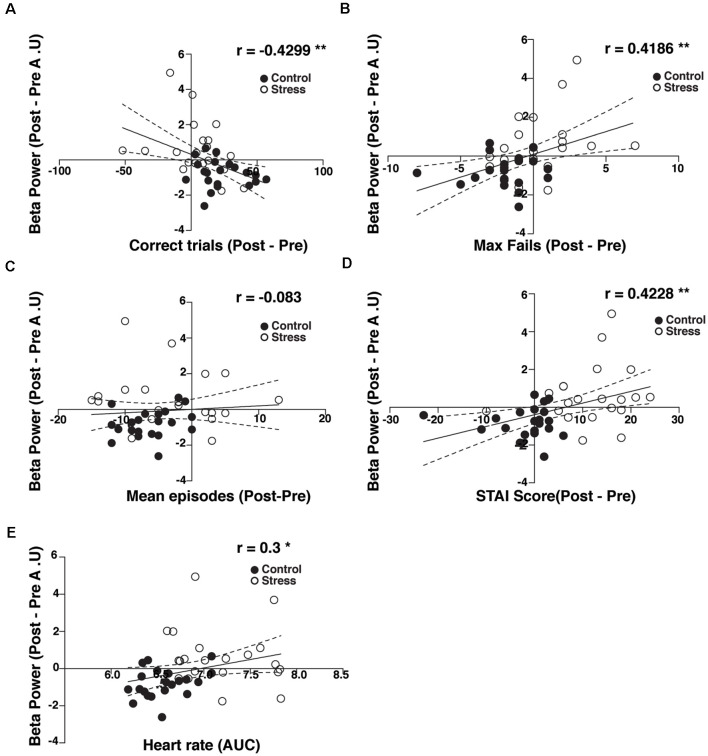
Selective attention depends on goal-directed and stimulus-driven modulatory factors, each relayed by different brain rhythms. Under certain circumstances, stress-related states can change the balance between goal-directed and stimulus-driven factors. However, the neuronal mechanisms underlying these changes remain unclear. In this study, we explored how psychosocial stress can modulate brain rhythms during an attentional task and a task-free period. We recorded the EEG and ECG activity of 42 healthy participants subjected to either the Trier Social Stress Test (TSST), a controlled procedure to induce stress, or a comparable control protocol (same physical and cognitive effort but without the stress component), flanked by an attentional task, a 90 s of task-free period and a state of anxiety questionnaire. We observed that psychosocial stress induced an increase in heart rate (HR), self-reported anxiety, and alpha power synchronization. Also, psychosocial stress evoked a relative beta power increase during correct trials of the attentional task, which correlates positively with anxiety and heart rate increase, and inversely with attentional accuracy. These results suggest that psychosocial stress affects performance by redirecting attentional resources toward internal threat-related thoughts. An increment of endogenous top-down modulation reflected an increased beta-band activity that may serve as a compensatory mechanism to redirect attentional resources toward the ongoing task. The data obtained here may contribute to designing new ways of clinical management of the human stress response in the future and could help to minimize the damaging effects of persistent stressful experiences.
选择性注意取决于目标导向和刺激驱动的调节因素,每种因素都由不同的脑节律传递。在某些情况下,与压力相关的状态会改变目标导向和刺激驱动因素之间的平衡。然而,这些变化背后的神经元机制仍不清楚。在本研究中,我们探讨了心理社会压力如何在注意力任务和无任务期间调节脑节律。我们记录了42名健康参与者的脑电图(EEG)和心电图(ECG)活动,这些参与者要么接受了特里尔社会压力测试(TSST)(一种诱导压力的对照程序),要么接受了类似的对照方案(相同的体力和认知努力,但没有压力成分),两侧分别是注意力任务、90秒的无任务期和一份焦虑状态问卷。我们观察到,心理社会压力导致心率(HR)增加、自我报告的焦虑增加以及α波功率同步增加。此外,心理社会压力在注意力任务的正确试验期间引起相对β波功率增加,这与焦虑和心率增加呈正相关,与注意力准确性呈负相关。这些结果表明,心理社会压力通过将注意力资源重新导向与内部威胁相关的想法来影响表现。内源性自上而下调节的增加反映了β波段活动的增加,这可能作为一种补偿机制,将注意力资源重新导向正在进行的任务。此处获得的数据可能有助于未来设计人类压力反应的新临床管理方法,并有助于将持续压力经历的破坏性影响降至最低。