Velotti Patrizia, Civilla Claudia, Rogier Guyonne, Beomonte Zobel Sara
Department of Dynamic and Clinical Psychology, Faculty of Medicine and Psychology, Sapienza University of Rome, Rome, Italy.
Front Psychiatry. 2021 Mar 23;12:590021. doi: 10.3389/fpsyt.2021.590021. eCollection 2021.
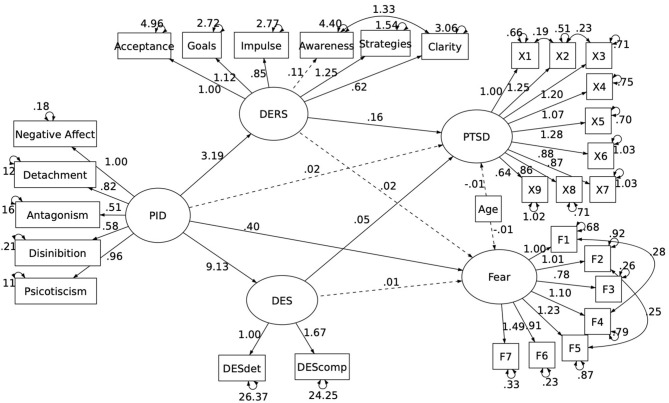
The 2019 coronavirus disease (COVID-19) outbreak is currently putting a strain on the mental health resilience of the world's population. Specifically, it is likely to elicit an intense response to fear and to act as a risk factor for the onset of posttraumatic stress disorder (PTSD). Some individuals may be more at risk than others, with pathological personality variables being a potential candidate as a central vulnerability factor. In addition, the pathways that lead the pathological personality to PTSD and intense fear responses to COVID-19 are likely to be explained by poor emotion regulation capacities, as well as by dissociative mechanisms. This study aimed to shed light on vulnerability factors that may account for the onset of PTSD and intense responses of fear in response to COVID-19 outbreak and to test the mediating role of emotion dysregulation and dissociation proneness in these pathways. We used a longitudinal design of research administered to a sample of community individuals ( = 308; mean = 35.31, SD = 13.91; 22.7% were male). Moreover, we used self-report questionnaires to measure pathological personality, emotion regulation capacities, dissociative proneness at the beginning of the lockdown, and PTSD symptoms and fear of COVID-19 at the end of the Italian lockdown (from March 9 to May 18, 2020). Structural equation modeling was used to test the hypotheses. We found that pathological personality levels longitudinally predicted PTSD and fear of COVID-19 levels. Moreover, the associations between emotion dysregulation and dissociation were shown to significantly and totally mediate the relationship between pathological personality and PTSD, whereas no significant mediation effects were observed in relation to fear of COVID-19. Individuals with pathological personality traits may be more vulnerable to the onset of negative psychological consequences related to COVID-19 outbreak, such as PTSD symptomatology and fear levels. Emotion regulation capacities appear to be relevant targets of interventions for PTSD symptomatology. Future research should explore the mediating variables linking pathological personality to intense fear responses to COVID-19.
2019年冠状病毒病(COVID-19)疫情目前正给全球人口的心理健康恢复力带来压力。具体而言,它可能引发对恐惧的强烈反应,并成为创伤后应激障碍(PTSD)发病的风险因素。一些人可能比其他人面临更高的风险,病理人格变量可能是一个潜在的核心脆弱因素。此外,导致病理人格引发PTSD以及对COVID-19产生强烈恐惧反应的途径,可能可以用情绪调节能力差以及解离机制来解释。本研究旨在阐明可能导致PTSD发病以及对COVID-19疫情产生强烈恐惧反应的脆弱因素,并检验情绪失调和解离倾向在这些途径中的中介作用。我们对一组社区个体(n = 308;平均年龄 = 35.31岁,标准差 = 13.91;22.7%为男性)采用纵向研究设计。此外,我们使用自我报告问卷来测量封锁开始时的病理人格、情绪调节能力、解离倾向,以及意大利封锁结束时(2020年3月9日至5月18日)的PTSD症状和对COVID-19的恐惧。采用结构方程模型来检验假设。我们发现病理人格水平能纵向预测PTSD和对COVID-19的恐惧水平。此外,情绪失调与解离之间的关联被证明显著且完全中介了病理人格与PTSD之间的关系,而在对COVID-19的恐惧方面未观察到显著的中介效应。具有病理人格特质的个体可能更容易受到与COVID-19疫情相关的负面心理后果的影响,如PTSD症状和恐惧水平。情绪调节能力似乎是针对PTSD症状进行干预的相关目标。未来的研究应探索将病理人格与对COVID-19的强烈恐惧反应联系起来的中介变量。