Laboratory of Clinical Immunology and Microbiology, Translational Autoinflammatory Diseases Section (TADS), National Institute of Allergy and Infectious Diseases, National Institutes of Health, Bethesda, MD, United States.
Department of Pediatrics, University of Alberta, Edmonton, AB, Canada.
Front Immunol. 2021 Mar 22;12:636225. doi: 10.3389/fimmu.2021.636225. eCollection 2021.
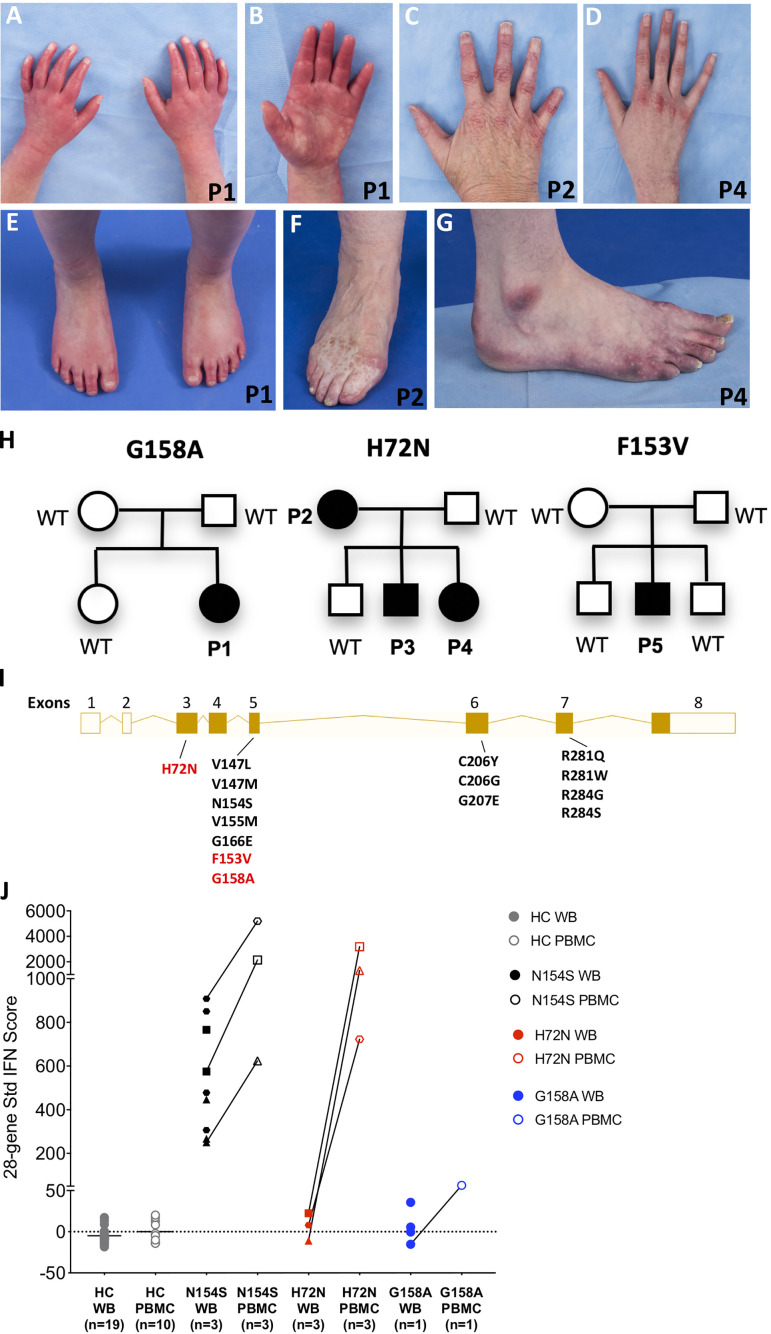
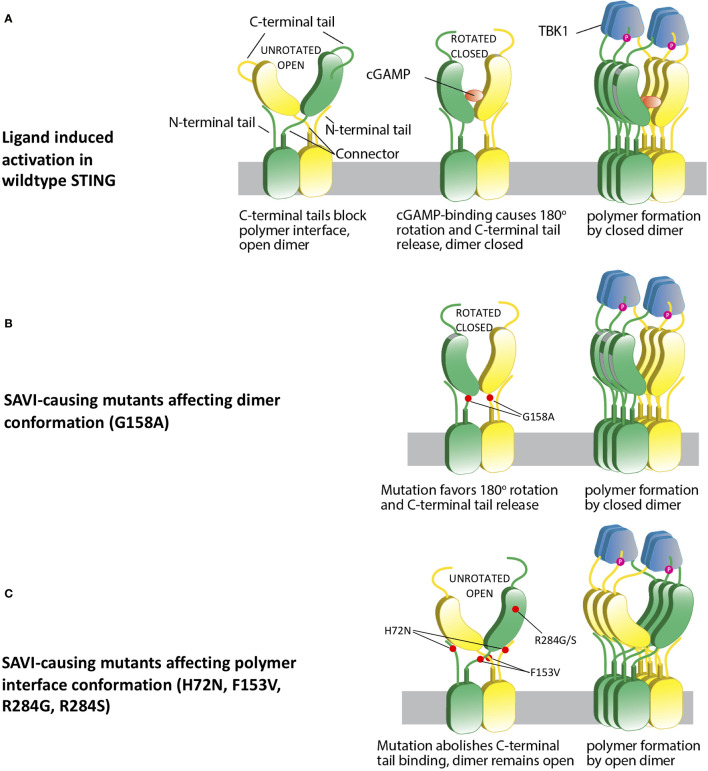
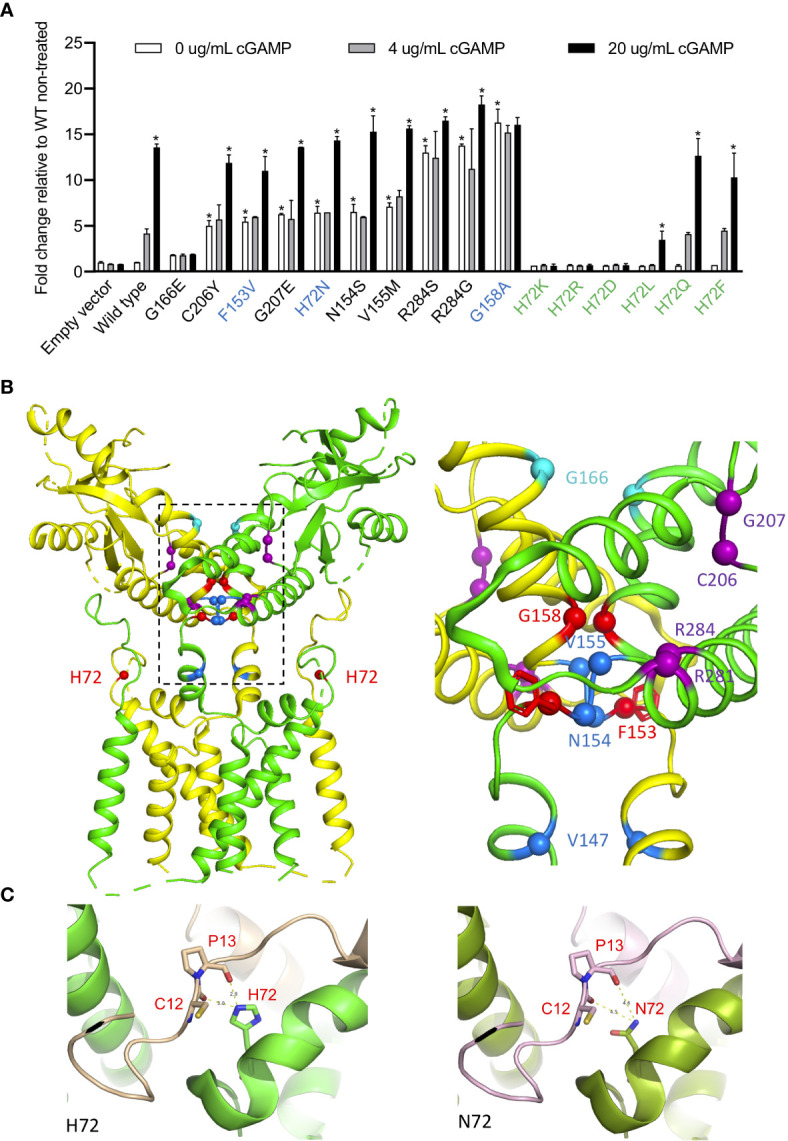
Gain-of-function mutations in cause the monogenic interferonopathy, SAVI, which presents with early-onset systemic inflammation, cold-induced vasculopathy and/or interstitial lung disease. We identified 5 patients (3 kindreds) with predominantly peripheral vascular disease who harbor 3 novel variants, p.H72N, p.F153V, and p.G158A. The latter two were predicted by a previous cryo-EM structure model to cause STING autoactivation. The p.H72N variant in exon 3, however, is the first SAVI-causing variant in the transmembrane linker region. Mutations of p.H72 into either charged residues or hydrophobic residues all led to dramatic loss of cGAMP response, while amino acid changes to residues with polar side chains were able to maintain the wild type status. Structural modeling of these novel mutations suggests a reconciled model of STING activation, which indicates that STING dimers can oligomerize in both open and closed states which would obliviate a high-energy 180° rotation of the ligand-binding head for STING activation, thus refining existing models of STING activation. Quantitative comparison showed that an overall lower autoactivating potential of the disease-causing mutations was associated with less severe lung disease, more severe peripheral vascular disease and the absence of a robust interferon signature in whole blood. Our findings are important in understanding genotype-phenotype correlation, designing targeted STING inhibitors and in dissecting differentially activated pathways downstream of different STING mutations.
导致单基因干扰素病 SAVI 的功能获得性突变,其特征为早发系统性炎症、冷诱导血管病和/或间质性肺病。我们鉴定了 5 名(3 个家系)主要表现为周围血管疾病的患者,他们携带 3 种新型 变异体,p.H72N、p.F153V 和 p.G158A。后两种变异体被先前的冷冻电镜结构模型预测会导致 STING 自身激活。然而,位于外显子 3 中的 p.H72N 变异体是引起 SAVI 的第一个跨膜连接区变异体。将 p.H72 突变为带电荷残基或疏水性残基都会导致 cGAMP 反应明显丧失,而将氨基酸变化为具有极性侧链的残基则能够保持野生型状态。这些新突变的结构建模表明,STING 激活的一种调和模型,这表明 STING 二聚体可以在开放和关闭状态下聚合,从而消除 STING 激活的配体结合头部的高能量 180°旋转,从而完善现有的 STING 激活模型。定量比较表明,致病突变的总体较低的自身激活潜力与较轻的肺部疾病、更严重的周围血管疾病以及全血中缺乏强大的干扰素特征相关。我们的发现对于理解基因型-表型相关性、设计靶向 STING 抑制剂以及剖析不同 STING 突变下游差异化激活途径具有重要意义。