Laureano-Eugenio Jorge, Gómez-Rodríguez Raúl Otoniel, Tasejo-Corzantes Jhunny, Silvestre Ramírez Augusto, Pretell Aguilar Rosa María, Alcalde-Rabanal Jacqueline Elizabeth
Secretaría de Salud de Jalisco Jalisco México Secretaría de Salud de Jalisco, Jalisco, México.
Ministerio de Salud y Asistencia Social Ciudad de Guatemala Guatemala Ministerio de Salud y Asistencia Social, Ciudad de Guatemala, Guatemala.
Rev Panam Salud Publica. 2021 Apr 6;45:e37. doi: 10.26633/RPSP.2021.37. eCollection 2021.
Evaluate the sustainability of the Healthy Municipalities strategy in Guatemala in order to have solid evidence to support decision-making.
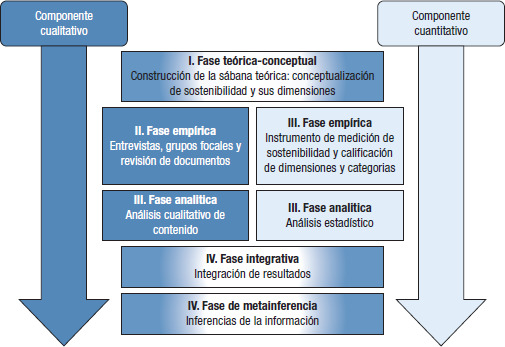
A concurrent mixed-methods study was carried out in five phases: 1) theoretical-conceptual (based on a narrative review of the literature on sustainability, dimensions and categories were proposed for evaluation); (2) empirical (four municipalities were selected for convenience and 29 semi-structured interviews and four focus groups were conducted with key actors to explore sustainability; with this information, a score was assigned to each category and dimension); (3) analytical, by category and dimension (content analysis was performed for qualitative information, and totals and averages were calculated for quantitative information); (4) integrative (qualitative data were integrated into matrices by category and dimension, and quantitative data were supported by qualitative information); and 5) meta-inference (consideration was given to the context and its influence on the results).
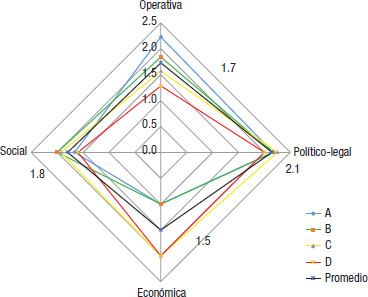
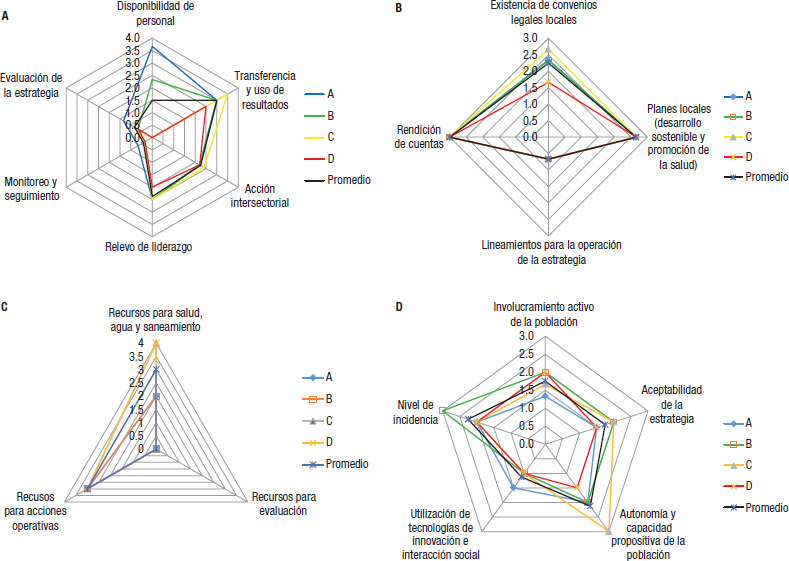
Ninety-two (92) informants participated. In operational terms, progress was observed in the transfer and use of results, and in rotations in leadership. In the legal and political sphere, accountability and local planning were highlighted. In the economic sphere, progressive investment in health, water and sanitation was emphasized, as well as insufficient investment in social determinants of health. In the social sphere, few mechanisms were observed to promote and strengthen social participation.
In the municipalities that participated in the study, a fair level of sustainability was observed in the Healthy Municipalities strategy.
评估危地马拉健康城市战略的可持续性,以便获得确凿证据支持决策。
开展了一项同步混合方法研究,分五个阶段进行:1)理论概念阶段(基于对可持续性文献的叙述性综述,提出用于评估的维度和类别);(2)实证阶段(方便起见选择了四个城市,与关键行为者进行了29次半结构化访谈和四次焦点小组讨论以探索可持续性;利用这些信息,为每个类别和维度赋予一个分数);(3)按类别和维度进行分析(对定性信息进行内容分析,对定量信息计算总数和平均值);(4)整合阶段(将定性数据按类别和维度整合到矩阵中,定量数据以定性信息为支撑);以及5)元推理阶段(考虑背景及其对结果的影响)。
92名 informant 参与。在操作层面,在结果的转移和使用以及领导层轮换方面观察到了进展。在法律和政治领域,突出了问责制和地方规划。在经济领域,强调了对健康、水和卫生设施的逐步投资,以及对健康社会决定因素的投资不足。在社会领域,观察到促进和加强社会参与的机制很少。
在参与研究的城市中,健康城市战略的可持续性水平尚可。