Chibuk Jason, Flory Andi, Kruglyak Kristina M, Leibman Nicole, Nahama Alexis, Dharajiya Nilesh, van den Boom Dirk, Jensen Taylor J, Friedman Jeffrey S, Shen M Richard, Clemente-Vicario Francisco, Chorny Ilya, Tynan John A, Lytle Katherine M, Holtvoigt Lauren E, Murtaza Muhammed, Diaz Luis A, Tsui Dana W Y, Grosu Daniel S
PetDx, La Jolla, CA, United States.
The Cancer Institute, Animal Medical Center, New York, NY, United States.
Front Vet Sci. 2021 Mar 23;8:664718. doi: 10.3389/fvets.2021.664718. eCollection 2021.
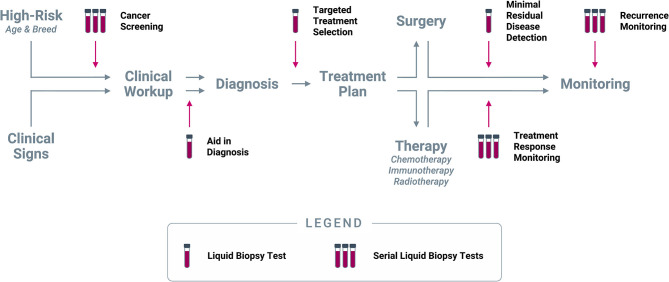
Cancer is the leading cause of death in dogs, in part because many cases are identified at an advanced stage when clinical signs have developed, and prognosis is poor. Increased understanding of cancer as a disease of the genome has led to the introduction of liquid biopsy testing, allowing for detection of genomic alterations in cell-free DNA fragments in blood to facilitate earlier detection, characterization, and management of cancer through non-invasive means. Recent discoveries in the areas of genomics and oncology have provided a deeper understanding of the molecular origins and evolution of cancer, and of the "one health" similarities between humans and dogs that underlie the field of comparative oncology. These discoveries, combined with technological advances in DNA profiling, are shifting the paradigm for cancer diagnosis toward earlier detection with the goal of improving outcomes. Liquid biopsy testing has already revolutionized the way cancer is managed in human medicine - and it is poised to make a similar impact in veterinary medicine. Multiple clinical use cases for liquid biopsy are emerging, including screening, aid in diagnosis, targeted treatment selection, treatment response monitoring, minimal residual disease detection, and recurrence monitoring. This review article highlights key scientific advances in genomics and their relevance for veterinary oncology, with the goal of providing a foundational introduction to this important topic for veterinarians. As these technologies migrate from human medicine into veterinary medicine, improved awareness and understanding will facilitate their rapid adoption, for the benefit of veterinary patients.
癌症是犬类的主要死因,部分原因是许多病例在临床症状出现的晚期才被确诊,预后较差。对癌症作为一种基因组疾病的认识不断加深,促使了液体活检检测的引入,这种检测能够检测血液中游离DNA片段的基因组改变,从而通过非侵入性手段促进癌症的早期检测、特征分析和管理。基因组学和肿瘤学领域的最新发现,让人们对癌症的分子起源和演变,以及人类与犬类之间构成比较肿瘤学领域基础的“同一健康”相似性有了更深入的理解。这些发现,再加上DNA分析技术的进步,正在将癌症诊断的范式转向早期检测,以改善治疗结果。液体活检检测已经彻底改变了人类医学中癌症的管理方式——它也有望在兽医学中产生类似的影响。液体活检的多种临床应用案例正在出现,包括辅助诊断、靶向治疗选择、治疗反应监测、微小残留病检测和复发监测。这篇综述文章重点介绍了基因组学的关键科学进展及其与兽医肿瘤学的相关性,目的是为兽医提供关于这个重要主题的基础介绍。随着这些技术从人类医学向兽医学转移,提高认识和理解将有助于它们的迅速应用,从而造福兽医患者。