Department of Agronomy, MNS University of Agriculture Multan, Multan, Punjab, Pakistan.
Crop Science Group, Institute of Crop Science and Resource Conservation (INRES), University of Bonn, Bonn, Germany.
Environ Sci Pollut Res Int. 2021 Aug;28(32):43528-43543. doi: 10.1007/s11356-021-13700-4. Epub 2021 Apr 9.
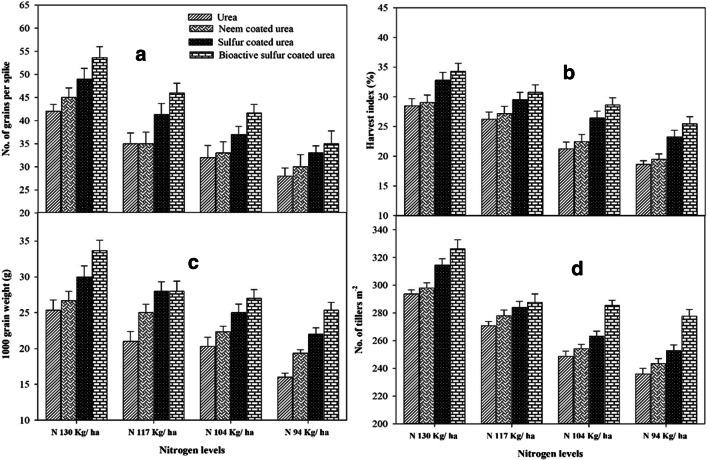
Higher demands of food led to higher nitrogen application to promote cropping intensification and produce more which may have negative effects on the environment and lead to pollution. While sustainable wheat production is under threat due to low soil fertility and organic matter due to nutrient degradation at high temperatures in the region. The current research explores the effects of different types of coated urea fertilizers and their rates on wheat crop under arid climatic conditions of Pakistan. Enhancing nitrogen use efficiency by using eco-friendly coated urea products could benefit growers and reduce environmental negative effects. A trial treatment included N rates (130, 117, 104, and 94 kg ha) and coated urea sources (neem coated, sulfur coated, bioactive sulfur coated) applied with equal quantity following split application method at sowing, 20 and 60 days after sowing (DAS). The research was arranged in a split-plot design with randomized complete block design had three replicates. Data revealed that bioactive sulfur coated urea with the application of 130 kg N ha increased chlorophyll contents 55.0 (unit value), net leaf photosynthetic rate (12.51 μmol CO m s), and leaf area index (5.67) significantly. Furthermore, research elucidates that bioactive sulfur urea with the same N increased partial factor productivity (43.85 Kg grain Kg N supplied), nitrogen harvest index (NHI) 64.70%, and partial nutrient balance (1.41 Kg grain N content Kg N supplied). The neem-coated and sulfur-coated fertilizers also showed better results than monotypic urea. The wheat growth and phenology significantly improved by using coated fertilizers. The crop reached maturity earlier with the application of bioactive sulfur-coated urea than others. Maximum total dry matter 14402 (kg ha) recorded with 130 kg N haapplication. Higher 1000-grain weight (33.66 g), more number of grains per spike (53.67), grain yield (4457 kg ha), and harvest index (34.29%) were obtained with optimum N application 130 kg ha (recommended). There is a significant correlation observed for growth, yield, and physiological parameters with N in the soil while nitrogen-related indices are also positively correlated. The major problem of groundwater contamination with nitrate leaching is also reduced by using coated fertilizers. Minimum nitrate concentration (7.37 and 8.77 kg ha) was observed with the application of bioactive sulfur-coated and sulfur-coated urea with lower N (94 kg ha), respectively. The bioactive sulfur-coated urea with the application of 130 kg N ha showed maximum phosphorus 5.45 mg kg and potassium 100.67 mg kg in the soil. Maximum nitrogen uptake (88.20 kg ha) is showed by bioactive sulfur coated urea with 130 kg N ha application. The total available NPK concentrations in soil showed a significant correlation with physiological attributes; grain yield; harvest index; and nitrogen use efficiency components, i.e., partial factor productivity, partial nutrient balance, and nitrogen harvest index. This research reveals that coating urea with secondary nutrients, neem oil, and microbes are highly effective techniques for enhancing fertilizer use efficiency and wheat production in calcareous soils and reduced N losses under arid environments.
更高的食物需求导致更高的氮施用量,以促进作物集约化种植和生产更多的作物,这可能对环境产生负面影响,并导致污染。而由于该地区高温导致土壤肥力和有机质下降,可持续的小麦生产受到威胁。目前的研究探索了在巴基斯坦干旱气候条件下,不同类型包膜尿素肥料及其用量对小麦作物的影响。通过使用环保型包膜尿素产品提高氮素利用效率,可以使种植者受益,并减少环境的负面影响。一项试验处理包括氮施用量(130、117、104 和 94 千克/公顷)和包膜尿素来源(印楝油包膜、硫磺包膜、生物活性硫磺包膜),以等量的方式在播种时、播种后 20 天和 60 天(DAS)进行分次施用。研究采用裂区设计,随机完全区组设计有 3 个重复。结果表明,生物活性硫磺包膜尿素在施氮量为 130 千克/公顷时,叶绿素含量增加了 55.0(单位值),净叶光合速率(12.51 μmol CO m s)和叶面积指数(5.67)显著增加。此外,研究表明,生物活性硫磺包膜尿素在相同的氮用量下可以提高部分因子生产力(43.85 千克谷物/千克氮供应)、氮收获指数(NHI)64.70%和部分养分平衡(1.41 千克谷物氮含量/千克氮供应)。印楝油包膜和硫磺包膜肥料的效果也优于单一尿素。包膜肥料的使用显著改善了小麦的生长和物候期。与其他肥料相比,生物活性硫磺包膜尿素使作物更早成熟。在施氮量为 130 千克/公顷时,总干物质最高,为 14402(千克/公顷)。施氮量为 130 千克/公顷时,千粒重(33.66 克)、每穗粒数(53.67)、穗粒数(4457 千克/公顷)和收获指数(34.29%)最高。施氮量为 130 千克/公顷时,氮的推荐施用量为(130 千克/公顷)。在土壤中氮与生长、产量和生理参数之间存在显著相关性,与氮有关的指数也呈正相关。使用包膜肥料还可以减少地下水硝酸盐淋溶造成的污染问题。生物活性硫磺包膜尿素和硫磺包膜尿素的施氮量分别为 94 千克/公顷和 130 千克/公顷时,土壤中硝酸盐浓度最低,分别为 7.37 和 8.77 千克/公顷。生物活性硫磺包膜尿素在施氮量为 130 千克/公顷时,土壤中磷含量最高,为 5.45 毫克/千克,钾含量最高,为 100.67 毫克/千克。生物活性硫磺包膜尿素在施氮量为 130 千克/公顷时,氮素吸收量最高,为 88.20 千克/公顷。土壤中有效氮磷钾浓度与生理特性、籽粒产量、收获指数和氮素利用效率成分(部分因子生产力、部分养分平衡和氮素收获指数)均呈显著相关。本研究表明,在石灰性土壤中,包膜尿素与中微量元素、印楝油和微生物结合使用是提高肥料利用效率和小麦产量的有效技术,可以减少氮素在干旱环境下的损失。