Department of Gene Function and Phenomics, National Institute of Genetics, Mishima, Shizuoka, 411-8540 Japan.
Institute of Innovative Research, Tokyo Institute of Technology, Yokohama, Kanagawa, 226-8503 Japan.
Plant Cell Physiol. 2021 Sep 30;62(6):926-941. doi: 10.1093/pcp/pcab052.
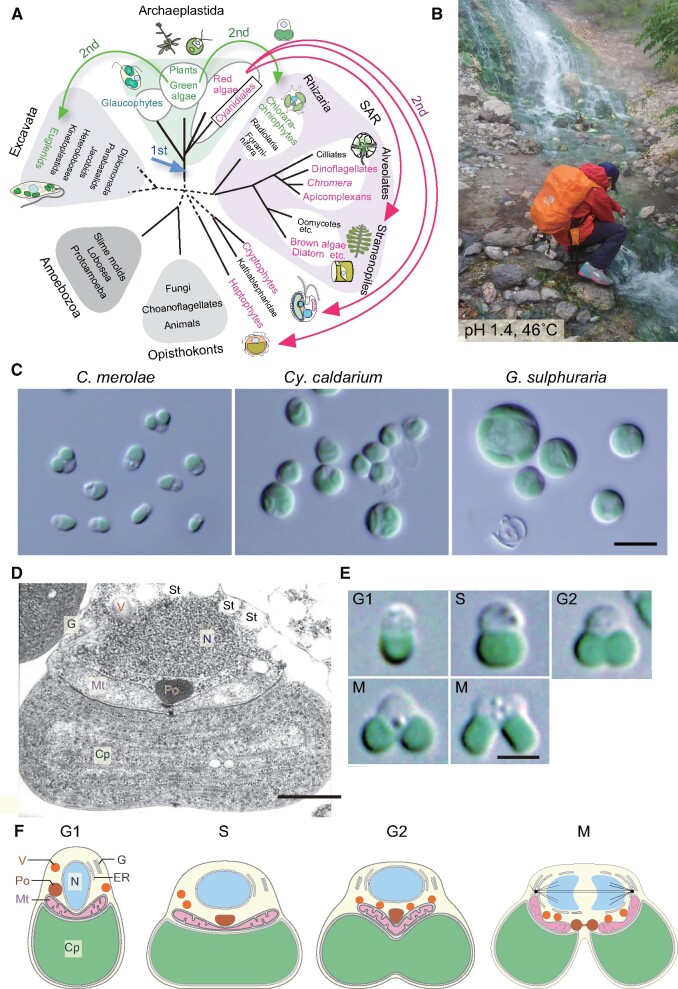
Several species of unicellular eukaryotic algae exhibit relatively simple genomic and cellular architecture. Laboratory cultures of these algae grow faster than plants and often provide homogeneous cellular populations exposed to an almost equal environment. These characteristics are ideal for conducting experiments at the cellular and subcellular levels. Many microalgal lineages have recently become genetically tractable, which have started to evoke new streams of studies. Among such algae, the unicellular red alga Cyanidioschyzon merolae is the simplest organism; it possesses the minimum number of membranous organelles, only 4,775 protein-coding genes in the nucleus, and its cell cycle progression can be highly synchronized with the diel cycle. These properties facilitate diverse omics analyses of cellular proliferation and structural analyses of the intracellular relationship among organelles. C. merolae cells lack a rigid cell wall and are thus relatively easily disrupted, facilitating biochemical analyses. Multiple chromosomal loci can be edited by highly efficient homologous recombination. The procedures for the inducible/repressive expression of a transgene or an endogenous gene in the nucleus and for chloroplast genome modification have also been developed. Here, we summarize the features and experimental techniques of C. merolae and provide examples of studies using this alga. From these studies, it is clear that C. merolae-either alone or in comparative and combinatory studies with other photosynthetic organisms-can provide significant insights into the biology of photosynthetic eukaryotes.
几种单细胞真核藻类表现出相对简单的基因组和细胞结构。这些藻类的实验室培养物比植物生长得更快,通常提供暴露在几乎相同环境中的同质细胞群体。这些特性非常适合在细胞和亚细胞水平上进行实验。最近,许多微藻谱系在遗传上变得易于处理,这引发了新的研究潮流。在这些藻类中,单细胞红藻 Cyanidioschyzon merolae 是最简单的生物体;它拥有最少数量的膜细胞器,只有 4775 个核编码基因,其细胞周期进程可以与昼夜周期高度同步。这些特性促进了细胞增殖的各种组学分析和细胞器之间细胞内关系的结构分析。C. merolae 细胞缺乏刚性细胞壁,因此相对容易被破坏,有利于生化分析。多个染色体位点可以通过高效的同源重组进行编辑。核中转基因或内源性基因的诱导/抑制表达以及叶绿体基因组修饰的程序也已经开发出来。在这里,我们总结了 C. merolae 的特征和实验技术,并提供了使用该藻类进行研究的示例。从这些研究中可以清楚地看出,C. merolae——无论是单独使用还是与其他光合生物进行比较和组合研究——都可以为光合真核生物的生物学提供重要的见解。