
ESCRT机制介导单细胞红藻中的细胞分裂缢裂
ESCRT Machinery Mediates Cytokinetic Abscission in the Unicellular Red Alga .
作者信息
Yagisawa Fumi, Fujiwara Takayuki, Takemura Tokiaki, Kobayashi Yuki, Sumiya Nobuko, Miyagishima Shin-Ya, Nakamura Soichi, Imoto Yuuta, Misumi Osami, Tanaka Kan, Kuroiwa Haruko, Kuroiwa Tsuneyoshi
机构信息
Center for Research Advancement and Collaboration, University of the Ryukyus, Okinawa, Japan.
Graduate School of Engineering and Science, University of the Ryukyus, Okinawa, Japan.
出版信息
Front Cell Dev Biol. 2020 Apr 3;8:169. doi: 10.3389/fcell.2020.00169. eCollection 2020.
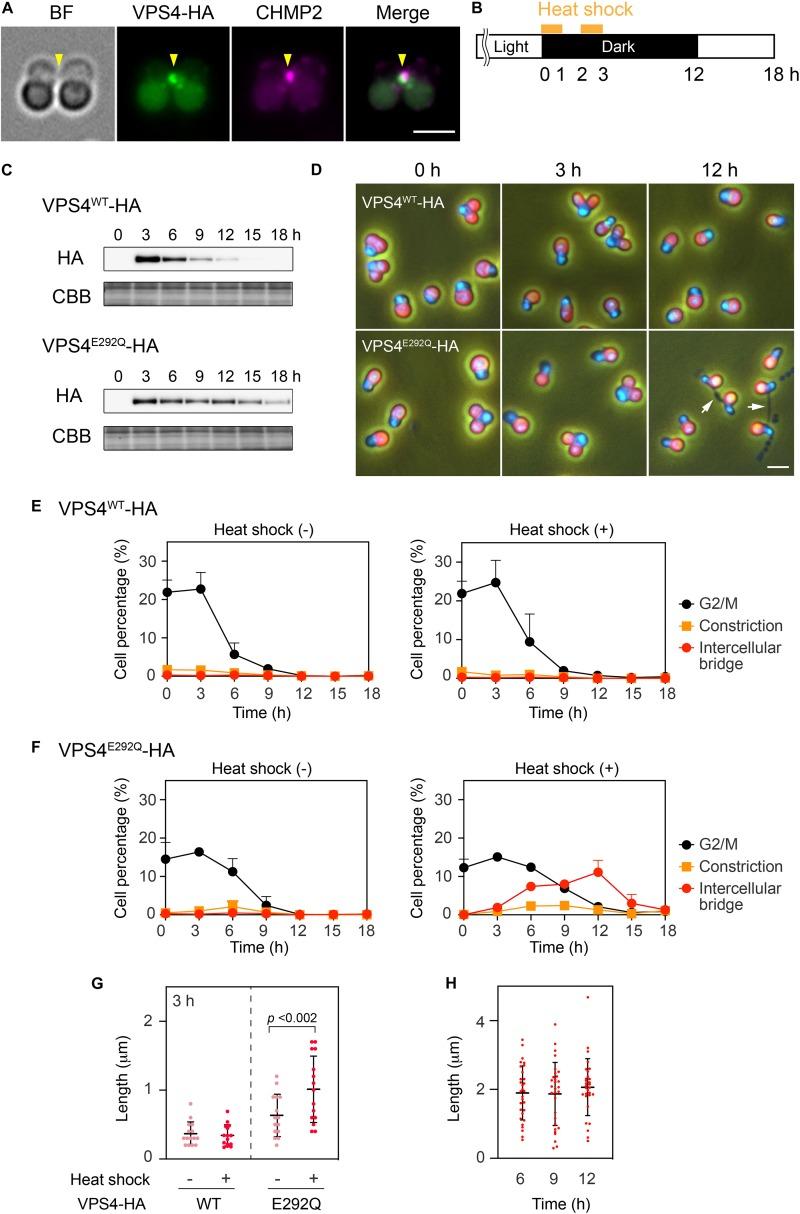
In many eukaryotes, cytokinesis proceeds in two successive steps: first, ingression of the cleavage furrow and second, abscission of the intercellular bridge. In animal cells, the actomyosin contractile ring is involved in the first step, while the endosomal sorting complex required for transport (ESCRT), which participates in various membrane fusion/fission events, mediates the second step. Intriguingly, in archaea, ESCRT is involved in cytokinesis, raising the hypothesis that the function of ESCRT in eukaryotic cytokinesis descended from the archaeal ancestor. In eukaryotes other than in animals, the roles of ESCRT in cytokinesis are poorly understood. To explore the primordial core mechanisms for eukaryotic cytokinesis, we investigated ESCRT functions in the unicellular red alga that diverged early in eukaryotic evolution. provides an excellent experimental system. The cell has a simple organelle composition. The genome (16.5 Mb, 5335 genes) has been completely sequenced, transformation methods are established, and the cell cycle is synchronized by a light and dark cycle. Similar to animal and fungal cells, cells divide by furrowing at the division site followed by abscission of the intercellular bridge. However, they lack an actomyosin contractile ring. The proteins that comprise ESCRT-I-IV, the four subcomplexes of ESCRT, are partially conserved in . Immunofluorescence of native or tagged proteins localized the homologs of the five ESCRT-III components [charged multivesicular body protein (CHMP) 1, 2, and 4-6], apoptosis-linked gene-2-interacting protein X (ALIX), the ESCRT-III adapter, and the main ESCRT-IV player vacuolar protein sorting (VPS) 4, to the intercellular bridge. In addition, ALIX was enriched around the cleavage furrow early in cytokinesis. When the ESCRT function was perturbed by expressing dominant-negative VPS4, cells with an elongated intercellular bridge accumulated-a phenotype resulting from abscission failure. Our results show that ESCRT mediates cytokinetic abscission in . The fact that ESCRT plays a role in cytokinesis in archaea, animals, and early diverged alga supports the hypothesis that the function of ESCRT in cytokinesis descended from archaea to a common ancestor of eukaryotes.
在许多真核生物中,胞质分裂分两个连续步骤进行:首先是分裂沟的内陷,其次是细胞间桥的脱离。在动物细胞中,肌动球蛋白收缩环参与第一步,而参与各种膜融合/裂变事件的转运所需的内体分选复合体(ESCRT)介导第二步。有趣的是,在古细菌中,ESCRT参与胞质分裂,这就提出了一个假说,即ESCRT在真核生物胞质分裂中的功能起源于古细菌祖先。在动物以外的真核生物中,ESCRT在胞质分裂中的作用了解甚少。为了探索真核生物胞质分裂的原始核心机制,我们研究了ESCRT在单细胞红藻中的功能,这种红藻在真核生物进化早期就已分化。它提供了一个极好的实验系统。该细胞的细胞器组成简单。其基因组(16.5 Mb,5335个基因)已完全测序,转化方法已建立,并且细胞周期通过明暗循环进行同步。与动物和真菌细胞类似,该细胞在分裂位点通过缢裂进行分裂,随后细胞间桥脱离。然而,它们缺乏肌动球蛋白收缩环。组成ESCRT的四个亚复合体ESCRT-I-IV的蛋白质在该红藻中部分保守。对天然或标记蛋白质的免疫荧光分析将ESCRT-III的五个组分[带电荷的多囊泡体蛋白(CHMP)1、2和4 - 6]、凋亡相关基因2相互作用蛋白X(ALIX)、ESCRT-III适配器以及ESCRT-IV的主要成分液泡蛋白分选(VPS)4的同源物定位到细胞间桥上。此外,在胞质分裂早期,ALIX在分裂沟周围富集。当通过表达显性负性VPS4干扰ESCRT功能时,出现细胞间桥拉长的细胞积累现象——这是脱离失败导致的一种表型。我们的结果表明,ESCRT介导该红藻的胞质分裂脱离。ESCRT在古细菌、动物和早期分化的红藻的胞质分裂中发挥作用,这一事实支持了ESCRT在胞质分裂中的功能从古细菌遗传给真核生物共同祖先的假说。



 Zotero 插件