Jung Won Beom, Im Geun Ho, Jiang Haiyan, Kim Seong-Gi
Center for Neuroscience Imaging Research, Institute for Basic Science, 16419 Suwon, Republic of Korea.
Department of Biomedical Engineering, Sungkyunkwan University, 16419 Suwon, Republic of Korea.
Proc Natl Acad Sci U S A. 2021 Mar 16;118(11). doi: 10.1073/pnas.2023265118.
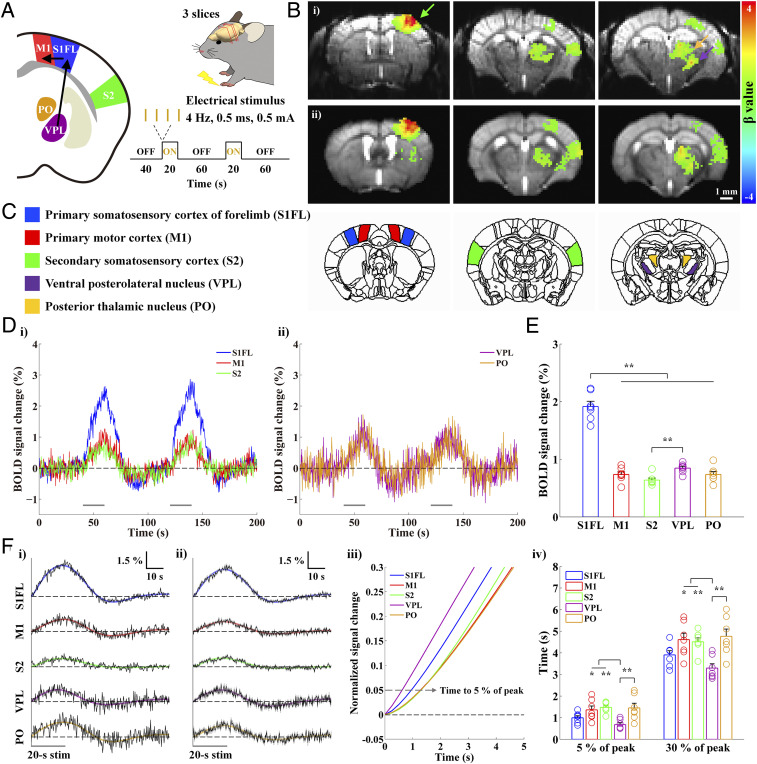
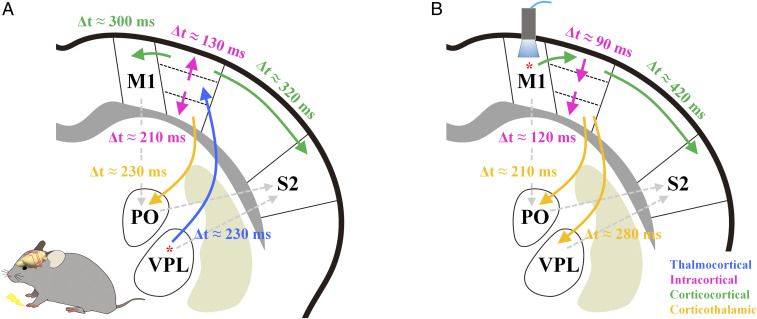
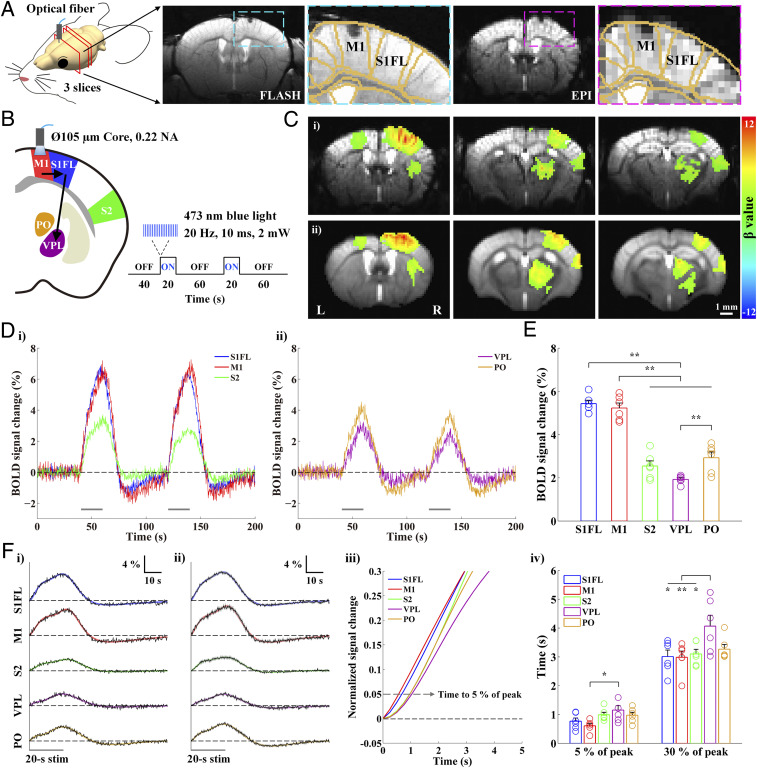
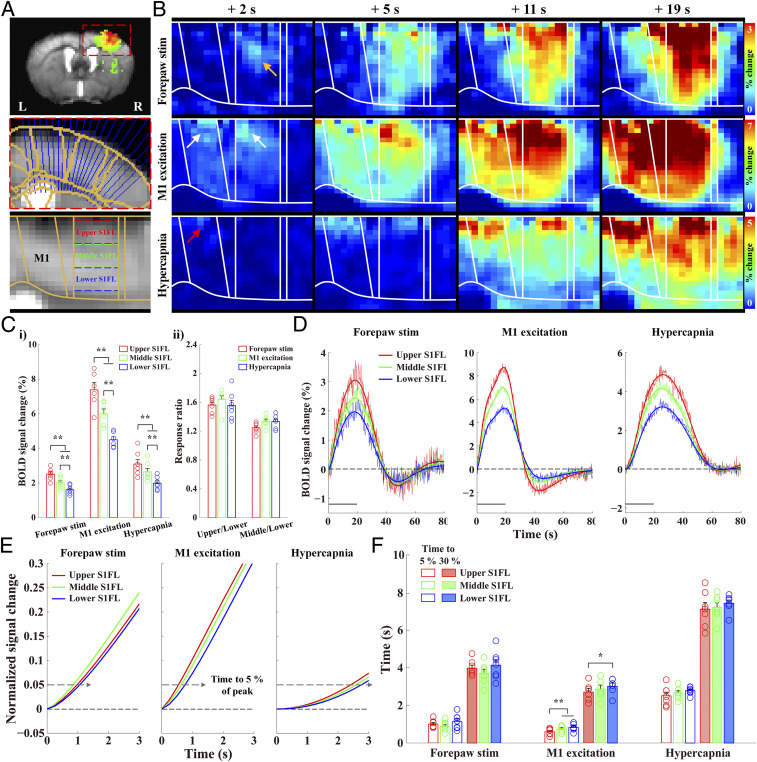
Blood oxygenation level-dependent (BOLD) functional magnetic resonance imaging (fMRI) has been widely used to localize brain functions. To further advance understanding of brain functions, it is critical to understand the direction of information flow, such as thalamocortical versus corticothalamic projections. For this work, we performed ultrahigh spatiotemporal resolution fMRI at 15.2 T of the mouse somatosensory network during forepaw somatosensory stimulation and optogenetic stimulation of the primary motor cortex (M1). Somatosensory stimulation induced the earliest BOLD response in the ventral posterolateral nucleus (VPL), followed by the primary somatosensory cortex (S1) and then M1 and posterior thalamic nucleus. Optogenetic stimulation of excitatory neurons in M1 induced the earliest BOLD response in M1, followed by S1 and then VPL. Within S1, the middle cortical layers responded to somatosensory stimulation earlier than the upper or lower layers, whereas the upper cortical layers responded earlier than the other two layers to optogenetic stimulation in M1. The order of early BOLD responses was consistent with the canonical understanding of somatosensory network connections and cannot be explained by regional variabilities in the hemodynamic response functions measured using hypercapnic stimulation. Our data demonstrate that early BOLD responses reflect the information flow in the mouse somatosensory network, suggesting that high-field fMRI can be used for systems-level network analyses.
血氧水平依赖(BOLD)功能磁共振成像(fMRI)已被广泛用于定位脑功能。为了进一步加深对脑功能的理解,了解信息流的方向至关重要,例如丘脑皮质投射与皮质丘脑投射。在这项研究中,我们在15.2 T磁场下对小鼠体感网络进行了超高时空分辨率fMRI,刺激前爪体感并对初级运动皮层(M1)进行光遗传学刺激。体感刺激在腹后外侧核(VPL)诱发最早的BOLD反应,随后是初级体感皮层(S1),然后是M1和丘脑后核。对M1中兴奋性神经元的光遗传学刺激在M1诱发最早的BOLD反应,随后是S1,然后是VPL。在S1内,皮层中层对体感刺激的反应早于上层或下层,而上层皮层对M1中的光遗传学刺激的反应早于其他两层。早期BOLD反应的顺序与对体感网络连接的经典理解一致,并且不能用高碳酸血症刺激测量的血流动力学反应函数中的区域变异性来解释。我们的数据表明,早期BOLD反应反映了小鼠体感网络中的信息流,这表明高场fMRI可用于系统水平的网络分析。