Department of Medicine, Division of Endocrinology and Center for Endocrine Tumors Leiden (CETL), Leiden University Medical Center, Leiden, The Netherlands.
Centre for Endocrinology, William Harvey Research Institute, Barts and the London School of Medicine and Dentistry, Queen Mary University of London, UK.
J Clin Endocrinol Metab. 2021 Sep 27;106(10):e3796-e3819. doi: 10.1210/clinem/dgab238.
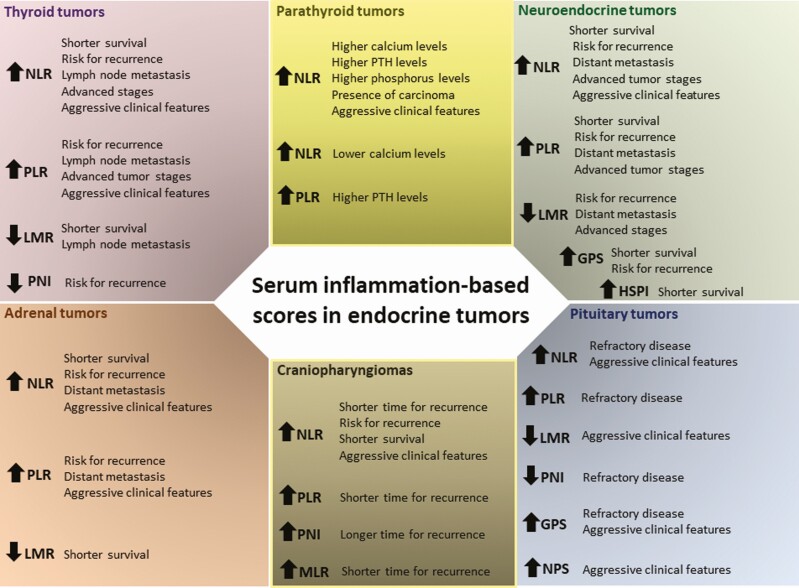
Serum inflammation-based scores reflect systemic inflammatory response and/or patients' nutritional status, and may predict clinical outcomes in cancer. While these are well-described and increasingly used in different cancers, their clinical usefulness in the management of patients with endocrine tumors is less known.
A comprehensive PubMed search was performed using the terms "endocrine tumor," "inflammation," "serum inflammation-based score," "inflammatory-based score," "inflammatory response-related scoring," "systemic inflammatory response markers," "neutrophil-to-lymphocyte ratio," "neutrophil-to-platelet ratio," "lymphocyte-to-monocyte ratio," "Glasgow prognostic score," "neutrophil-platelet score," "Systemic Immune-Inflammation Index," and "Prognostic Nutrition Index" in clinical studies.
The neutrophil-to-lymphocyte ratio and the platelet-to-lymphocyte ratio are the ones most extensively investigated in patients with endocrine tumors. Other scores have also been considered in some studies. Several studies focused in finding whether serum inflammatory biomarkers may stratify the endocrine tumor patients' risk and detect those at risk for developing more aggressive and/or refractory disease, particularly after endocrine surgery.
In this review, we summarize the current knowledge on the different serum inflammation-based scores and their usefulness in predicting the phenotype, clinical aggressiveness, and disease outcomes and prognosis in patients with endocrine tumors. The value of such serum inflammation-based scores in the management of patients with endocrine tumors has been emerging over the last decade. However, further research is necessary to establish useful markers and their cut-offs for routine clinical practice for individual diseases.
血清炎症指标反映全身炎症反应和/或患者的营养状况,可能预测癌症患者的临床结局。虽然这些指标在不同的癌症中已经得到了很好的描述和越来越广泛的应用,但它们在内分泌肿瘤患者管理中的临床应用价值知之甚少。
我们使用“内分泌肿瘤”“炎症”“血清炎症指标”“炎症评分”“炎症反应相关评分”“全身炎症反应标志物”“中性粒细胞与淋巴细胞比值”“中性粒细胞与血小板比值”“淋巴细胞与单核细胞比值”“格拉斯哥预后评分”“中性粒细胞-血小板评分”“系统免疫炎症指数”和“预后营养指数”等术语,在临床研究中对 PubMed 进行了全面检索。
在患有内分泌肿瘤的患者中,中性粒细胞与淋巴细胞比值和血小板与淋巴细胞比值是研究最多的两种指标。其他评分在一些研究中也有所涉及。一些研究集中于寻找血清炎症生物标志物是否可以对内分泌肿瘤患者的风险进行分层,并检测那些可能发生侵袭性和/或难治性疾病的患者,特别是在接受内分泌手术后。
在这篇综述中,我们总结了目前关于不同血清炎症指标的知识,以及它们在预测内分泌肿瘤患者表型、临床侵袭性和疾病结局及预后方面的有用性。在过去十年中,这些基于血清炎症的评分在管理内分泌肿瘤患者方面的价值已经显现。然而,需要进一步的研究来确定用于常规临床实践的有用标志物及其用于特定疾病的临界值。