Department of Surgery, Graduate School of Medicine, Kyoto University, Kyoto 606-8501, Japan.
Department of Gastroenterological Surgery, Kitano Hospital, The Tazuke Kofukai Medical Research Institute, Osaka 530-8480, Japan.
Int J Mol Sci. 2021 Jul 27;22(15):8002. doi: 10.3390/ijms22158002.
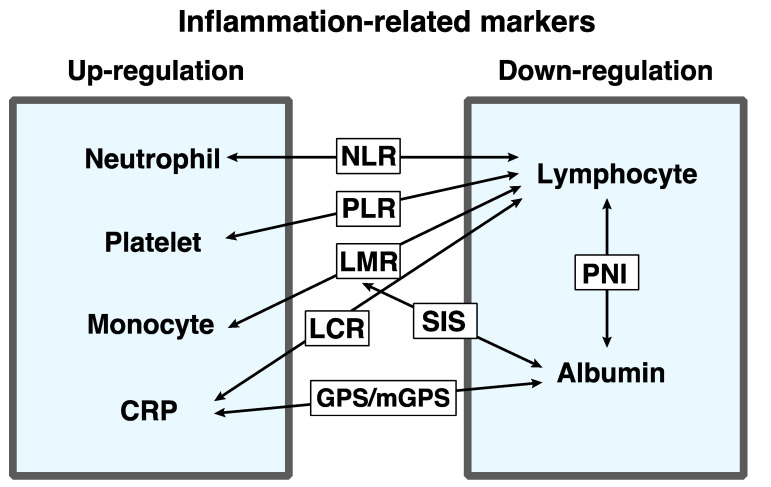
Colorectal cancer (CRC) is the leading cause of cancer deaths around the world. It is necessary to identify patients with poor prognosis or with high risk for recurrence so that we can selectively perform intensive treatments such as preoperative and/or postoperative chemotherapy and extended surgery. The clinical usefulness of inflammation-related prognostic biomarkers available from routine blood examination has been reported in many types of cancer, e.g., neutrophil-lymphocyte ratio (NLR), lymphocyte-C-reactive protein ratio (LCR), platelet-lymphocyte ratio (PLR), lymphocyte-monocyte ratio (LMR), and so on. Moreover, some scoring systems based on circulating blood cell counts and albumin concentration have been also reported to predict cancer patients' prognosis, such as the Glasgow prognostic score (GPS), systemic inflammation score (SIS), and prognostic nutritional index (PNI). The optimal biomarker and optimal cutoff value of the markers can be different depending on the cancer type. In this review, we summarize the prognostic impact of each inflammation-related marker in CRC.
结直肠癌(CRC)是全球癌症死亡的主要原因。有必要识别预后不良或有高复发风险的患者,以便我们可以选择性地进行强化治疗,如术前和/或术后化疗和扩大手术。来自常规血液检查的炎症相关预后生物标志物在许多类型的癌症中的临床实用性已被报道,例如中性粒细胞-淋巴细胞比(NLR)、淋巴细胞-C 反应蛋白比(LCR)、血小板-淋巴细胞比(PLR)、淋巴细胞-单核细胞比(LMR)等。此外,还报道了一些基于循环血细胞计数和白蛋白浓度的评分系统来预测癌症患者的预后,例如格拉斯哥预后评分(GPS)、全身炎症评分(SIS)和预后营养指数(PNI)。最佳生物标志物和标志物的最佳截断值可能因癌症类型而异。在这篇综述中,我们总结了每个炎症相关标志物在 CRC 中的预后影响。