Department of Fundamental Microbiology, University of Lausanne, Lausanne, Switzerland.
Department of Fundamental Microbiology, University of Lausanne, Lausanne, Switzerland.
J Biol Chem. 2021 Jan-Jun;296:100639. doi: 10.1016/j.jbc.2021.100639. Epub 2021 Apr 8.
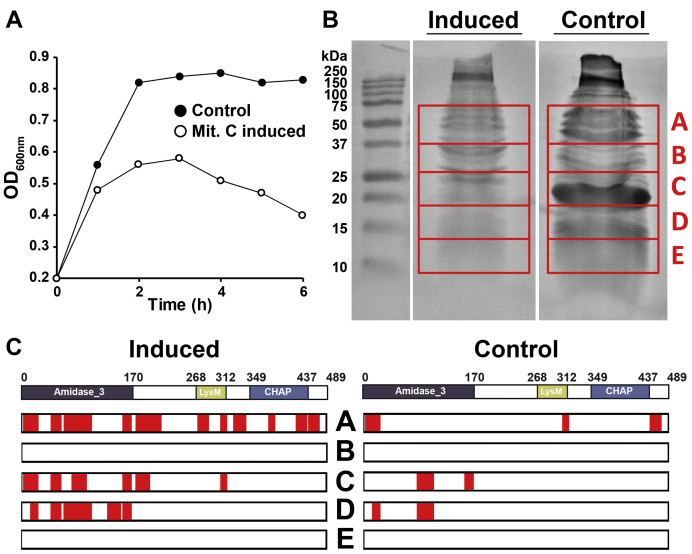
Endolysins are peptidoglycan hydrolases produced at the end of the bacteriophage (phage) replication cycle to lyse the host cell. Endolysins in Gram-positive phages come in a variety of multimodular forms that combine different catalytic and cell wall binding domains. However, the reason why phages adopt endolysins with such complex multidomain architecture is not well understood. In this study, we used the Streptococcus dysgalactiae phage endolysin PlySK1249 as a model to investigate the role of multidomain architecture in phage-induced bacterial lysis and lysis regulation. PlySK1249 consists of an amidase (Ami) domain that lyses bacterial cells, a nonbacteriolytic endopeptidase (CHAP) domain that acts as a dechaining enzyme, and a central LysM cell wall binding domain. We observed that the Ami and CHAP domains synergized for peptidoglycan digestion and bacteriolysis in the native enzyme or when expressed individually and reunified. The CHAP endopeptidase resolved complex polymers of stem-peptides to dimers and helped the Ami domain to digest peptidoglycan to completion. We also found that PlySK1249 was subject to proteolytic cleavage by host cell wall proteases both in vitro and after phage induction. Cleavage disconnected the different domains by hydrolyzing their linker regions, thus hindering their bacteriolytic cooperation and possibly modulating the lytic activity of the enzyme. PlySK1249 cleavage by cell-wall-associated proteases may represent another example of phage adaptation toward the use of existing bacterial regulation mechanism for their own advantage. In addition, understanding more thoroughly the multidomain interplay of PlySK1249 broadens our knowledge on the ideal architecture of therapeutic antibacterial endolysins.
溶菌酶是噬菌体(phage)复制周期末期产生的肽聚糖水解酶,用于裂解宿主细胞。革兰氏阳性噬菌体中的溶菌酶有多种多模块形式,结合了不同的催化和细胞壁结合结构域。然而,噬菌体采用如此复杂的多结构域架构的原因尚不清楚。在这项研究中,我们使用了 Streptococcus dysgalactiae 噬菌体溶菌酶 PlySK1249 作为模型,研究了多结构域架构在噬菌体诱导细菌裂解和裂解调控中的作用。PlySK1249 由一个酰胺酶(Ami)结构域组成,该结构域裂解细菌细胞,一个非裂解内肽酶(CHAP)结构域作为去链酶,和一个中央 LysM 细胞壁结合结构域。我们观察到,在天然酶或单独表达并重新统一时,Ami 和 CHAP 结构域协同作用于肽聚糖的消化和细菌裂解。CHAP 内肽酶将复杂的 Stem-peptides 聚合物分解为二聚体,并帮助 Ami 结构域完成肽聚糖的消化。我们还发现,PlySK1249 在体外和噬菌体诱导后都会被宿主细胞壁蛋白酶进行蛋白水解切割。切割通过水解它们的连接区域,将不同的结构域断开,从而阻碍它们的裂解合作,并可能调节酶的裂解活性。PlySK1249 被细胞壁相关蛋白酶的切割可能代表了噬菌体适应利用现有细菌调控机制为自身利益服务的另一个例子。此外,更深入地了解 PlySK1249 的多结构域相互作用,拓宽了我们对治疗性抗菌溶菌酶理想结构的认识。