Department of Clinical Medicine and Surgery, University of Naples Federico II, Naples, Italy; Translational Genomics and Targeted Therapies in Solid Tumors Group, August Pi I Sunyer Biomedical Research Institute (IDIBAPS), Barcelona, Spain; SOLTI Breast Cancer Research Group, Barcelona, Spain.
Department of Hematology, Hospital Clinic, August Pi I Sunyer Biomedical Research Institute (IDIBAPS), Barcelona, Spain.
ESMO Open. 2021 Jun;6(3):100102. doi: 10.1016/j.esmoop.2021.100102. Epub 2021 Apr 7.
Two promising therapeutic strategies in oncology are chimeric antigen receptor-T cell (CAR-T) therapies and antibody-drug conjugates (ADCs). To be effective and safe, these immunotherapies require surface antigens to be sufficiently expressed in tumors and less or not expressed in normal tissues. To identify new targets for ADCs and CAR-T specifically targeting breast cancer (BC) molecular and pathology-based subtypes, we propose a novel in silico strategy based on multiple publicly available datasets and provide a comprehensive explanation of the workflow for a further implementation.
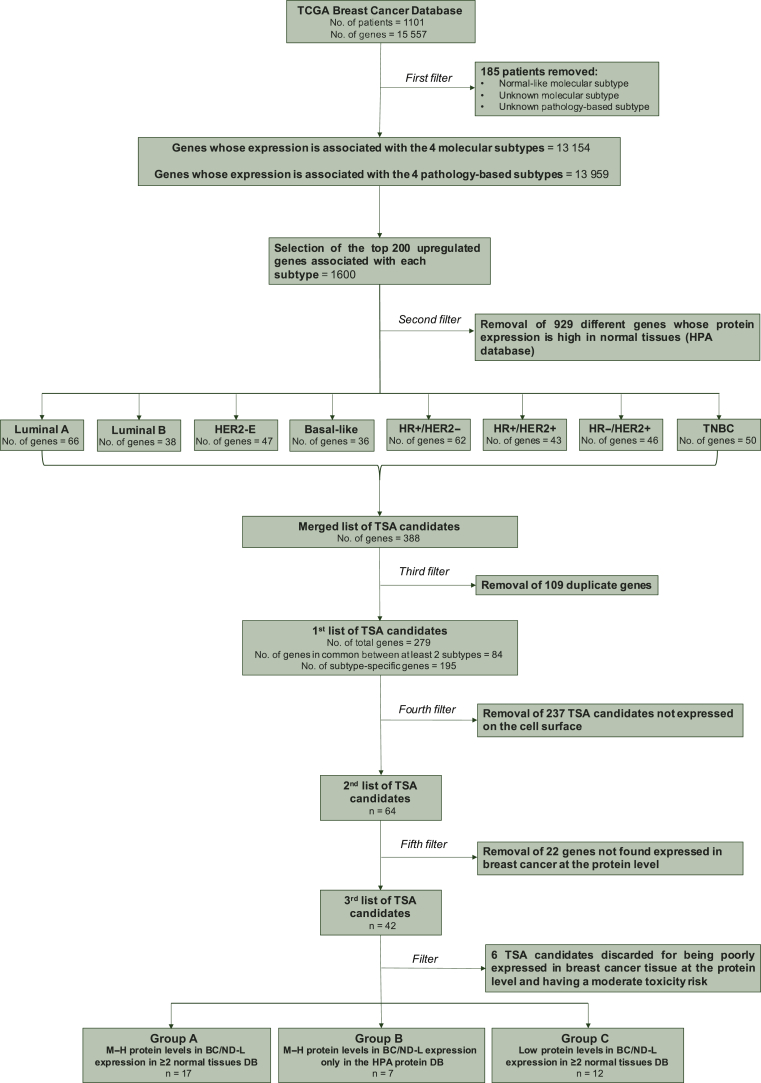
We carried out differential gene expression analyses on The Cancer Genome Atlas BC RNA-sequencing data to identify BC subtype-specific upregulated genes. To fully explain the proposed target-discovering methodology, as proof of concept, we selected the 200 most upregulated genes for each subtype and undertook a comprehensive analysis of their protein expression in BC and normal tissues through several publicly available databases to identify the potentially safest and viable targets.
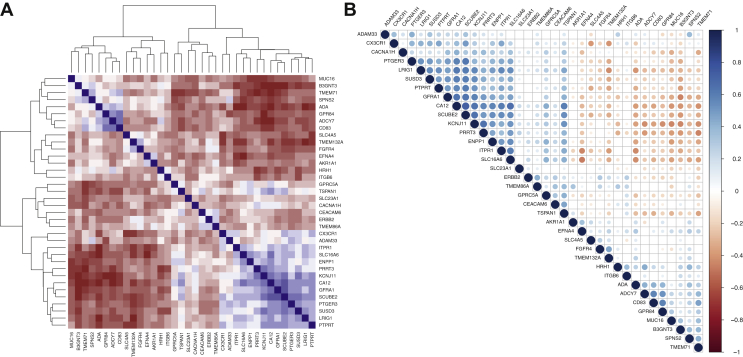
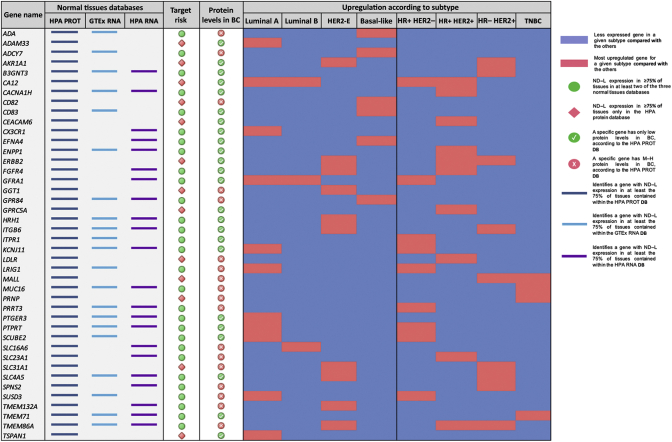
We identified 36 potentially suitable and subtype-specific tumor surface antigens (TSAs), including fibroblast growth factor receptor-4 (FGFR4), carcinoembryonic antigen-related cell adhesion molecule 6 (CEACAM6), GDNF family receptor alpha 1 (GFRA1), integrin beta-6 (ITGB6) and ectonucleotide pyrophosphatase/phosphodiesterase 1 (ENPP1). We also identified 63 potential TSA pairs that might be appropriate for co-targeting strategies. Finally, we validated subtype specificity in a cohort of our patients, multiple BC cell lines and the METABRIC database.
Overall, our in silico analysis provides a framework to identify novel and specific TSAs for the development of new CAR-T and antibody-based therapies in BC.
肿瘤学中有两种有前途的治疗策略,即嵌合抗原受体-T 细胞(CAR-T)疗法和抗体药物偶联物(ADC)。为了有效和安全,这些免疫疗法需要在肿瘤中充分表达表面抗原,而在正常组织中较少或不表达。为了确定针对乳腺癌(BC)分子和基于病理的亚型的新型 ADC 和 CAR-T 的新靶点,我们提出了一种基于多个公开可用数据集的新的计算策略,并提供了进一步实施的工作流程的全面解释。
我们对癌症基因组图谱 BC RNA 测序数据进行了差异基因表达分析,以确定 BC 亚型特异性上调的基因。为了充分解释所提出的目标发现方法,作为概念验证,我们为每个亚型选择了前 200 个上调基因,并通过几个公开可用的数据库对其在 BC 和正常组织中的蛋白表达进行了全面分析,以确定潜在的最安全和可行的靶标。
我们确定了 36 个潜在的合适且具有亚型特异性的肿瘤表面抗原(TSA),包括成纤维细胞生长因子受体 4(FGFR4)、癌胚抗原相关细胞黏附分子 6(CEACAM6)、GDNF 家族受体α1(GFRA1)、整合素β-6(ITGB6)和核苷酸外切酶/磷酸二酯酶 1(ENPP1)。我们还确定了 63 对可能适合共靶向策略的潜在 TSA 对。最后,我们在我们的患者队列、多个 BC 细胞系和 METABRIC 数据库中验证了亚型特异性。
总体而言,我们的计算分析为开发针对 BC 的新型 CAR-T 和基于抗体的疗法提供了一个识别新型和特异性 TSA 的框架。