Faculty of Medical Sciences, Translational and Clinical Research Institute, Newcastle University, Newcastle upon Tyne, UK.
Department of Molecular Biology, University Hospital Essen, University of Duisburg-Essen, Essen, Germany.
J Biol Chem. 2021 Jan-Jun;296:100650. doi: 10.1016/j.jbc.2021.100650. Epub 2021 Apr 9.
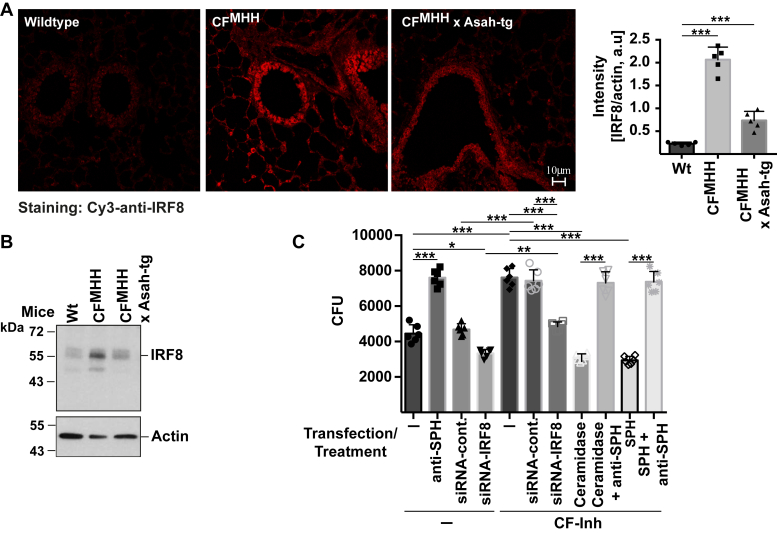
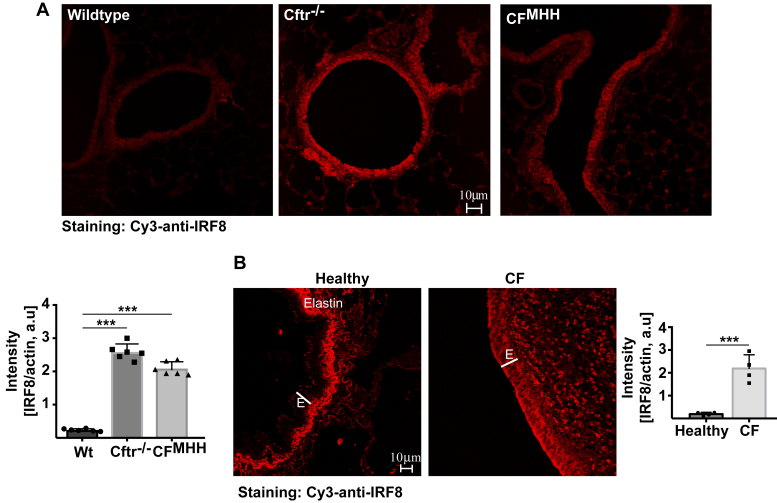
Most patients with cystic fibrosis (CF) suffer from acute and chronic pulmonary infections with bacterial pathogens, which often determine their life quality and expectancy. Previous studies have demonstrated a downregulation of the acid ceramidase in CF epithelial cells resulting in an increase of ceramide and a decrease of sphingosine. Sphingosine kills many bacterial pathogens, and the downregulation of sphingosine seems to determine the infection susceptibility of cystic fibrosis mice and patients. It is presently unknown how deficiency of the cystic fibrosis transmembrane conductance regulator (CFTR) connects to a marked downregulation of the acid ceramidase in human and murine CF epithelial cells. Here, we employed quantitative PCR, western blot analysis, and enzyme activity measurements to study the role of IRF8 for acid ceramidase regulation. We report that genetic deficiency or functional inhibition of CFTR/Cftr results in an upregulation of interferon regulatory factor 8 (IRF8) and a concomitant downregulation of acid ceramidase expression with CF and an increase of ceramide and a reduction of sphingosine levels in tracheal and bronchial epithelial cells from both human individuals or mice. CRISPR/Cas9- or siRNA-mediated downregulation of IRF8 prevented changes of acid ceramidase, ceramide, and sphingosine in CF epithelial cells and restored resistance to Pseudomonas aeruginosa infections, which is one of the most important and common pathogens in lung infection of patients with CF. These studies indicate that CFTR deficiency causes a downregulation of acid ceramidase via upregulation of IRF8, which is a central pathway to control infection susceptibility of CF cells.
大多数囊性纤维化 (CF) 患者患有急性和慢性肺部细菌感染,这通常会影响他们的生活质量和预期寿命。先前的研究表明,CF 上皮细胞中的酸性神经酰胺酶下调导致神经酰胺增加和鞘氨醇减少。鞘氨醇能杀死许多细菌病原体,而鞘氨醇的下调似乎决定了囊性纤维化小鼠和患者的感染易感性。目前尚不清楚囊性纤维化跨膜电导调节因子 (CFTR) 的缺乏如何与人类和鼠 CF 上皮细胞中酸性神经酰胺酶的明显下调相关。在这里,我们采用定量 PCR、western blot 分析和酶活性测量来研究 IRF8 对酸性神经酰胺酶调节的作用。我们报告说,CFTR/Cftr 的遗传缺陷或功能抑制导致干扰素调节因子 8 (IRF8) 的上调,以及 CF 中酸性神经酰胺酶表达的下调,同时导致气管和支气管上皮细胞中的神经酰胺增加和鞘氨醇减少,无论是来自人类个体还是小鼠。CRISPR/Cas9 或 siRNA 介导的 IRF8 下调可防止 CF 上皮细胞中酸性神经酰胺酶、神经酰胺和鞘氨醇的变化,并恢复对铜绿假单胞菌感染的抵抗力,铜绿假单胞菌是 CF 患者肺部感染中最重要和最常见的病原体之一。这些研究表明,CFTR 缺陷通过上调 IRF8 导致酸性神经酰胺酶下调,这是控制 CF 细胞感染易感性的核心途径。